Last Updated on June 21, 2026 by Jean Louis
Special Beestrot Serie!
The Fast Food Revolution: How Three Entrepreneurs Changed What the World Eats
How one man’s pressure cooker, a blend of 11 herbs and spices, and a white suit conquered the world—despite the Colonel’s initial distrust of franchises.
Key Takeaways
- Colonel Harland Sanders was 65 years old and living on $105 Social Security checks when he began franchising KFC
- His “Colonel” title was honorary — bestowed by Kentucky’s governor, not earned in military service
- The first KFC franchise opened in Salt Lake City, Utah in 1952 — not Kentucky
- Sanders sold the company in 1964 for $2 million, then spent the rest of his life criticizing its quality
- KFC became the first Western fast-food chain to open in China (1987), three years before McDonald’s
A White Suit, A Secret Recipe, and A Grudge
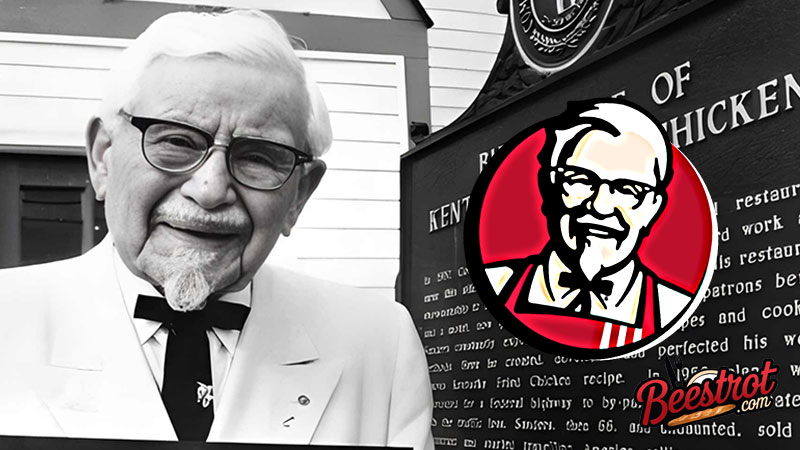
Picture this: A 65-year-old man, recently bankrupted when a new highway bypassed his restaurant, sits in his car with nothing but a Social Security check for $105 and a pressure cooker full of chicken. Most people would call it quits. Harland Sanders called it a beginning.
The story of Kentucky Fried Chicken isn’t just a business success — it’s the ultimate American reinvention tale. A man who failed at nearly everything he tried for six decades somehow built one of the most recognizable brands on Earth. And he did it wearing a white suit, sporting a goatee, and carrying a title he never earned in any military.
Here’s the thing that gets me: the most famous “Colonel” in American history got his rank from a Kentucky governor, not the U.S. Army. The chicken empire that bears Kentucky’s name launched its first franchise in Utah. And the man who created “finger lickin’ good” chicken spent his final years publicly trashing the quality of his own creation.
If that isn’t the most American story you’ve ever heard, I don’t know what is.
The Hard Road to the Colonel (1890-1952)
A Childhood of Hardship
Harland David Sanders was born on September 9, 1890, in a four-room house near Henryville, Indiana. When his father Wilbur died in 1895, five-year-old Harland became the family cook while his mother worked at a canning factory. By age six, he was baking bread from scratch.
“Mom didn’t spare the rod if we disobeyed her,” Sanders later recalled. That strict upbringing — combined with poverty that forced him to drop out of school after seventh grade — shaped a man who would prove remarkably stubborn, foul-mouthed, and absolutely relentless.
A Resume of Failures
What Sanders lacked in formal education, he made up for in sheer variety of employment. His pre-chicken career reads like a randomized job generator:
| Age | Job | What Happened |
|---|---|---|
| 10 | Farmhand | First paying job |
| 16 | U.S. Army soldier | Served briefly in Cuba, honorably discharged |
| 18 | Railroad laborer | Met his first wife Josephine |
| 20s | Streetcar conductor | Fired |
| 20s | Insurance salesman | Fired for insubordination |
| 30s | Tire salesman | Lost the job |
| 30s | Ferry operator | Business failed |
| 30s | Lawyer | Career ended after courtroom brawl with his own client |
That last one deserves emphasis. Sanders actually studied law by correspondence and practiced in justice-of-the-peace courts in Arkansas — until he got into a physical fight with a client during a trial, destroying his legal reputation entirely.
His biographer John Ed Pearce summarized it bluntly: Sanders “had encountered repeated failure largely through bullheadedness, a lack of self-control, impatience, and a self-righteous lack of diplomacy.”
The Corbin, Kentucky Service Station
In 1930, at age 40, Sanders finally found something that stuck. Shell Oil gave him a service station in Corbin, Kentucky — rent-free, in exchange for a percentage of sales. The location sat along busy U.S. Route 25, a major artery for travelers heading to Florida.
Sanders noticed hungry travelers asking where to eat. So he started serving meals on his own dining table in the living quarters of the station. The food was good enough that people began stopping specifically to eat.
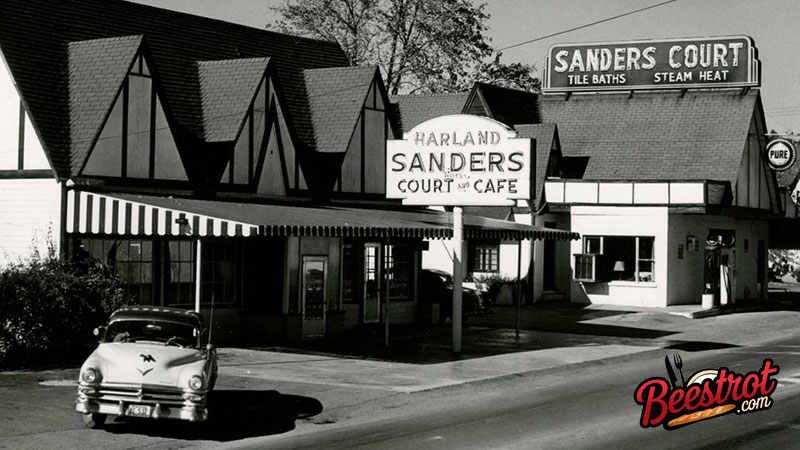
By 1937, he’d expanded to a 142-seat restaurant and motel across the street: Sanders Court & Café. The famous food critic Duncan Hines visited and included it in his popular travel guide Adventures in Good Eating, calling it “a very good place to stop” with “sizzling steaks, fried chicken, country ham, hot biscuits.“
Becoming “The Colonel”
In 1935, Kentucky Governor Ruby Laffoon made Sanders an honorary “Kentucky Colonel” — a ceremonial title recognizing his contributions to the state’s cuisine. It meant nothing militarily, but Sanders loved it.
After a second commissioning in 1950 by Governor Lawrence Wetherby, he fully embraced the persona. He grew a goatee, switched to a black frock coat (later changing to white suits that hid flour stains better), and insisted everyone call him “Colonel.”
As Pearce noted, his friends went along with the title change “jokingly at first and then seriously.” By his final years, Sanders never appeared in public without the white suit — summer or winter.
The Pressure Cooker Breakthrough
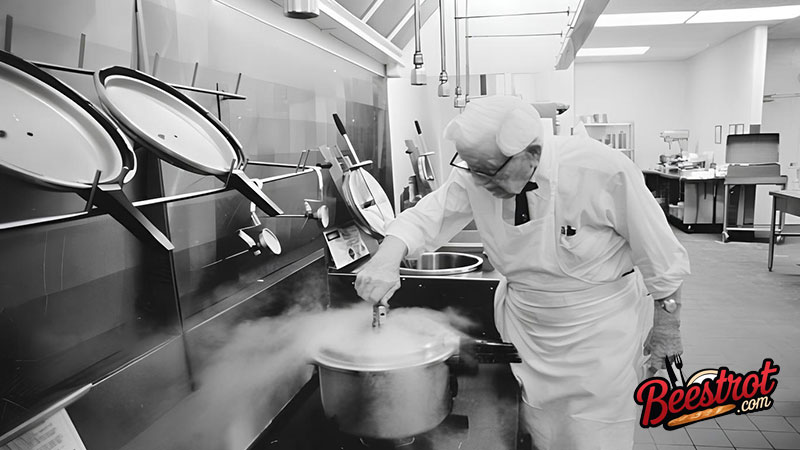
Traditional pan-fried chicken took 30-45 minutes to prepare — far too long for hungry travelers. In 1939, Sanders discovered that a pressure cooker could deliver perfectly cooked chicken in just 9 minutes while keeping the meat moist and flavorful.
This wasn’t just a time-saver. It was a scalable innovation — the kind of breakthrough that transforms a good local restaurant into a potential franchise empire.
By 1940, Sanders had also perfected his seasoning blend: the legendary 11 herbs and spices that remain a trade secret to this day. The recipe is reportedly kept in a vault at KFC’s Louisville headquarters, with no single supplier knowing the complete formula.
Devastation and Reinvention (1952-1964)
The Interstate Destroys Everything
Sanders’ Corbin restaurant thrived for over two decades. Then, in the early 1950s, the government announced that Interstate 75 would bypass Corbin entirely.
Overnight, Sanders watched his future evaporate. The steady stream of travelers that had built his business would soon disappear onto a highway that didn’t pass his door. In 1956, he sold everything — the restaurant, the motel, all of it!
After paying his debts, the 65-year-old Sanders was left with almost nothing. His monthly income? A $105 Social Security check.
The Franchise Hustle
Most people facing bankruptcy at retirement age would give up. Sanders loaded his pressure cooker and seasoning blend into his car and hit the road.
His pitch was simple: let me cook chicken for your restaurant staff. If they like it, you pay me four cents (later five cents) for every chicken you sell using my recipe and method. You get a proven product; I get ongoing royalties.
Legend has it Sanders was rejected over 1,000 times before finding his first taker. While the exact number is disputed, the rejections were certainly numerous. Restaurant owners didn’t understand franchising. They didn’t trust a guy in a white suit cooking chicken in their kitchens. They said no, again and again.
Sanders kept driving.
Pete Harman and the Birth of “Kentucky Fried Chicken”
On August 3, 1952, Sanders arrived in Salt Lake City to visit Pete Harman, who ran one of the city’s most prominent restaurants. Harman was intrigued enough to let Sanders cook for him and his wife Arline.
They loved it. Harman became KFC’s first franchisee.
Here’s where it gets interesting: the name “Kentucky Fried Chicken” wasn’t Sanders’ idea. Harman hired a sign painter named Rodney L. Anderson to advertise the new menu item. Anderson’s suggestion? “Kentucky Fried Chicken” — because a product from Kentucky sounded exotic and evoked Southern hospitality in Utah.
The brand name was invented by a sign painter in Salt Lake City.
Within two weeks, Sanders returned to find cars lined up down the street. Harman’s restaurant sales tripled in the first year, with 75% of the increase coming from fried chicken sales.
Harman went on to contribute several innovations that became KFC staples:
- Trademarked the slogan “It’s Finger Lickin’ Good!”
- Invented the bucket meal in 1957 (14 pieces of chicken, 5 bread rolls, and a pint of gravy in a cardboard bucket for $3.50)
- Helped develop training manuals and product guides for other franchisees
Sanders’ biographer called Harman the “virtual co-founder” of the chain. The two remained close friends for the rest of Sanders’ life.
Explosive Growth
With Harman’s success as proof of concept, Sanders signed up franchisees across the country. The model was elegant: minimal upfront investment for Sanders, ongoing royalty income, and franchisees who were financially motivated to succeed.
By 1960, there were about 200 KFC franchises. By 1963, that number exploded to over 600 — making Kentucky Fried Chicken the largest fast-food operation in the United States, surpassing even McDonald’s at the time.
One notable early franchisee: Dave Thomas, who would later found Wendy’s!
Selling the Empire
The $2 Million Deal
By 1964, the 73-year-old Sanders was overwhelmed. Managing 600+ franchises across multiple countries was too much.
Enter John Y. Brown Jr., a 29-year-old Kentucky lawyer and future governor, and Jack C. Massey, a Tennessee venture capitalist. They offered Sanders $2 million for the company (equivalent to about $20 million today).
Sanders was conflicted. Some family members opposed the sale. According to one account, Massey — knowing Sanders believed in astrology — specifically chose a day when the Colonel’s horoscope would be “unusually positive” to make the formal offer.
The deal closed in 1964. Sanders received:
- A $50,000 down payment
- A lifetime salary of $40,000 per year as brand ambassador
- Retention of Canadian operations
- The right to keep using his name and likeness
He also retained something the new owners didn’t anticipate: his very loud opinions about how they were ruining his chicken.
The Colonel Becomes the Brand
Brown recognized that Sanders’ face was KFC’s greatest asset. The white suit, the goatee, the grandfatherly demeanor — it was marketing gold.
Sanders traveled constantly as KFC’s spokesman, appearing on television, conducting interviews, and visiting restaurants around the world. He logged over 250,000 miles annually until shortly before his death.
But there was a catch: Sanders hated what the company was doing to his recipes.
The Secret Recipe and the Pressure Cooker Revolution
The 11 Herbs and Spices
KFC’s “Original Recipe” chicken is seasoned with Sanders’ famous blend of 11 herbs and spices. The exact formula remains one of the most closely guarded trade secrets in the food industry.
According to KFC:
- The recipe is kept in a vault at the company’s Louisville headquarters
- Only a handful of people know the complete formula
- Different suppliers produce portions of the seasoning blend, so no single company knows everything
- The original handwritten recipe was reportedly displayed at KFC headquarters, then moved to a more secure location
In 2016, a Chicago Tribune investigation tested a recipe found in a scrapbook belonging to Sanders’ nephew’s wife. With the addition of MSG, the newspaper’s taste testers found it “indistinguishable” from actual KFC chicken. KFC denied it was the authentic recipe. 😄
The Pressure Fryer Innovation
Sanders’ real breakthrough wasn’t the seasoning — it was the cooking method.
Traditional Southern fried chicken requires:
- Pan-frying in cast iron
- 30-45 minutes of cooking time
- Constant attention from the cook
- Inconsistent results
Sanders’ pressure fryer method delivered:
- 9-minute cooking time
- Consistently moist meat
- Crispy exterior
- Scalable, reproducible results
This made franchise-level consistency possible. Any restaurant could train staff to produce chicken that tasted like Sanders’ original — the holy grail of franchising.
Corporate Chaos: The Ownership Carousel
The Ownership Timeline
After Sanders sold in 1964, KFC went through a dizzying series of corporate parents — most with zero restaurant experience:
| Years | Owner | Purchase Price | Notes |
|---|---|---|---|
| 1964-1971 | Brown/Massey investors | $2 million | Aggressive expansion |
| 1971-1982 | Heublein (liquor company) | $285 million | Sanders furious at quality changes |
| 1982-1986 | R.J. Reynolds (tobacco) | Acquired via Heublein | Part of massive conglomerate |
| 1986-1997 | PepsiCo | $850 million | Joined Pizza Hut, Taco Bell |
| 1997-present | Yum! Brands | Spun off from PepsiCo | Current owner |
Sanders vs. The Corporations
After Heublein took over in 1971, Sanders became increasingly vocal about declining quality. His most famous complaint targeted the gravy:
“That gravy is horrible. It tastes like wallpaper paste.”
He also called the new chicken “a damn fried doughball put on top of some chicken” and criticized the mashed potatoes as inedible.
When Heublein moved headquarters from Kentucky to Tennessee, Sanders reportedly exploded: “This ain’t no goddam Tennessee Fried Chicken, no matter what some slick, silk-suited son-of-a-bitch says.”
In 1973, Sanders opened his own restaurant in Shelbyville, Kentucky called “Claudia Sanders, the Colonel’s Lady Dinner House” (named for his second wife). Heublein sued. Sanders counter-sued for $122 million, claiming they misused his image and hindered his ability to open restaurants.
They settled out of court: Heublein paid Sanders $1 million and allowed his restaurant to continue as “Claudia Sanders Dinner House” — which still operates today.
The McNuggets Challenge
When McDonald’s launched Chicken McNuggets nationwide in 1983, it posed an existential threat to KFC. Suddenly, the hamburger giant was competing directly in the chicken market.
KFC responded with Kentucky Nuggets in 1985 — but it was too late. McDonald’s had already captured the chicken nugget market. (As we covered in our McDonald’s article, the McNuggets themselves were developed partly as a response to government dietary guidelines pushing consumers away from beef.)
Global Expansion and the China Phenomenon
First Across the Atlantic
KFC was among the first American fast-food chains to expand internationally:
- 1965: First UK location (Preston, Lancashire)
- 1960s: Expansion to Canada, Mexico, Jamaica
- 1970: KFC Japan launched (joint venture with Mitsubishi)
The Japan operation produced one of KFC’s strangest success stories: in 1974, the company launched a “Kentucky for Christmas” campaign positioning fried chicken as a holiday meal. It became a cultural phenomenon. Today, Japanese families pre-order KFC weeks in advance for Christmas dinner, and the chain sees its highest sales of the year during the holiday season.
The China Story
On November 12, 1987, KFC became the first Western fast-food chain to open in China.
The location: a three-story restaurant near Qianmen Gate, just south of Tiananmen Square in Beijing. With 500 seats across 1,400 square meters, it was the largest KFC in the world.
Opening day was chaos. Thousands of Beijingers braved freezing weather and two-hour waits. The restaurant sold 2,200 buckets of chicken and earned 83,000 yuan — when the average Beijing monthly wage was just 100 yuan.
Why KFC succeeded where others hesitated:
- Cultural fit: Fried chicken was already familiar in Chinese cuisine; hamburgers were foreign
- Local partnerships: KFC partnered with the Beijing Municipal Bureau of Animal Husbandry
- Premium positioning: Early KFC wasn’t “fast food” in China — it was an experience, a window into American life
- First-mover advantage: McDonald’s didn’t enter China until 1990
By 1988, the Beijing location had the highest volume sales of any KFC in the world.
KFC’s Chinese Empire Today
As of early 2025, KFC operates over 12,600 outlets in China — more than any other country. It’s become the largest restaurant chain in China, period.
The menu has evolved dramatically for local tastes:
- Congee (rice porridge) for breakfast
- Egg tarts as dessert
- Spicy Sichuan chicken
- Dragon Twisters (adopted from street vendors)
- Youtiao (fried dough sticks)
- Rice bowls as alternatives to sandwiches
McDonald’s, by contrast, has roughly half the locations. KFC’s early entry and cultural adaptability gave it an insurmountable lead.
The Colonel’s Legacy
Death of an Icon
Sanders was diagnosed with acute leukemia in June 1980. He continued appearing in public in his white suit until the month before his death.
On December 16, 1980, Colonel Harland Sanders died of pneumonia at Jewish Hospital in Louisville. He was 90 years old.
The mourning was extraordinary:
- His body lay in state in the Kentucky State Capitol rotunda — an honor typically reserved for governors
- Over 1,000 mourners attended his funeral at Southern Baptist Theological Seminary
- Singer Pat Boone performed “He Touched Me” at Sanders’ personal request
- He was buried in Cave Hill Cemetery in Louisville, still wearing his white suit and black string tie
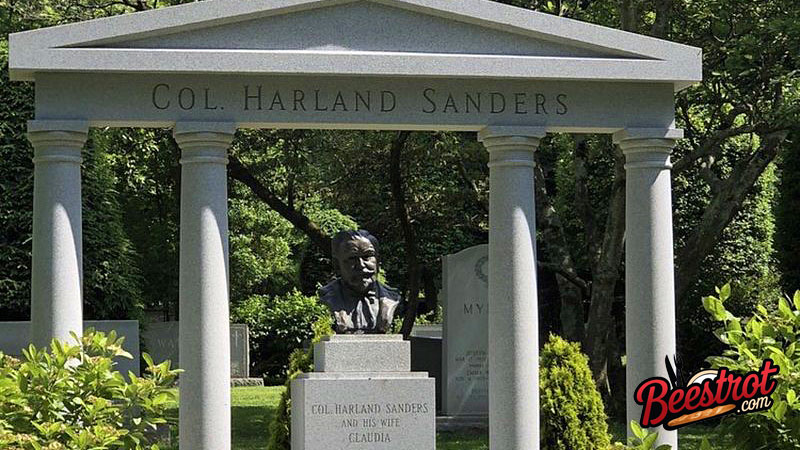
Col Harland Sanders Grave in Louisville, KY – USA
At the time of his death, there were approximately 6,000 KFC restaurants in 48 countries, generating $2 billion in annual sales.
KFC Today
The brand Sanders built has continued growing:
- 30,000+ locations in 150 countries
- World’s second-largest restaurant chain (after McDonald’s)
- $33+ billion in global system-wide sales
- Over 12 million customers served daily
- Owned by Yum! Brands (also parent of Taco Bell and Pizza Hut)
The Colonel’s face remains central to KFC’s marketing. Since 2015, the company has run campaigns featuring various celebrities portraying Sanders, including Darrell Hammond, Norm Macdonald, Reba McEntire, and even animated versions.
A 2022 survey found that nearly 80% of U.S. customers recognize Colonel Sanders — not bad for a man who’s been dead for over four decades.
Here’s My Take
Here’s what gets me about Sanders’ story: he wasn’t special at 40. Or 50. Or even 60.
Think about that. At an age when most people are preparing for retirement, Sanders was a failed lawyer, failed insurance salesman, failed businessman whose primary asset was a chicken recipe he cooked for travelers.
Then the highway bypassed his restaurant, and he lost everything.
What would you do at 65, bankrupt, with a $105 monthly check? Most of us would quietly fade away. Sanders loaded his car and started driving, cooking chicken for skeptical restaurant owners who said no a thousand times before someone finally said yes.
That’s not talent. That’s stubbornness. The same bullheadedness that got him into courtroom brawls and fired from job after job — it turns out that quality has a flip side. When applied to something worth doing, it becomes persistence.
The other thing that strikes me: Sanders never stopped caring about quality. Even after selling the company, he kept complaining publicly when the chicken didn’t meet his standards. He was a pain in the ass to every corporate owner who took over KFC. But he was a pain in the ass because the chicken mattered to him.
That gravy really did taste like wallpaper paste to him. And he said so.
There’s a lesson there about the tension between building something and letting it go. Sanders created a system that could scale globally — but systems, by their nature, optimize for consistency and cost, not for the obsessive quality standards of one particular cook.
Whether KFC’s chicken today would satisfy the Colonel is debatable. What’s not debatable: the man invented something that feeds millions of people daily across 150 countries. And he did it in his mid-60s, after a lifetime of failures.
It’s never too late to become who you were supposed to be!
Cook. Learn. Inspire.
Jean-Louis
When Legends Sat Together: The 1979 Summit of Hospitality Pioneers
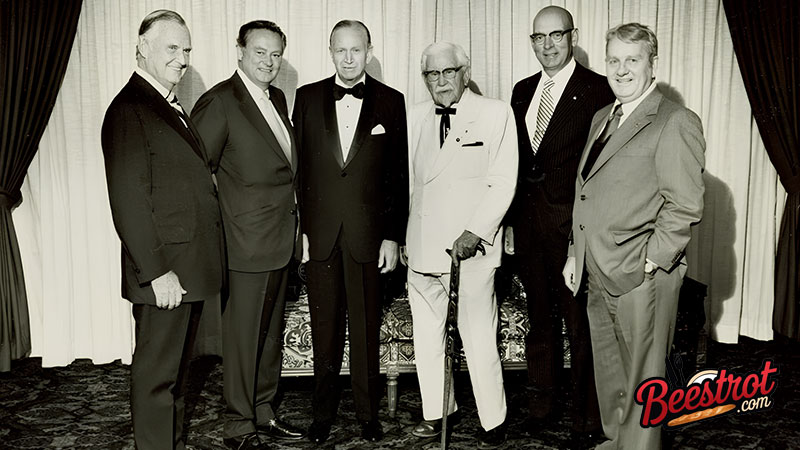
Hotel and Restaurant Greats from 1979 (left to right): Patrick O’Malley (Canteen Corp.), Barron Hilton (Hilton Hotels), J. Willard Marriott (Marriott Corp.), Col. Harland Sanders (Kentucky Fried Chicken), Jim McLamore (Burger King), Kemmons Wilson (Holiday Inns). Colonel Sanders died about one year after this photo in 1980. Photography By Tucker.mccormack – Own work CC BY-SA 4.0
Next in this series: We’ll explore Subway — the “healthy” fast-food chain that revolutionized sandwich shops and then nearly collapsed under the weight of its own contradictions.