Last Updated on July 5, 2026 by Jean Louis
Special Beestrot Serie!
The Fast Food Revolution: How Three Entrepreneurs Changed What the World Eats
How a simple California hamburger stand became a $26 billion real estate empire — and why the founders never wanted it to happen.
Key Takeaways
- McDonald’s was founded on May 15, 1940
by brothers Richard and Maurice McDonald in San Bernardino, California — not by Ray Kroc, who joined 14 years later. - The “Speedee Service System” (1948)
revolutionized food service by applying assembly-line principles to hamburger production, cutting service time and prices dramatically. - Ray Kroc didn’t invent McDonald’s — he scaled it.
The 52-year-old milkshake machine salesman transformed a regional chain into a global phenomenon after becoming franchise agent in 1954. - McDonald’s is actually a real estate company.
Harry Sonneborn’s 1956 strategy of owning land and leasing to franchisees generates 38% of total revenue — more than food sales from company-owned stores. - Today’s numbers are staggering:
43,000+ locations in 100+ countries, $26 billion annual revenue, 69 million customers served daily.
Two Brothers From New Hampshire
Richard James McDonald (1909–1998) and Maurice James “Mac” McDonald (1902–1971) were sons of Irish Catholic immigrants from New Hampshire. Like many Americans during the Depression era, they headed west to California seeking opportunity.
Their father Patrick had opened a food stand near Monrovia in 1937. The brothers tried their hand at various ventures — including a failed attempt at the movie business — before opening their first restaurant.
On May 15, 1940, they launched “McDonald’s Bar-B-Q” at 1398 North E Street in San Bernardino, California, just off Route 66. It was a typical drive-in of its era: carhops in roller skates, a sprawling menu of 25 items, and customers eating in their cars.
The restaurant did well. The brothers bought a mansion in the hills, drove new Cadillacs every year. But they weren’t satisfied.
“We just became bored,” Dick McDonald later recalled. “The money was coming in and there wasn’t much for us to do.”
What they did next would change how the world eats.
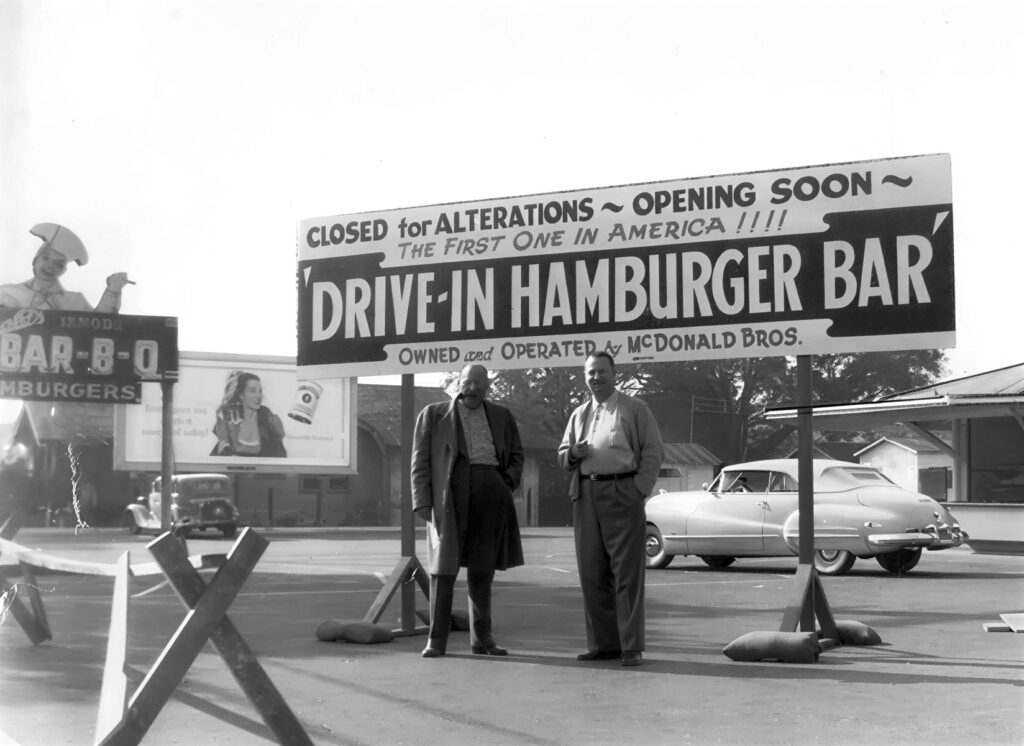
1948 – McDonald Brothers renovating the restaurant that will become the legend – Image enhanced for clarity in total respect of the original.
The Speedee Revolution
In 1948, the McDonald brothers made a radical decision. They closed their successful restaurant for three months and completely reinvented it.
They had noticed something crucial: 80% of their sales came from hamburgers. The barbecue, the variety, the carhops — all of it was noise. So they stripped everything away.
The transformation was dramatic:
| Before (1940-1948) | After (1948) |
|---|---|
| 25 menu items | 9 items |
| Carhop service | Self-service window |
| Real plates and silverware | Paper wrappers and cups |
| 20 employees | Minimal staff |
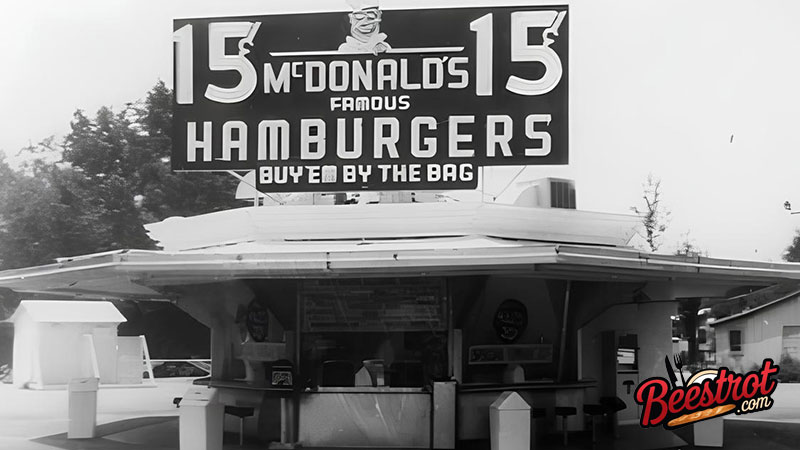
| Variable prices | 15-cent hamburgers |
They called it the “Speedee Service System” — essentially Henry Ford’s assembly line applied to food. Each worker had one specific task. Hamburgers were prepared identically every time: mustard, ketchup, onions, two pickles. No substitutions.
The first months were rough. Customers expected carhops and were confused by the walk-up window. But the brothers held firm. Soon, working-class families discovered they could feed everyone for the price of a single meal elsewhere. Lines stretched around the block.
By the early 1950s, annual revenue hit $350,000 and profits doubled. Word spread through the restaurant industry.
“There was a fraternity of us, and every one of us saw the McDonald’s in San Bernardino and basically copied it after the boys gave us a tour,” recalled James Collins of Collins Food International. Among those visitors: Glen Bell, who would later found Taco Bell.
The brothers even began franchising — opening locations in Phoenix (1953) and Downey, California (1953). The Phoenix location introduced the now-iconic Golden Arches, designed by architect Stanley Clark Meston.
But Dick and Mac McDonald had no interest in building an empire. They were content with their comfortable life in San Bernardino.
Then a milkshake machine salesman walked into their parking lot.
Enter Ray Kroc: The 52-Year-Old Dreamer
Raymond Albert Kroc was born in Oak Park, Illinois, on October 5, 1902. At 15, he lied about his age to join the Red Cross ambulance corps during World War I — where, incidentally, he met a fellow trainee named Walt Disney.
After the war, Kroc bounced between jobs: jazz pianist, radio DJ, real estate salesman, paper cup salesman. In 1939, he became the exclusive distributor for the Multimixer, a machine that could make five milkshakes simultaneously.
By 1954, Kroc was 52 years old, twice divorced, and still hustling Multimixers across the country. Then he received an order that made no sense: a single restaurant in San Bernardino wanted eight machines.
Why would any restaurant need to make 40 milkshakes at once?
Kroc flew to California to see for himself. He stood in the parking lot, watching in disbelief as over 100 customers lined up at lunch. The food emerged with astonishing speed. Families gushed about the quality.
“My God, I’ve been standing out there looking at it but I can’t believe it,” Kroc told the brothers. “When will this die down?”
“Sometime late tonight,” Dick replied.
“I’ve got to become involved in this.”
The brothers had already had a franchise agent — Bill Tansey — but he’d suffered a heart attack. Kroc offered to take over. On April 15, 1955, he opened the ninth McDonald’s restaurant in Des Plaines, Illinois — the first east of the Mississippi.
The deal gave Kroc 1.9% of gross sales from franchises, of which the McDonald brothers received 0.5%. It seemed fair enough. But Kroc had ambitions the brothers didn’t share.
He wanted a thousand locations. They were happy with a few dozen.
He wanted to change the original blueprint. They refused to authorize modifications.
He wanted control. They wanted to be left alone.
By 1961, the tension was unbearable. Kroc asked the brothers to name their price. They said $2.7 million — calculated so each brother would receive $1 million after taxes.
Kroc “went ballistic” at the figure but found the financing through his colleague Harry Sonneborn. The deal closed. The brothers kept their original San Bernardino location but were forbidden from using the McDonald’s name. They renamed it “The Big M.”
In what many consider an act of deliberate revenge, Kroc opened a McDonald’s directly across the street. It drove the brothers out of business. The original McDonald’s was demolished in 1971.
“Up until the time we sold, there was no mention of Kroc being the founder,” Dick McDonald said years later. “If we had heard about it, he would be back selling milkshake machines.”
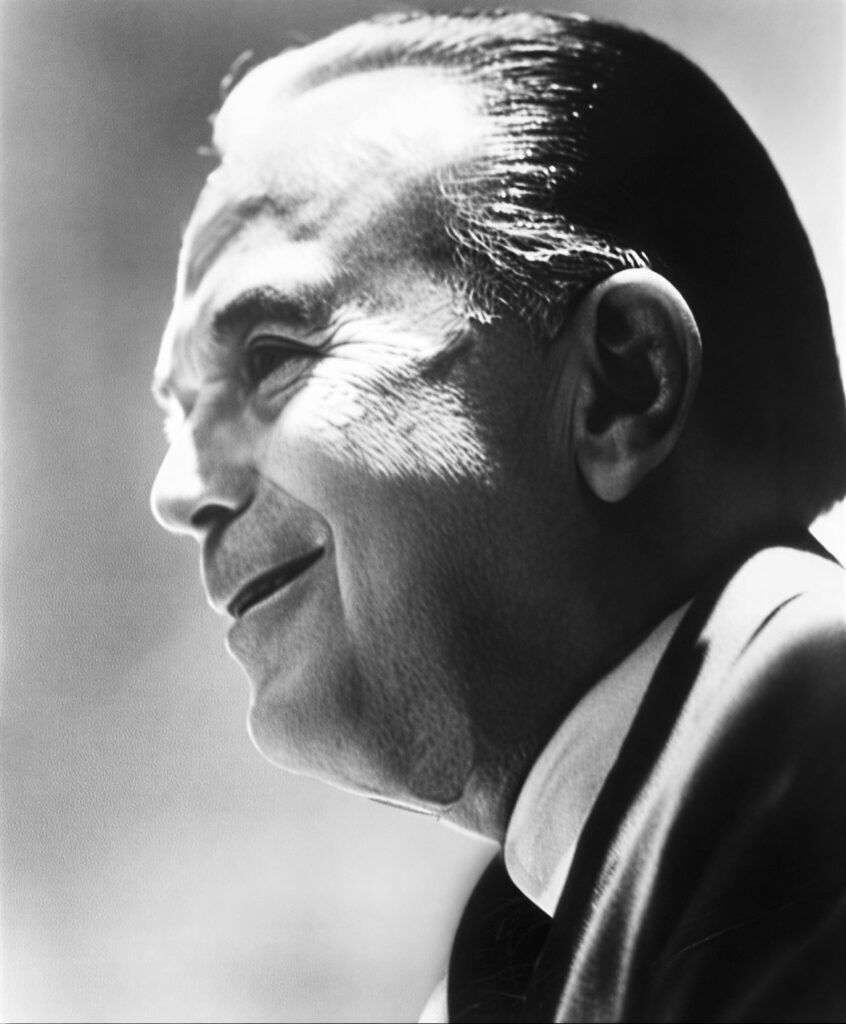
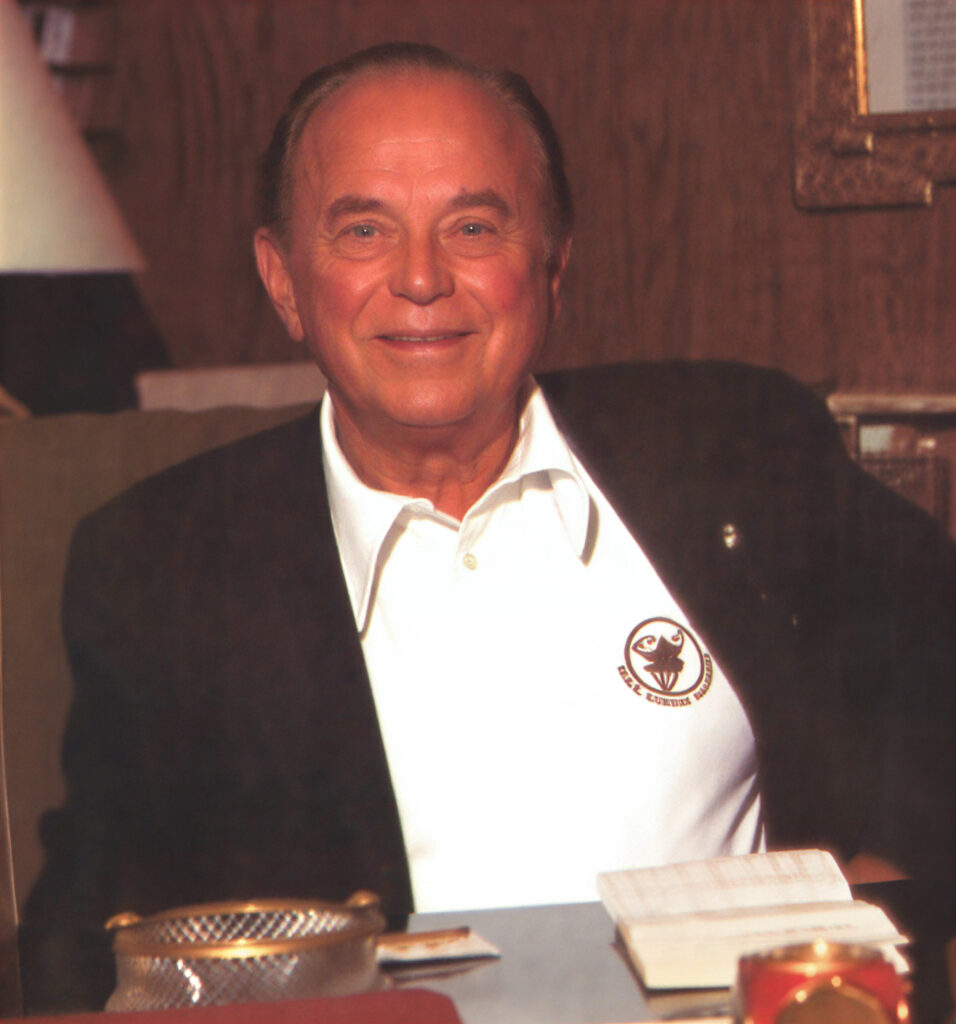
Ray Kroc in 1976 (left) and in 1978 (right) – Images were enhanced for clarity in respect of the originals
The Real Business: Real Estate
Here’s the twist that makes McDonald’s one of the most fascinating business stories ever told: it’s not really a hamburger company.
In 1956, Kroc was struggling. He was opening restaurants aggressively but earning only 1.4% royalties — not enough to cover expansion costs or repay loans. Then he met Harry J. Sonneborn, a former Tastee-Freez executive who saw the flaw in Kroc’s model immediately.
“You’re not in the hamburger business,” Sonneborn told Kroc. “You’re in the real estate business.”
Sonneborn’s insight was transformative: instead of just collecting franchise fees, McDonald’s should buy the land, build the restaurant, and lease it back to franchisees. This created:
- Steady rental income regardless of how many burgers sold
- Control over franchisees — break the rules, lose your lease
- Appreciating assets — land values rise over time
- Leverage for expansion — property could be used as collateral for loans
They formed the Franchise Realty Corporation in 1956. McDonald’s would charge franchisees a 20-40% markup on lease costs or 5% of sales — whichever was higher. The initial franchise deposit was just $950, which McDonald’s used to fund the next location.
Sonneborn famously explained the strategy to investors: “We are not technically in the food business. We are in the real estate business. The only reason we sell 15-cent hamburgers is because they are the greatest producer of revenue from which our tenants can pay us rent.”
The numbers today prove him right:
| Revenue Source (2024) | Amount |
|---|---|
| Total Revenue | $25.92 billion |
| Rent from Franchisees | ~$10 billion (38.6%) |
| Royalties from Franchisees | ~$5.7 billion |
| Company-Operated Restaurants | ~$10.2 billion |
McDonald’s owns approximately 45% of the land and 70% of the buildings where its restaurants operate. These real estate holdings are worth over $40 billion — representing nearly all of the company’s assets.
The genius? McDonald’s financing is fixed-rate, but its income from franchisees is variable. As prices rise with inflation, McDonald’s captures the upside while costs stay flat.
After the Sonneborn model was implemented, McDonald’s went from struggling to opening 68 new locations in 1959 alone. By the time Kroc bought out the brothers in 1961, there were 228 restaurants generating $37 million in sales.
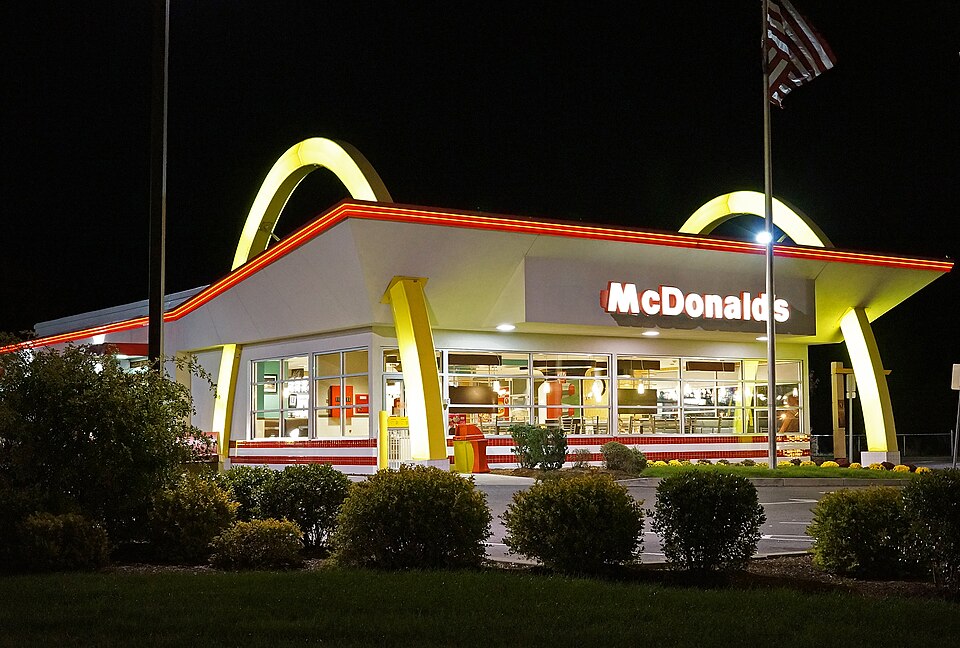
McDonalds Golden Arches – Saugus, Massachussetts USA
Hamburger University and the Gospel of Consistency
Ray Kroc was obsessed with three things: Quality, Service, Cleanliness — the “QSC” that became his mantra. A Big Mac in Tokyo had to taste identical to one in Toledo. How do you achieve that across thousands of locations run by independent operators?
You build a university.
In February 1961, the first class of 15 students gathered in the basement of a McDonald’s restaurant in Elk Grove Village, Illinois. The instructor was Fred L. Turner — a former grill cook who had joined McDonald’s in 1956 and would eventually become CEO.
They called it Hamburger University.
It sounds like a joke, but the program was deadly serious. Students received intensive training in:
- Restaurant operations and the Speedee Service System
- Leadership and management skills
- Quality control and food safety
- Customer service standards
- The McDonald’s way — down to exact temperatures and timing
Graduates earned a certificate in “Hamburgerology” — later recognized by the American Council on Education for actual college credit.
Today, Hamburger University has:
- 10 campuses worldwide (Chicago, Tokyo, London, Sydney, Munich, São Paulo, Shanghai, and more)
- Over 350,000 graduates since 1961
- 5,000+ students trained annually
- An acceptance rate of approximately 1% at some locations — more selective than Harvard
The flagship campus occupies 130,000 square feet in Chicago, with 300-seat auditoriums, interactive classrooms, and full kitchen labs. In May 2025, McDonald’s launched Hamburger University Online with over 22,000 digital courses.
Fred Turner, who started it all in that basement, later reflected: “Hamburger University is an investment in our future where we challenge highly motivated, dedicated people and provide them with training and experience.”
Forty percent of McDonald’s global leadership has attended Hamburger University. The consistency you experience at any McDonald’s worldwide? That’s the university’s legacy.
The Chicken Pivot: How McNuggets Saved the Empire
By 1977, McDonald’s faced an existential threat — and it had nothing to do with competition.
That year, the U.S. government released “Dietary Goals for the United States”, a landmark report from Senator George McGovern’s nutrition committee. The findings were damning for the burger business: beef and pork, laden with cholesterol and saturated fat, were identified as primary contributors to heart disease. The government explicitly urged Americans to “decrease consumption of meat and increase consumption of poultry and fish.”
McDonald’s was, at its core, a hamburger company. And the government had just told 200 million Americans to stop eating hamburgers.
Sales at the 6,000 McDonald’s restaurants began to decline. Meanwhile, KFC was thriving — the chicken chain had been growing aggressively throughout the 1970s, and suddenly its core product was exactly what health-conscious consumers wanted. The company that had built its empire on beef watched helplessly as chicken became the healthier alternative.
McDonald’s had tried chicken before — fried chicken, chicken pot pie — but nothing stuck. They couldn’t compete with KFC in the fried chicken market. Ray Kroc, frustrated, asked executive chef René Arend (a Luxembourger who had once cooked for the Queen of England) to develop a deep-fried onion nugget instead.
Then came the pivotal moment. McDonald’s board chairman Fred Turner passed Arend in a hallway and asked casually: “Why not a chicken nugget?”
Arend got to work. By 1979, he had developed the recipe. The concept was elegant: bite-sized pieces of processed chicken, battered and deep-fried — something entirely new that wouldn’t compete directly with KFC’s bone-in chicken.
Keystone Foods developed the manufacturing process, and founder Herb Lotman was so confident in the product that he built a $13 million plant (about $47 million today) in just three months — with no guarantee from McDonald’s.
Initial testing in 1980 was explosive. “The McNuggets were so well received that every franchise wanted them,” Arend recalled. “There wasn’t a system to supply enough chicken.”
The chicken shortage was real — and it led to an unexpected innovation. While waiting for poultry supplies to catch up, Arend applied the same process to pork and created the McRib in 1981.
By 1983, supply chains were ready, and Chicken McNuggets rolled out nationwide. The results were staggering:
- Within three years, McNuggets accounted for 7.5% of domestic sales
- McDonald’s became the second-largest chicken seller in America — behind only KFC
- American chicken consumption began a historic rise: from 36.6 pounds per person in 1965 to 97.5 pounds by 2020
The McNugget didn’t just save McDonald’s — it transformed the entire poultry industry. In 1980, most chickens were sold whole. Today, 90% are processed into pieces, cutlets, or nuggets. A fast-food item created to counter health concerns about beef became one of the most consequential food innovations of the 20th century.
KFC responded in 1985 with “Kentucky Nuggets,” but the damage was done. McDonald’s had successfully invaded chicken territory.
Global Domination
The first international McDonald’s opened in Richmond, British Columbia, Canada, in June 1967. Then came Puerto Rico. Then the world.
The pace of expansion defies comprehension:
| Year | Milestone |
|---|---|
| 1967 | First international location (Canada) |
| 1971 | Opens in Japan, Germany, Australia |
| 1990 | Opens in Moscow — 30,000 customers on day one |
| 1992 | Opens in China |
| 2024 | 43,000+ locations in 100+ countries |
During the 1990s, it was said that a new McDonald’s opened somewhere in the world every five hours.
But McDonald’s didn’t simply export American burgers. The company learned to adapt:
- India: McAloo Tikki (potato patty) and Chicken Maharaja Mac — no beef
- Japan: Teriyaki McBurger and Ebi (shrimp) Burger
- France: Croque McDo and macarons at McCafé
- Indonesia: McRice with fried chicken
- Middle East: Halal-certified menus
This “glocalization” strategy — global standards with local flavors — allowed McDonald’s to become a symbol of both American culture and local adaptation. The brand became so ubiquitous that The Economist created the “Big Mac Index” in 1986 as a lighthearted way to compare purchasing power between countries.
Today’s scale is almost incomprehensible:
- 69 million customers served daily — roughly the population of France
- 9 million pounds of french fries sold every day
- 80 hamburgers sold per second worldwide
- 1.5 billion toys distributed annually through Happy Meals
McDonald’s is the world’s largest toy distributor and the fourth-largest employer globally, with over 2.5 million workers.
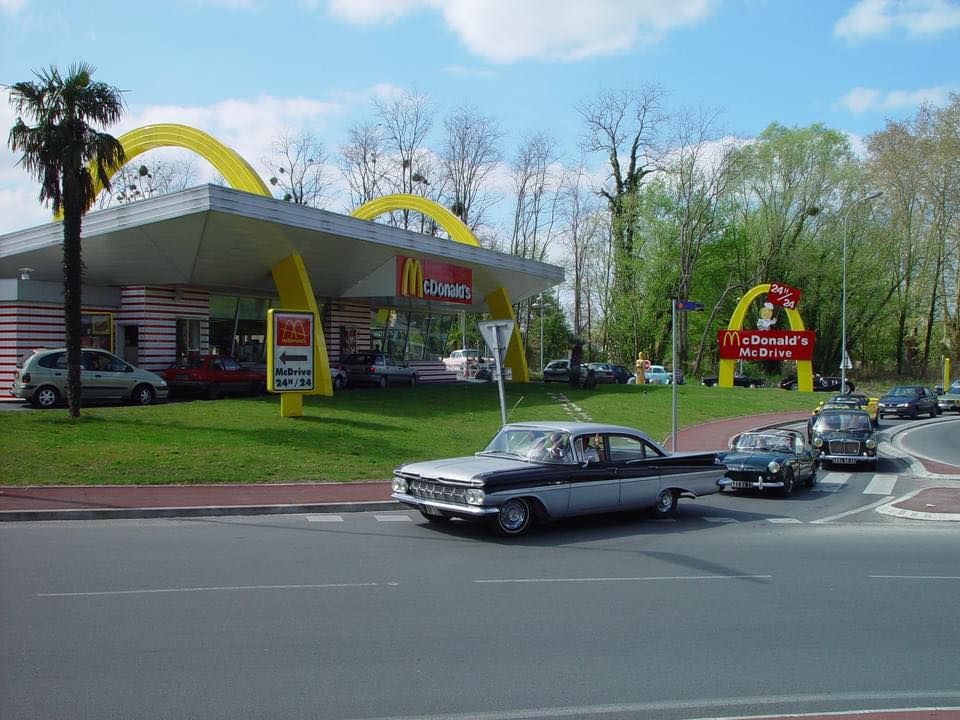
Retro-Style McDonalds Villenace d’Ornon near Bordeaux in France (photo from their official Facebook page)
The Shadow Side of the Golden Arches
No empire grows this large without controversy.
Health concerns have dogged McDonald’s for decades. The 2004 documentary Super Size Me — in which filmmaker Morgan Spurlock ate only McDonald’s for 30 days with devastating health effects — crystallized growing anxieties about fast food and obesity. The company eliminated its “Super Size” option shortly after.
Labor practices drew criticism as “McJob” entered the dictionary — defined as low-paying work with few benefits or prospects. McDonald’s counters that it provides entry-level employment and advancement opportunities, pointing to Hamburger University and internal promotion programs.
Environmental impact remains a concern: the beef supply chain contributes to deforestation, packaging generates waste, and the sheer scale of operations has a significant carbon footprint. McDonald’s has pledged 100% recyclable or renewable packaging by 2025 and has reduced plastic use by 8% in recent years.
Cultural homogenization — what sociologist George Ritzer called “McDonaldization” — describes the spread of efficiency, calculability, predictability, and control throughout society. For some, the Golden Arches represent American cultural imperialism; McDonald’s has been targeted by protesters from Paris to Bangalore.
The company’s response has evolved: healthier menu options (salads, apple slices in Happy Meals), removal of artificial preservatives from classic burgers, and the McCafé pivot toward coffee culture. In early 2025, McDonald’s introduced the McValue Meal — a $5 bundle designed to address criticism that prices had risen beyond what core customers could afford.
My Personal Take
Here’s the contradiction I can’t quite resolve: I know the critiques. I’ve read the exposés. And yet, I’ve eaten at McDonald’s in so many countries, and there’s something almost comforting about that familiarity.
What fascinates me most is the tension between the founders and Kroc — a story of innovation versus scale, contentment versus ambition.
The McDonald brothers invented something genuinely revolutionary. The Speedee Service System changed how humanity eats. They deserved recognition and wealth, and they got some of both. But they never wanted an empire. They wanted a comfortable life in San Bernardino, doing good work with their hands.
Ray Kroc wanted everything. He saw what they had built and imagined it replicated infinitely. He was 52 years old, running out of time, and he seized his chance with both hands. Was he a visionary or a pirate? Probably both.
The lesson, perhaps, is that innovation and scaling are different skills requiring different temperaments. The McDonald brothers were brilliant innovators. Kroc was a brilliant scaler. Neither could have done what the other did.
And Harry Sonneborn? He might be the most important figure in the whole story — the one who saw that the real value wasn’t in hamburgers at all. Every time you see those Golden Arches, you’re looking at a piece of real estate first, a restaurant second.
That’s the actual secret sauce.
Cook. Learn. Inspire.
Jean-Louis
Next in this series: KFC — The Colonel’s Impossible Second Act, the story of a 65-year-old failure who became a global icon.