Last Updated on October 14, 2026 by Jean Louis
A kilogram of vanilla beans costs somewhere between four hundred and six hundred dollars, depending on the harvest. For a spice that ends up in birthday cakes and breakfast yogurt, that number is worth stopping at. Only saffron sits above it on the global price chart. Everything else falls below.
The question worth asking is not why vanilla costs so much. The question is why it took three centuries to figure out how to grow it outside of one country, and why a twelve-year-old boy was the one who finally did.
A Flower With One Problem
The vanilla orchid, Vanilla planifolia, is native to the forests of eastern Mexico. For the Totonac people who first cultivated it, and later for the Aztecs who added it to xocolatl, their chocolate drink, vanilla arrived without complication. In the forests of Veracruz, a small stingless bee called the Melipona handled pollination quietly and efficiently, working through the orchid’s unusual anatomy as a matter of routine. The problem was that the Melipona bee could not be transplanted.
The Spanish brought the bean to Europe in the early sixteenth century. Hernán Cortés encountered it at the court of Moctezuma and recognised that the flavour was extraordinary. What the Spanish did not bring with them was the bee.
For three hundred years, every vanilla orchid planted outside Mexico bloomed perfectly and produced nothing. The flower would open for a single day, present itself to the air, and close without result. Growers in Java, in Réunion, in the heated greenhouses of Belgium watched the same failure repeat until it began to seem like proof that vanilla was simply not meant to leave its homeland.
The anatomy of the vanilla flower makes the problem precise. A thin membrane called the rostellum sits between the anther, which carries the pollen, and the stigma, which must receive it. In Mexico, the Melipona bee navigates this structure by instinct. Everywhere else, nothing did. Charles Morren, a Belgian botanist, managed to hand-pollinate a vanilla orchid in 1836 and produced a single pod. His method confirmed that pollination was possible outside Mexico. It was also too slow and too technically demanding to function at any commercial scale, and the problem stayed open for five more years, waiting for someone who would find a simpler way.
Réunion, 1841
Ferréol Bellier-Beaumont was a plantation owner on the French island of Réunion, then called Bourbon. He had been attempting to grow vanilla for years without producing a single pod. Among the enslaved workers on his estate was a boy named Edmond, approximately twelve years old, who had been taken in by Bellier-Beaumont as a child. Nothing in the record suggests anyone expected anything particular from him.
What drew Edmond to the vanilla vines that morning is not recorded in any document that has survived. What happened next was witnessed, and Bellier-Beaumont understood immediately what he was looking at.
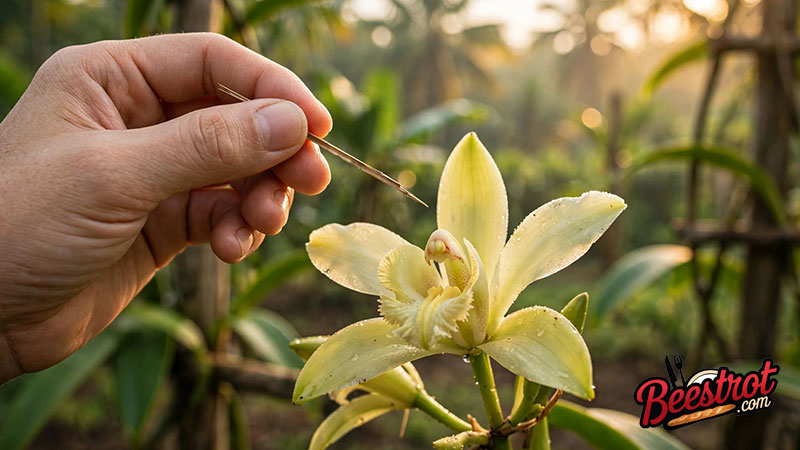
Using a thin sliver of bamboo and his own thumb, Edmond lifted the rostellum inside the flower, then pressed the anther directly against the stigma, transferring the pollen in a single clean motion that took less than a second. He showed the technique to Bellier-Beaumont. Within the year, pods appeared on vines that had never produced before. The simplicity of the method was its genius, and its genius was that anyone could learn it in minutes.
The technique spread across Réunion within a decade. It reached Madagascar, the Comoros Islands, Indonesia. Within a generation, Réunion had become the dominant vanilla producer in the world, exporting beans by the tonne from vines that had been sterile for decades. Today the same motion Edmond made in 1841 is repeated hundreds of millions of times every year during vanilla harvests across the Indian Ocean. No improvement has been found. The technique has been taught, inherited, and passed across families of vanilla workers for nearly two centuries, and it has not changed.
What the Trade Became
Madagascar took over as the world’s leading producer in the twentieth century. Today it accounts for approximately eighty percent of global vanilla supply, grown primarily in the Sava region in the northeast of the island. The harvest is an intense, labour-concentrated event that happens once a year, during the weeks when the orchids bloom, and the vines must be checked daily because each flower opens for a single day and will not accept pollination before or after.
The economics are not gentle. Madagascar vanilla farming is done almost entirely by smallholders, on plots often less than a hectare, by families who depend almost entirely on the annual harvest for their income. The price fluctuates sharply with global supply, and a single cyclone season can devastate yields across the region. In years when harvests are short, the price of vanilla spikes in ways that send food manufacturers searching for alternatives. Vanillin, the primary flavour compound in real vanilla, can be synthesised from lignin or guaiacol, and the industrial food industry has done exactly that at enormous scale. Approximately ninety-nine percent of vanilla flavouring used in food products worldwide is synthetic.
Every real vanilla bean you have ever tasted was pollinated by a human hand, following a technique devised by a twelve-year-old enslaved boy who died without a marked grave and received nothing for what he discovered.
Edmond Albius was freed in 1848, when France abolished slavery across its colonial territories. He worked various jobs in the years that followed, received no compensation for the discovery that had transformed a global industry, and died in 1880. A French naturalist eventually documented the story in enough detail to establish the historical record, but the recognition arrived decades after it could have changed anything material for Edmond himself. His grave on Réunion was not formally marked until the twentieth century.
The Orchid That Still Requires a Human
There is something worth pausing on in the fact that vanilla, the flavour most associated with the plain and the everyday, cannot be produced at industrial scale without individual human attention to each individual flower. Research into mechanical pollination systems and self-fertile vanilla varieties has continued for decades and has not produced a commercial solution. Every attempt to remove the human hand from the process has failed to replicate the speed and reliability of Edmond’s method at the volumes the market demands.
The price of real vanilla is therefore not a mystery or a market anomaly. It is an accurate accounting of time, of labour, and of a technique that has not changed since a boy on a French colonial island looked at a flower that had baffled European botanists for three hundred years and understood something about it that none of them had made practical.
The next time you open a vanilla bean and smell what is inside, the seeds arrived there because someone pressed their thumb against a single bloom on a single morning. That is not poetry. That is the supply chain, and it runs in an unbroken line back to Réunion in 1841.
Every dish has a past. I am just following it back to the beginning.
Jean Louis


Sources
- Edmond Albius, Wikipedia
- Vanilla planifolia, Wikipedia
- Vanilla, Wikipedia
- Edmond Albius, Encyclopaedia Britannica
- Vanilla, Encyclopaedia Britannica