Last Updated on October 14, 2026 by Jean Louis
I once paid forty euros for a small glass vial in a spice shop in Granada. The shopkeeper wrapped it in tissue paper as if it were a piece of jewellery. Inside were perhaps two hundred threads of saffron, each one a deep burgundy fading to orange at the tip. The smell was unlike anything I had experienced before: earthy, honeyed, faintly metallic, with something underneath that I could not name. I stood outside on the cobblestones trying to decide if I had been robbed or given a gift.
The answer, as I came to understand it, is that saffron occupies a category of its own. It is not merely an expensive ingredient. It is the most expensive spice on earth by weight, more costly than gold in certain forms, and it has held that position for over three thousand years. The question worth asking is not why it costs so much. The question is what took me so long to understand what that price actually means.
Why the Price Is Not a Trick
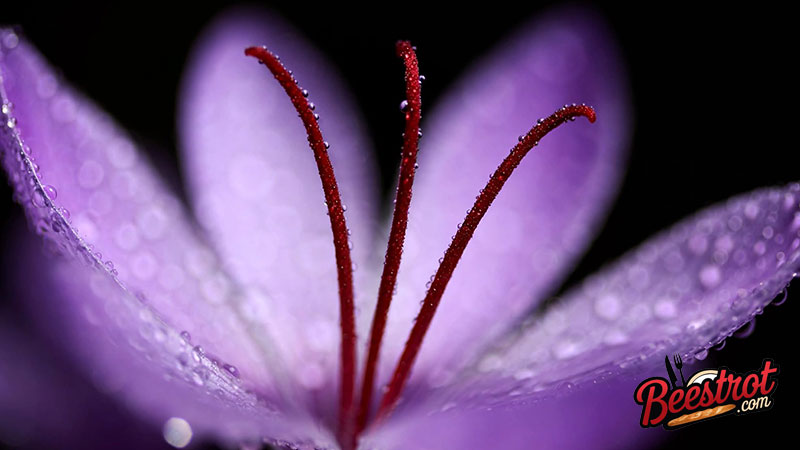
Saffron comes from the dried stigmas of Crocus sativus, a small purple flower that blooms for only two weeks each autumn. Each flower produces exactly three stigmas. Each stigma must be picked by hand within hours of the flower opening, before the sun rises and the heat degrades the volatile compounds that give saffron its character. A single kilogram of dried saffron requires somewhere between 150,000 and 200,000 flowers. There is no machine that can do this work. There has never been one.
To produce one kilogram of dried saffron, harvesters must pick between 150,000 and 200,000 flowers, each by hand, each at dawn. No mechanisation has ever replicated this process at scale.
The harvest window in Iran, which produces roughly 90 percent of the world’s saffron, lasts about three weeks. Villages in the Khorasan region mobilise entirely around it. Families who have grown saffron for generations understand that speed is everything: a stigma left too long on the flower loses potency. The labour is not artisanal in the romantic sense. It is simply the only way the thing can be done.
This is the first thing to understand about saffron’s price. It is not a story of rarity engineered by cartels or scarcity manufactured by traders. It is a story of irreducible human labour applied to a plant that will not cooperate with modernity.
What You Are Actually Buying
Saffron’s flavour comes from three primary compounds: safranal, which provides the distinctive aroma; picrocrocin, which delivers the slightly bitter, complex taste; and crocin, the carotenoid pigment responsible for the extraordinary golden colour it imparts to a dish. These compounds are fragile. They degrade with light, with heat, and with time.
When you add saffron threads to warm liquid, you are not simply colouring a dish. You are releasing a chemistry that took months to develop in the field and that will begin to fade the moment the vial is opened. A good paella, a proper risotto Milanese, a bowl of bouillabaisse in Marseille: in each of these, saffron does something no other ingredient replicates. It does not shout. It hums underneath everything else, making the other flavours more present, more coherent, more themselves.
Saffron does not add a flavour so much as it amplifies the flavours already in the dish. Chefs describe it as the ingredient that makes a recipe cohere.
This is also why cheap saffron is worse than no saffron at all. Adulterated saffron, dyed with safflower or turmeric, or stretched with other plant fibres, gives colour without depth. It makes a dish yellow. It does not make it anything else. The price of genuine saffron is, in this sense, a quality guarantee that no other spice requires you to think about so carefully.
Three Thousand Years of Trade
Saffron appears in the Hebrew Bible, in ancient Greek texts, in Roman records of trade routes that stretched from the Aegean to Persia. Alexander the Great used saffron-infused water to treat his battle wounds during his campaigns in Asia. Cleopatra reportedly bathed in saffron water before meeting Julius Caesar. Whether or not these stories are literally true, they point to something real: saffron has always been associated with power, wealth, and medicine.
In medieval Europe, the saffron trade was so lucrative that it prompted its own wars. The Saffron War of 1374 began when a nobleman near Basel hijacked a shipment of 800 pounds of saffron bound for wealthy merchants. The cargo was valued more than the lives of the men guarding it. It was eventually ransomed. Nothing about saffron’s status in the European economy had changed by the time the great spice routes to Asia were opened: it remained the one luxury that could not be replicated, because the labour required to produce it could not be exported to a cheaper context.
The Saffron War of 1374 began when 800 pounds of the spice were hijacked near Basel. The cargo was considered worth fighting for. It was eventually ransomed and delivered.
The books on saffron’s history that have shaped my understanding of this spice make clear that its value was never simply culinary. Saffron was currency, medicine, dye, and ritual offering simultaneously. The kitchen was only one destination for something that moved through civilisations in the way that gold moved: slowly, carefully, and in the hands of people who understood exactly what they were carrying.
How to Use It Without Wasting It
Most home cooks use saffron incorrectly, not because they are careless, but because no one explains what the spice actually needs. The threads should be steeped in warm, not boiling, liquid for at least fifteen minutes before being added to a dish. Warm water, warm stock, or warm white wine all work. The goal is to coax the crocin and safranal out of the threads gradually. Boiling liquid destroys the volatiles before they have a chance to dissolve into the dish.
A common mistake is to add threads directly to a hot pan. The dry heat scorches them. You lose the aroma entirely and are left with colour and bitterness but nothing of the honeyed complexity that makes saffron worth its price. Another mistake is to use too much: excess saffron makes a dish medicinal and sharp. The correct quantity for a risotto serving four is between twenty and thirty threads. No more.
Store your saffron in an airtight container away from light and heat. It will hold its potency for up to two years if kept correctly, though in my experience, if you are using it as often as you should, it will not last that long. The spice guides I return to most consistently make the same point: saffron is not a special occasion ingredient. It is a working ingredient that happens to cost more than most. Treat it that way and you will stop treating it as a luxury and start treating it as a tool.
The forty euros I spent in Granada have been repaid many times over. Not because I found ways to justify the expense, but because I learned what the price was actually for.
Every spice carries a world inside it. I am just learning to listen.
Jean Louis


Sources
- Saffron, Encyclopaedia Britannica
- Saffron in the Age of Antioxidants, National Library of Medicine
- Saffron, the World’s Most Expensive Spice, The Guardian
- The Saffron Wars, Smithsonian Magazine