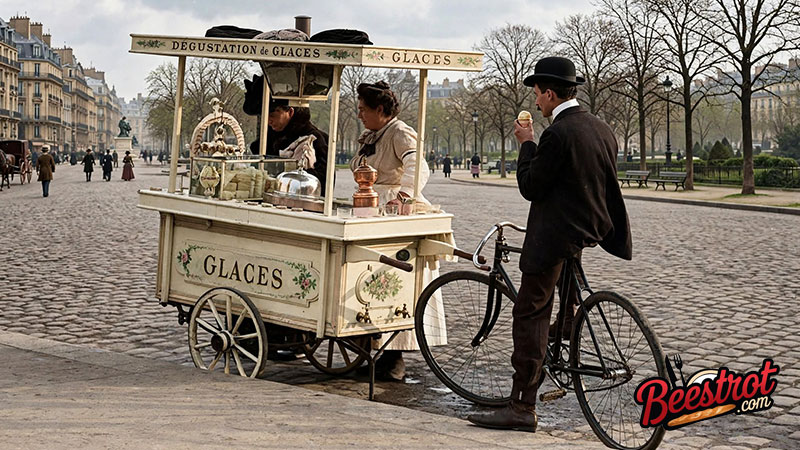
Marcel Pouzin (tireur de photographies) original photo improved - Paris 1900's
In the summer of 1671, the Duc de Condé served flavored ices at a banquet for Louis XIV at Chantilly. It was considered one of the great gestures of the occasion — not because the food was extraordinary, but because producing it at all required months of preparation, an ice house filled the previous winter, and cooks who had spent years learning a technique that almost no one outside royal service understood.
That banquet is documented. The ice house at Chantilly still exists. What it represents is two centuries of a simple fact: cold was a possession, and like all possessions, it reflected who held it.
A Treat That Required a Mountain
To understand why ice cream stayed royal for so long, you have to understand what ice cost before refrigeration existed. Someone had to go and get it. Mountain ice was cut in winter, packed in straw, loaded onto mules, and carried down to the lowlands where the kitchens were. Ice houses, those thick-walled underground vaults, could keep it for months if built correctly, but building one correctly required land, stone, and expertise most people did not have.
The Persians had flavored ice in 400 BC. The Tang dynasty emperor Taizong reportedly kept a store of ice mixed with mare’s milk. These were not precedents available to a French peasant in 1650. They were the private pleasures of men with armies and treasuries and the power to requisition mountains.
An ice house capable of preserving enough ice for a single summer season required walls four feet thick, a drainage system, and an underground depth of at least fifteen feet: a construction project beyond the means of any household that could not also afford to employ a dozen servants to maintain it.
Even among the wealthy, ice cream remained a curiosity. The techniques for making it, the precise ratios of salt to ice that created the right chilling temperature, the timing of the churning, were passed between cooks by word of mouth, guarded the way recipes are guarded when they represent power.
The Courts That Kept the Secret
Catherine de Medici arriving in France in 1533 carries, in popular history, a retinue of Florentine chefs and the secret of frozen desserts. Food historians dispute the exact route. What is harder to dispute is the result: by the time Louis XIV was eating at Versailles, his table featured flavored ices as a regular course, and no one outside his circle was eating anything remotely similar.
Café Procope opened in Paris in 1686 and began selling flavored ices to a paying public. It was a rupture, a small one, in the wall between royal and common. But the price still kept most people out. Ice remained expensive. The technique remained complex. The pleasure remained, for most, theoretical.
In 18th-century London, a single serving of ice cream at a fashionable assembly could cost the equivalent of a laborer’s weekly wage, not because the ingredients were rare, but because the infrastructure required to produce it was available only to those who already had everything else.
What kept ice cream royal for so long was not a secret formula. It was the cold chain. Without reliable cold, there was no ice cream. And reliable cold, before 1843, meant ice harvested from nature, transported at great expense, stored at great cost, and used before it became a puddle.
The Woman With the Patent
On September 9, 1843, a woman named Nancy M. Johnson was granted US Patent 3254 for a hand-cranked ice cream freezer. It was a tin cylinder inside a wooden bucket, with a crank that turned a paddle against a mixture of ice and salt. You filled it, you turned the handle, and in twenty minutes you had ice cream. Anyone who could afford a bucket of ice could now make it at home.
The patent was bought almost immediately by a Philadelphia manufacturer named William Young, who began producing the device commercially. Within a decade, versions of it were in kitchens across the United States. The Food of a Younger Land by Mark Kurlansky captures the America that emerged from this moment, a country in which food that had been a luxury was becoming ordinary so fast that people were still surprised by it.
Nancy Johnson’s invention did not merely make ice cream easier to produce — it transferred the knowledge entirely. The technique left the professional kitchen and entered the home, which meant it left the orbit of aristocracy and entered the orbit of anyone with an afternoon and a block of ice.
The ice trade helped. Frederic Tudor, the Boston merchant who built an industry around cutting lake ice and shipping it to warmer climates, had already been at work for decades by the time Johnson filed her patent. By the 1850s, ice was being delivered door to door in American cities, affordable enough that households kept it as a matter of routine. The cold chain, once the exclusive property of kings, had become a delivery route.
The Invention That Finished the Job
Mechanical refrigeration arrived in stages through the second half of the nineteenth century. Carl von Linde’s compression refrigerator, Jacob Perkins’s earlier vapor-compression experiments, the slow industrialization of cold: together they did what the hand-cranked freezer had started. They made ice cream manufacturable at scale, transportable without loss, sellable at a price that had nothing to do with mountain passes or underground vaults.
By 1874, the ice cream soda had been invented in Philadelphia. By the 1904 World’s Fair in St. Louis, the ice cream cone appeared, a practical response to a shortage of dishes that turned out to be one of the most successful food delivery innovations of the century. Scoop: A History of Ice Cream by Laura Weir traces how this acceleration happened, how a dessert that had required a monarch’s resources became the thing a child buys with pocket change.
What the banquet at Chantilly shows is not just a duke trying to impress a king. It shows the last years of a world in which temperature itself was a possession. When that ended, ice cream was only the most visible sign of the change. The cold had been democratized. Everything that depended on cold came with it.
What the Scoop Remembers
There is something quietly remarkable about the ice cream cone. It is one of the few foods whose entire history, from royal exclusivity to universal availability, fits inside two centuries. Most foods took longer. Most luxuries are still luxuries. Ice cream crossed the entire distance in the time between the French Revolution and the first automobiles, driven by one patent, one trade route, and one industrial process that turned cold from a privilege into a price point.
The Emperors of Ice-Cream by Eric Quinton takes its title from a Wallace Stevens poem that has nothing to do with frozen desserts and everything to do with pleasure and its relationship to power. Stevens was onto something. The emperors of ice cream were, for a long time, actual emperors. That the rest of us got it eventually is not an accident of generosity. It is an accident of engineering.
The ice house at Chantilly is still there, stone walls thick enough to keep a winter cold through a summer. It no longer serves a purpose. The cold it once stored at such cost is now in every kitchen in the world, humming quietly behind a white door. What took an estate to produce in 1671 takes a plug socket today.
That is what one invention does, when it arrives at the right moment.
Every dish has a past. I am just following it back to the beginning.
Jean Louis


Sources
- Who Invented Ice Cream, Library of Congress
- Ice cream, Wikipedia
- Nancy M. Johnson, Wikipedia
- The Ice Trade, Wikipedia
- The Cold Hard History of Ice Cream, Smithsonian Magazine