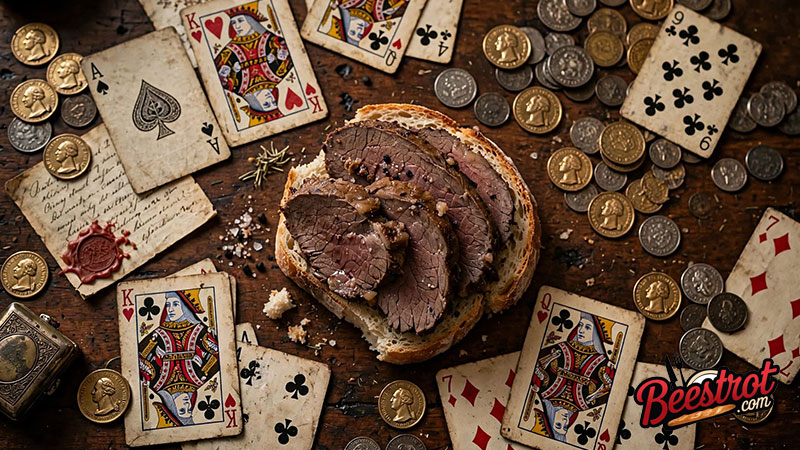
There is a version of this story that has been told so many times it has acquired the texture of fact. A man sits at a card table in eighteenth-century London, refuses to leave, refuses to stop playing, and asks for meat placed between two slices of bread so he can eat without putting down his cards. Everyone else at the table orders the same. History names the meal after him.
It is a satisfying story. It has a clear moment, a clear man, and a name. The only problem is that almost none of it holds up to any scrutiny.
The Source of the Story
The gambling account comes from a single source: a French traveler named Pierre-Jean Grosley, who published “A Tour to London” in 1772. Grosley was not present at the card table. He was reporting what he had heard about English eating habits, filtered through the lens of a French observer who found the English relationship with food baffling and vaguely alarming. His account is vivid and entertaining and almost certainly secondhand.
The man at the center of it, John Montagu, 4th Earl of Sandwich, was by 1762 a well-known figure in London society. He had political enemies, a complicated personal life, and a reputation for industry that did not quite fit the gambling story. He served as First Lord of the Admiralty three times. He was known, in fact, for eating at his desk rather than at card tables, working through meals because there was always more to do. The gambling story may have been spread by those same political enemies, or it may contain a grain of truth stretched into legend. What it almost certainly was not is the origin of the thing it claims to explain.
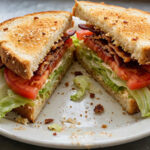
The first written record of “sandwich” as a food appears in Edward Gibbon’s diary in 1762, not at a card table, but at the Cocoa Tree, a London club, where Gibbon observed men of quality dining on cold meat between bread.
What John Montagu Was Actually Doing
The 4th Earl of Sandwich was a complicated man who has been poorly served by the legend attached to his name. He was capable enough as a naval administrator that Captain James Cook, on his third voyage, named a chain of Pacific islands after him. Those islands are now called Hawaii. He reformed naval provisioning, corresponded with scientists, and managed a naval department during one of the most difficult periods in British history. These are not the achievements of a man whose defining contribution was refusing to leave a card table.
His private life was more chaotic. His wife became mentally ill and was eventually institutionalized. His mistress, Martha Ray, was shot dead in the lobby of the Covent Garden theatre by a rejected suitor in 1779, in front of a crowd of witnesses. He was a figure of genuine tragedy and considerable political ability who has been remembered almost entirely for something he probably did not invent, at a card table he may never have sat at.
Captain Cook named the Sandwich Islands, now Hawaii, after the Earl. The name outlasted both Cook and Montagu. The food outlasted everything.
The Food That Already Existed
Bread with things placed inside or between it is not an eighteenth-century English invention. It is one of the oldest prepared foods in human history, arriving independently in nearly every culture that had grain and something worth putting next to it.
The Passover seder includes what is called the Hillel sandwich, named after the rabbi Hillel the Elder, who in the first century BCE combined lamb, bitter herbs, and matzo between two pieces of unleavened bread as a way of fulfilling multiple commandments in a single bite. This is documented in the Talmud. It predates John Montagu by roughly 1,800 years.
Medieval European households used thick slices of stale bread called trenchers as edible plates, piling meat and sauce on top and eating the bread itself at the end of the meal. Dutch workers had been eating filled bread rolls for generations. Street food vendors across the Ottoman Empire sold flatbreads stuffed with grilled meat at every market. The idea of putting food between bread required no single moment of invention because it was too obvious, too practical, and too ancient to need one.
Bee Wilson traces the filled bread across cultures and centuries in Sandwich: A Global History, watching the same solution appear independently wherever humans had grain and something worth wrapping in it. The Earl lent his name to a food that was already everywhere.
Why His Name Stuck
The more interesting question is not who invented the sandwich but why this particular aristocrat’s name attached itself to a food that was already common. The answer has less to do with the food and more to do with how language and fashion moved through eighteenth-century English society.
In the 1760s and 1770s, London’s upper-class clubs were laboratories of naming. Foods, drinks, and habits that the aristocracy adopted in public quickly acquired the names of whoever made them fashionable, regardless of who had actually originated them. The Earl of Sandwich was prominent enough, and the association between him and this particular way of eating public enough, that the name traveled downward through society the way all fashions did: from the clubs to the taverns to the streets and eventually to every kitchen in the country.
Tom Standage’s An Edible History of Humanity places this kind of naming within a broader pattern of how foods acquire identity through association rather than invention. The sandwich is not unusual in this. It is one example among many of a food whose name belongs to someone who arrived late to the story and had the good fortune, or misfortune, to be standing in the right place when the story needed a title.
The Meal That Needed a Name
There is something worth noticing in the fact that the sandwich needed a name at all. Before it had one in English, the thing existed everywhere but could not be easily ordered, discussed, or written about as a category. The Earl of Sandwich, whatever he was actually doing in 1762, provided the word that allowed a practice already common across Europe to become something nameable, something that could be developed, varied, exported, and eventually industrialized on a scale no eighteenth-century gambler could have imagined.
Bee Wilson’s Consider the Fork examines how the tools and technologies of eating shape what and how we consume, and the sandwich sits in that history as an object almost entirely about portability, about eating while doing something else, about the refusal to stop. Whether the Earl understood this instinctively or whether someone else did and he got the credit anyway, the thing he named outlasted his enemies, his political career, the islands Cook named after him, and almost everything else about a life that was far stranger and more interesting than the story his name is attached to.
The gambling story is probably fiction. The sandwich is very much real. And somewhere in that distance between the two lies the actual history of how a food gets its name.
Every dish has a past. I am just following it back to the beginning.
Jean Louis


Sources
- John Montagu, 4th Earl of Sandwich, Wikipedia
- Sandwich, Wikipedia
- Hillel Sandwich, Wikipedia
- History of the Sandwich, BBC Food
- Sandwich, Encyclopaedia Britannica