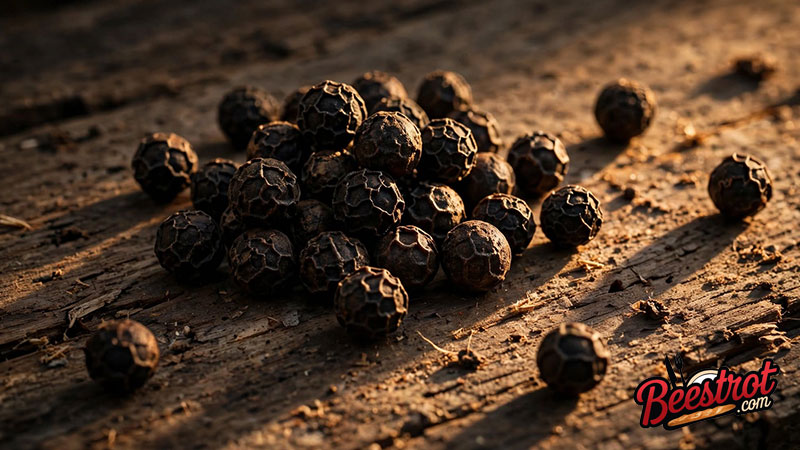
In 408 AD, Alaric, king of the Visigoths, laid siege to Rome. Among the terms of ransom he set for the city were 3,000 pounds of black pepper. Not silver. Not territory. Pepper. The Romans paid it.
That transaction is one of the better-documented moments in the history of spice, and it tells you everything about the position black pepper held in the ancient world. It was not a flavour additive. It was a unit of value, as serious as gold and considerably more portable. And it stayed that way for nearly a thousand years.
What Made It Worth That Much
Black pepper comes from Piper nigrum, a climbing vine native to the Malabar coast of what is now Kerala, in southwestern India. For most of antiquity and the medieval period, there was no substitute, no way to grow it in Europe, and no route to it that did not pass through a long chain of intermediaries, each adding margin. The price reflected every hand the peppercorn had passed through before it reached a Roman kitchen or a Venetian merchant’s stall.
In medieval Europe, pepper was used to pay rent, to settle debts, and to form part of dowries. English guild records document transactions denominated in pepper. The German word Pfeffersäcke, meaning pepper sacks, was a term for the wealthy spice merchants of the era, in roughly the same way a contemporary expression might identify someone by the currency they control. The pepper sack was the plutocrat of his time.
The search for a direct sea route to the pepper-growing regions of India drove two of the most consequential voyages in history. Vasco da Gama rounded the Cape of Good Hope in 1498. The motivation was not exploration in the romantic sense. It was pepper, and the fortunes locked inside every shipment that moved through Arab and Venetian traders on its way west. The spice that arrived in your kitchen was shaped by that entire chain of events.
For most of recorded history, black pepper was not a condiment. It was a currency precious enough to pay ransoms with. Understanding that changes what you should do with it in the kitchen.
What the Price Taught Cooks to Do With It
When an ingredient is expensive enough to pay ransom with, cooks treat it with precision. Medieval European manuscripts document pepper used in concentrated, deliberate doses: in spiced wines, in sauces built around its heat, in preparations where it was a protagonist, not a background correction. The proportion was measured. The timing was considered. The ingredient was not wasted, because wasting it had a cost that everyone understood.
That discipline maps directly onto how black pepper should be used today, not because it is still precious in the same sense, but because its chemistry rewards the same approach. The cooks who paid silver for their pepper knew something that the cooks who inherited a cheap pre-ground jar forgot. You do not sprinkle pepper. You place it.
The problem with cheap pepper is not the price. It is that cheap pepper taught a generation of home cooks to treat a complex spice like a reflex. The Romans would not recognise what most people do with the thing they paid ransoms for.
The Chemistry Behind the Precision
Black pepper contains two categories of active compounds that behave very differently. Piperine provides the heat: it binds to the same receptors as capsaicin and produces a slower, deeper burn. It is fat-soluble, which means it distributes through oil-based preparations and integrates into a dish over heat. Volatile terpenes, including sabinene, limonene, and beta-caryophyllene, carry the floral, woody, citrus-adjacent notes that make freshly ground pepper smell like something worth seeking.
The volatile compounds begin to dissipate the moment a peppercorn is cracked. A pre-ground pepper that has sat in a jar for three months has lost most of its aroma. What remains is piperine: heat without complexity. Functional as a burning agent, but not as a flavour with something to say.
This is why freshly ground pepper and pre-ground pepper taste different. Not slightly. Substantially. The terpenes are the difference between pepper that tastes like pepper and pepper that tastes like heat. Jack Turner’s account of the spice trade in Spice: The History of a Temptation documents how traders recognised quality by smell and texture, by exactly the volatile qualities that evaporate first. Marjorie Shaffer’s Pepper traces the same logic through centuries of cultivation practice in Kerala, where freshness was understood as the measure of value long before chemistry had a name for why.
Piperine survives heat better than the terpenes do. Pepper cooked into a braise from the beginning contributes heat that integrates into the dish over time. Pepper ground over the finished plate contributes both heat and aroma. Professional kitchens often do both. The Flavor Bible documents the flavour affinities that emerge from each approach, and why the timing is not interchangeable.
Grinding pepper fresh is not a ritual or a preference. It is the difference between using the ingredient and using what is left after the ingredient has already left.
How to Use It Like It Still Costs Something
Tellicherry peppercorns, grown in the Malabar region and left to ripen longer on the vine before harvest, develop a more complex flavour profile than standard black pepper. The difference is audible when you grind them: a deeper, more aromatic release. They cost slightly more than commodity black pepper and are worth finding.
Bloom pepper in fat before adding other ingredients when you want its fat-soluble piperine to distribute through the dish. A few turns of the grinder into warm olive oil or butter before a sauce builds is a technique professional kitchens use consistently and home kitchens almost never consider. The fat carries the compound where it needs to go.
Add freshly ground pepper at the end of cooking when you want the aroma to register alongside the heat. Add it at the beginning when you want it woven into the structure of the dish. These are different decisions that produce different results, and neither is better than the other in the abstract. The decision depends on what the preparation actually needs.
The spice that paid Roman ransoms and funded the age of maritime exploration costs almost nothing today. That accessibility is a gift. Whether it gets treated like one is a different matter entirely, and it starts with the grinder on your counter and what you decide to do with it.
Every spice carries a world inside it. I am just learning to listen.
Jean Louis


Sources
- Black Pepper, Wikipedia
- Spice Trade, Wikipedia
- Piperine, Wikipedia
- Black Pepper, Britannica
- How to Buy, Store, and Use Black Pepper, Serious Eats
More Delicious Reads
Tarragon Is the Most Underrated Herb in Western Cooking. Jean Louis Makes His Case.

Tea Was Not a British Tradition Until 1662. One Portuguese Woman Changed Everything.
Cheese Was Discovered by Accident Inside a Dead Animal's Stomach. It Became the Most Traded Food in ...

Top 10 Food and Cooking Movies: A Cinematic Feast for Food Lovers
The Michelin Star Was Invented to Sell Tyres. The Brothers Had No Interest in Food.
Pizza Was Peasant Food Eaten With the Hands in the Street. The Version the World Loves Was Invented ...

Champagne Was Invented by Accident. The Man Who Gets Credit for It Tried to Prevent It.
Sushi Was Originally Street Food Sold in Less Than 30 Seconds. Here Is What Happened to It.
Carrots Were Not Always Orange. The Dutch Changed That for Political Reasons.