There is a version of pizza that Alexandre Dumas described in 1843 as the food of the Neapolitan poor. He wrote about it in Le Corricolo, his account of travels through Italy. The pizza he described was sold in the streets, priced in fractions of a cent, eaten without plates, folded in half and consumed while walking. It was flour, water, lard, salt, and whatever was cheapest that week: sometimes anchovies, sometimes garlic, sometimes a scrape of pork fat. Dumas called it the gastronomic thermometer of the market. It was not a dish you ate at a table. It was food for people who could not afford to sit down.
Forty-six years later, in June 1889, a pizzaiolo named Raffaele Esposito was summoned to the Royal Palace of Capodimonte in Naples. Queen Margherita of Savoy, wife of King Umberto I, was visiting the city. Esposito prepared three pizzas. The queen expressed a preference for the one topped with tomato, mozzarella, and fresh basil. Esposito named it after her. The pizza that half the world orders by default on any given Tuesday night carries a royal dedication and a story that begins in a palace.
The street food of the Neapolitan poor and the favorite dish of a queen are, in most accounts, the same thing. What happened in between is worth looking at carefully.
The City That Invented Street Food
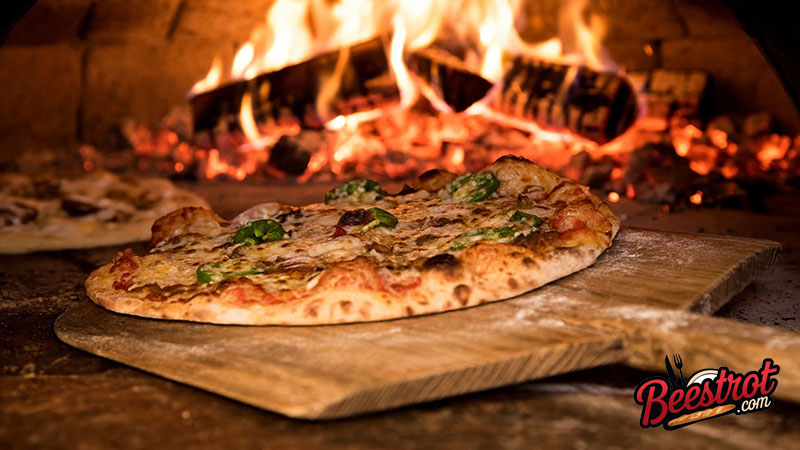
Naples in the eighteenth and nineteenth centuries had a problem that most European cities also had: a large population of urban poor with no kitchens, no means to cook, and a daily need to eat. The lazzaroni, as they were called, were the itinerant laborers, the dockworkers, the people who survived on whatever the city offered. Pizza was their solution. Baked in wood-fired ovens by vendors who sold slices by weight, it was fast, cheap, portable, and filling. A pizza in the 1830s cost less than a soldo. You could eat for almost nothing.
What those early pizzas looked like is not the question most people think to ask, because the answer disrupts the image. There was no mozzarella on the pizza of the lazzaroni. Mozzarella was expensive. The toppings were lard and salt, or anchovies, or garlic and oil. Tomato appeared on Neapolitan pizza from around the late eighteenth century onward as tomatoes became cheaper and more accepted as food, but the elaborate cheese-topped version came later, as ingredients became more affordable and the dish itself began migrating toward something more respectable.
The Letter That Still Exists
There is a document. Raffaele Esposito kept a letter dated June 11, 1889, signed by Camillo Galli, the prefect of the royal household. The letter thanks Esposito for the pizzas prepared for the queen and expresses her particular satisfaction with the tomato, mozzarella, and basil version. The letter is real. It has been preserved and authenticated. It sits at the historical center of the Margherita origin story and is the reason that story has lasted as long as it has.
Carol Helstosky, in Pizza: A Global History, notes that pizza with tomato and mozzarella already existed in Naples before the royal visit. The combination was not Esposito’s invention. What Esposito understood, and what the letter confirms, was that a royal preference is not the same thing as a royal invention. The queen liked a pizza that already existed. Esposito gave it her name. That reframing is subtle, but it changes the story considerably.
The combination of tomato, mozzarella, and basil predates the queen’s visit. What Esposito contributed was not the recipe. It was the dedication.
Why Italy Needed the Story
Italy had been unified as a nation only in 1861, less than thirty years before the Margherita pizza appeared. The new country was struggling with exactly the problem that all newly unified nations face: the feeling among its regions that they had little in common. The north distrusted the south. The south resented the north. The monarchy needed symbols that could cross those divisions. A Neapolitan pizzaiolo making something for a Savoy queen, from the north, and naming it in her honor, was a small piece of that symbolic work. It said: this is Italian food. It belongs to all of us.
John Dickie, in Delizia!, traces how Italian food became Italian identity over centuries, and the pattern repeats across dishes and regions. The story of a regional food being elevated by association with power, then adopted as national heritage, is not unique to pizza. But pizza is the example most people carry without knowing they carry it.
The Version the World Received
Pizza left Naples with the emigrants who crossed the Atlantic in the late nineteenth and early twentieth centuries. Lombardi’s in New York, generally cited as the first American pizzeria, opened around 1905. The pizza that arrived in America was already on its way to becoming something different: the oven temperatures were different, the flour was different, the cheese was different, and the distance from the street corners of Naples allowed the dish to drift into something new without anyone deciding that it had.
The version that conquered the world is neither the street food Dumas described nor quite the royal offering of 1889. It is a third thing, shaped by emigration, industrial production, and the specific demands of feeding people quickly in places far from Naples. That version generates hundreds of billions of dollars annually across the global restaurant industry. The lazzaroni who folded their pizza in half and ate it walking would not recognize most of it. The queen who gave her name to a topping combination in June 1889 probably would not either.
The food traveled so far and changed so completely that the original is now the niche version, and the copy is what everyone means when they say the word.
Every dish has a past. I am just following it back to the beginning.
Jean Louis


Sources
- A Slice of History: Pizza Through the Ages, Smithsonian Magazine
- The Surprising History of Pizza, National Geographic
- Italy’s Most Beloved Food Has a Complicated Past, BBC Travel
- Pizza History, History.com
- The True Story of Pizza Margherita, La Cucina Italiana