Last Updated on October 13, 2026 by Jean Louis
There is a smell that stops you at the door of a good bakery. Not just warm bread, something more specific than that. A char at the edges of the crust. A faint sourness underneath the sweetness. An almost mineral quality you cannot name but instantly recognize. You have tried to recreate it at home. Most people have. And most people have arrived at something that is fine, even good, but never quite that.
The gap is not skill. It is physics.
The Deck Oven Problem
Professional bakers use deck ovens. These are not larger versions of what sits in your kitchen. They are fundamentally different machines. A deck oven heats a thick stone surface, sometimes ceramic, sometimes refractory concrete, to temperatures between 480 and 530 degrees Fahrenheit. That surface holds heat with massive thermal mass. When you place a cold loaf on it, the stone does not cool down. It transfers an immediate, violent burst of bottom heat straight into the dough.
Your home oven cannot do this.
A domestic oven uses thin metal racks and thin metal walls. When cold dough enters, the temperature drops sharply and the oven struggles to recover. The bottom of your loaf never receives that initial shock of heat that sets the crust and drives the final rise, what bakers call oven spring, in the first critical minutes. The bread that comes out is different in a way that is hard to explain until you understand why it happens.
The first three minutes inside a deck oven are when a loaf becomes itself. Everything before that was preparation. Everything after is just baking.
Steam Is the Other Secret
Professional ovens inject steam into the baking chamber during the first minutes of the bake. Steam keeps the surface of the dough pliable long enough for the loaf to expand fully before the crust sets. Without it, the crust hardens too early, the loaf cannot rise to its potential, and you lose both height and the translucent, shattering quality that makes a great crust crack when you squeeze it.
Home ovens vent steam. They are designed to. A standard domestic oven has gaps and seals that allow moisture to escape, the opposite of what bread needs in its first minutes. Home bakers have tried ice cubes on the oven floor, pans of boiling water on lower racks, spray bottles aimed at the oven walls. These produce a fraction of the steam a professional oven delivers, and that fraction evaporates within seconds. The physics are not negotiable.
The crust of a great baguette is not made. It is grown in steam and then hardened in dry heat. The two phases must be precise, and in a home oven, only one of them is possible to control.
The Temperature Gap
Most domestic ovens max out at 500 degrees Fahrenheit, and most do not actually reach that temperature evenly. Hotspots, door seals that leak, heating elements that cycle on and off, all of these create an environment that is inconsistent in ways a home baker can feel but rarely measure.
Pizza ovens in Naples reach 900 degrees. Wood-fired bread ovens traditionally run far hotter for the first bake of the day, then drop steadily as the thermal mass releases its stored heat. Even a modest commercial deck oven maintains surface temperatures that no home kitchen can safely or legally replicate without specialized equipment. Temperature is not just a number on a dial. It is the language the dough uses to decide what it is going to be.
A loaf baked at 480 degrees and a loaf baked at 400 degrees are not the same bread, even from identical dough. They are different conversations between heat and gluten, and they end in different places every time.
The Time Equation
There is one more variable that home bakers can actually control, and most do not use it fully. Time.
Professional bakeries work with long fermentation schedules. A sourdough loaf at a serious bakery may ferment for 12 to 18 hours at cool temperatures before it ever sees the oven. During that time, enzymes break down complex starches into simpler sugars. Organic acids develop. The gluten network relaxes and reorganizes into a structure that traps gas more efficiently and gives the crumb its characteristic open, irregular texture. It is not magic. It is biochemistry that anyone can use.
Most home bakers, working from recipes designed for impatience, use fast yeast at warm temperatures and bake within two or three hours. The bread is technically correct. It is not the same bread.
Slow fermentation is not patience. It is flavor. Every hour in a cold environment is an hour the dough is doing work that fast yeast and warm kitchens simply skip.
The One Thing You Can Do
The Dutch oven.
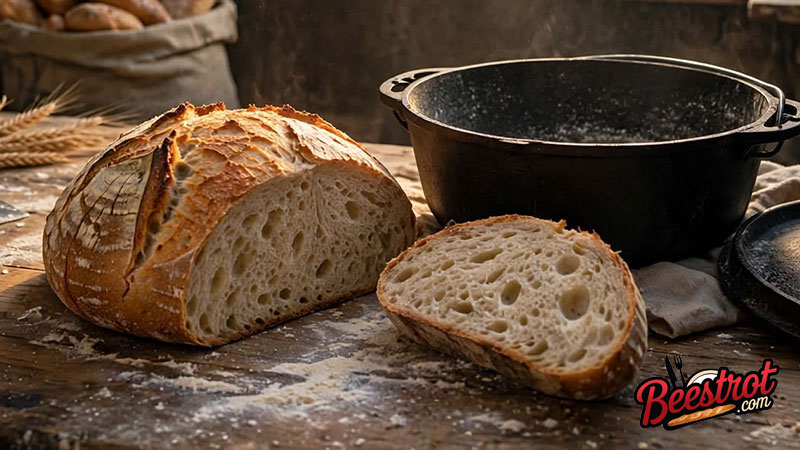
It is not a trick. It is physics working in your favor for once. A heavy cast-iron pot with a lid, preheated inside your oven at maximum temperature for at least 45 minutes, does two things simultaneously that no other home method can. First, it provides a surface with genuine thermal mass, not as much as a deck oven, but enough to give the loaf bottom heat with purpose. Second, it traps the steam that the dough itself releases in the first minutes of baking, creating a sealed microenvironment that replicates, imperfectly but meaningfully, what a professional steam injection system provides.
The result is a loaf with real oven spring, a crust that blisters and chars at the edges, and an interior that had time to fully open before the outside locked down. Remove the lid after 20 minutes and the dry heat finishes what the steam started.
It will not taste identical to what you buy at a serious bakery. But it will be closer than anything else you can do in a standard home kitchen, and it is replicable every time with no special equipment beyond the pot itself. A cold retard the night before, long fermentation if you have the time, and a screaming hot Dutch oven in a fully preheated oven: this is the complete answer, and it fits on one shelf.
The bread you make this way will still be yours. That is not a consolation. It is a different thing, a loaf with your timing, your flour, your hands. The bakery bread you admire was made by someone who has baked ten thousand loaves. You are working toward your first hundred. The gap is not a failure. It is the work.
A recipe is a promise. A technique is the truth behind it.
Jean Louis


Sources
- Dutch Oven Bread Baking, King Arthur Baking
- The Best Dutch Oven Bread, Serious Eats
- How to Bake Sourdough Bread, The Perfect Loaf
- How to Make Perfect Bread, BBC Good Food
- Deck Oven, Wikipedia