The first time I understood tarragon, I was eating a very simple roast chicken in Lyon. The bird had been rubbed with butter and stuffed with a handful of fresh tarragon before roasting. That was it. No other seasoning to speak of, no elaborate technique. What came out of that oven had a depth and fragrance that I spent the next several years trying to understand. The herb was not hidden inside the chicken. It had become the chicken.
Tarragon belongs, in a way that few herbs do, to the French kitchen. Not as a background note but as a structural element. Bearnaise sauce is not bearnaise without it. The classic combination of herbs called fines herbes has tarragon at its center. Poulet a l’estragon, chicken with tarragon, is one of those dishes that appears simple on paper and is revelatory on the plate. And yet outside France, and outside professional kitchens that look to France for guidance, tarragon sits largely ignored. Most home cooks in the English-speaking world could walk through a herb garden and identify rosemary, thyme, basil, and mint without hesitation. Tarragon, they would smell once and set down, uncertain what to do with it.
Tarragon is not a supporting herb. In the French tradition, it is a lead voice. The confusion is that most people have only ever heard it in the background, if at all.
Two Plants With the Same Name
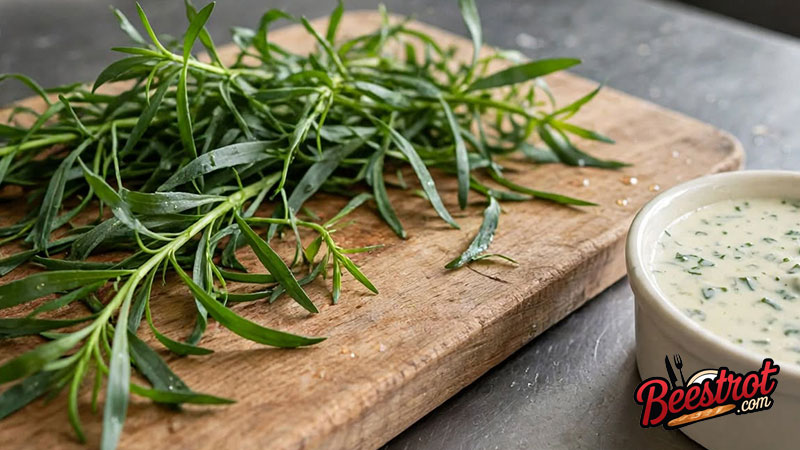
Part of the confusion around tarragon begins with a distinction that most cooks outside France never learn to make. There are two varieties sold under the name tarragon: French tarragon (Artemisia dracunculus var. sativa) and Russian tarragon (Artemisia dracunculus). They look similar in the garden. They are not the same thing in the kitchen.
French tarragon cannot be grown from seed. It produces no viable seeds and must be propagated from cuttings or root divisions, which makes it more difficult and more expensive to produce. Russian tarragon grows easily from seed, tolerates harsher conditions, and produces a plant that looks the part. The problem is that Russian tarragon has almost no flavor. It carries a faint hint of what the real thing offers and then nothing. Harold McGee, in On Food and Cooking, traces the chemistry of herb volatiles and the conditions that concentrate or diminish them. The aromatic compounds that give French tarragon its character, including estragole and ocimene, are present in the Russian variety in such small quantities as to be nearly irrelevant in cooking.
What this means practically is that a great deal of the tarragon sold dried in supermarkets, or grown from seed packets labeled simply tarragon, is Russian tarragon. It performs poorly and teaches cooks nothing about what the herb can actually do. They try it once, find it underwhelming, and do not reach for it again. French tarragon, by contrast, is anise-forward, complex, faintly sweet, with a warmth that does not announce itself loudly but that remains present through cooking. It does not need to shout. It transforms quietly.
Most people who believe they have tried tarragon and found it unremarkable have tried the wrong plant. French tarragon and Russian tarragon share a name and not much else.
What It Does in the Pan
Tarragon is unusual among culinary herbs in that its flavor survives heat reasonably well while also performing beautifully fresh. This gives it a range that herbs like basil, which deteriorate quickly under heat, do not have. You can steep tarragon in cream for a sauce and carry its flavor through to the finished dish. You can add it fresh at the end of a preparation and get a brighter, more immediate version of the same thing. Jerry Traunfeld, in The Herbfarm Cookbook, works through the full range of what individual herbs can do across a season, and tarragon appears in preparations from vinegar infusions to butter compounds to late-season roasts. The consistency of the herb across those applications is what marks it as versatile in a way that its reputation does not suggest.
The anise note in tarragon does not taste like licorice candy, which is what puts some people off when they hear the description. It is more like the background suggestion of anise that you get from good olive oil or from a very fresh fennel frond, present but not assertive. It lifts chicken the way acid lifts a heavy sauce: not by changing the flavor but by making space for everything else to be more clearly itself. Egg dishes, fish, and veal all respond to it in the same way. It does not compete. It clarifies.
The Dishes That Prove It
Bearnaise sauce is made from a reduction of white wine and tarragon vinegar, finished with egg yolks and butter, and finished again with fresh tarragon. The herb appears twice: once in the reduction, where it gives the sauce its aromatic base, and once at the end, where it gives the sauce its character. Remove the tarragon and you have hollandaise with more acidity. Replace it with anything else and you have something that has no name because no one has needed to name it. Julia Child, in Mastering the Art of French Cooking, gives the recipe with the precision that the dish requires and the authority that comes from understanding why each step matters. The tarragon is not optional in her version. It is the point.
Poulet a l’estragon, chicken cooked with tarragon, exists in many variations. The most common involve a cream sauce built around the herb, but the simplest versions, like the roast chicken I ate in Lyon, involve nothing more than fresh tarragon and butter inside the bird before it goes into the oven. The fat carries the herb through the meat. The result is a chicken that tastes more completely like itself than any chicken roasted with more complicated ingredients. This is what a good herb does at its best: it does not cover the ingredient it is paired with. It reveals what was already there.
Bearnaise without tarragon is not bearnaise. Poulet a l’estragon without tarragon is just chicken. The herb is not a garnish. It is the argument.
Why It Fell Away
Tarragon’s relative absence from non-French cooking has several explanations. It requires fresh or properly dried French variety to perform, which historically made it less accessible in markets where the Russian variety dominated. Its flavor profile, anise-forward and relatively subtle compared to something like thyme or oregano, does not translate well to heavy, spiced, or tomato-dominant cuisines. It is a herb that shows best in fat-based preparations and in dishes where a single flavor can be highlighted rather than layered beneath others.
There is also the simpler explanation that no food culture successfully exported it the way Italian cooking exported basil or the way Southeast Asian cooking has pushed herbs like lemongrass and Thai basil into wider international use. French cuisine exported its techniques globally but its specific herbal tradition, including the fines herbes combination of tarragon, chives, chervil, and parsley, remained largely the property of professional kitchens trained in the French method.
What this has left is a gap. A herb with a long history of proven culinary usefulness, documented in classical texts and present in some of the most admired preparations in Western cooking, sits underused by the majority of home cooks who could improve their chicken, their eggs, and their cream sauces considerably by learning one new plant. Jean Louis makes his case for tarragon not as a novelty but as an omission. Something that should already be in your kitchen is not there yet. That is a situation with a simple remedy.
Every spice carries a world inside it. I am just learning to listen.
Jean Louis


Sources
- Tarragon, Encyclopaedia Britannica
- What Is Tarragon? The Spruce Eats
- How to Use Tarragon, Serious Eats
- Tarragon, BBC Good Food
- Tarragon: The King of Herbs, Fine Cooking