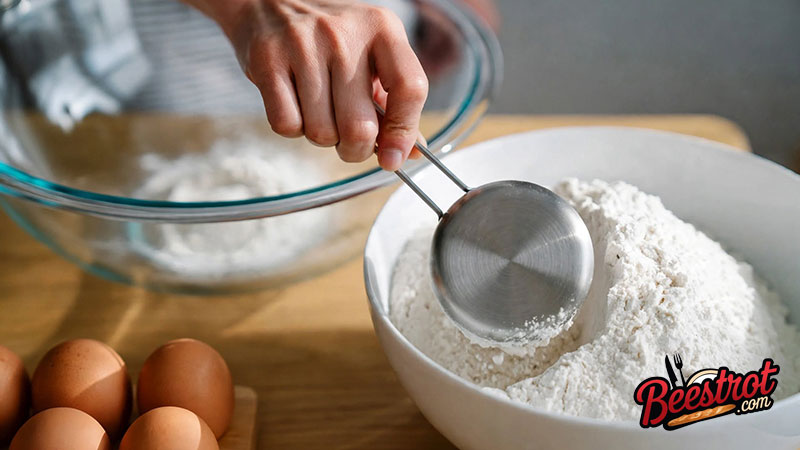
A cup of all-purpose flour can weigh anywhere from 120 grams to 170 grams, depending on who scooped it and how. That is a difference of more than forty percent. The recipe does not account for this. The recipe says one cup. It says it the same way to someone who sifted and spooned and someone who drove the measuring cup straight into the bag and packed it down. Both of those people believe they followed the recipe. Only one of them has any chance of getting the result it promised.
The Number on the Scale Is the Only One That Does Not Lie
Professional pastry kitchens do not use measuring cups. They have not used them in any serious kitchen I have ever worked in or visited. Every ingredient goes on a scale. Flour, butter, sugar, eggs, cream, leavening, salt. Everything. The recipe reads in grams or, in some older French texts, in kilograms. The quantities are fixed in a way that a volumetric measure never is, because the number on a scale does not change depending on the density of your flour, the humidity in your kitchen, the size of your measuring cup, or the way your hands move. It is a number. It is the same number every time.
A cup of all-purpose flour, depending on how it was scooped, can weigh between 120 and 170 grams. That forty-percent variation is not user error. It is a structural flaw in volumetric measurement applied to an ingredient whose density is not fixed. Professional pastry kitchens eliminated this problem by switching to weight measurement. Home recipes largely have not.
Why Baking Punishes Approximation
Cooking and baking are not the same discipline, even if they share a kitchen. When you are making a sauce or a braise, you can taste and adjust. The food gives you feedback before it is finished. Baking does not work that way. By the time you know something went wrong, the item has already spent thirty minutes in an oven and there is nothing left to adjust. The ratios of flour to fat to liquid to leavening were fixed the moment you finished mixing the dough. If those ratios were wrong, the result will be wrong. No amount of skill at the end of the process compensates for an error made at the beginning of it.
This is why J. Kenji López-Alt, whose The Food Lab applies controlled scientific method to cooking, measures baking ingredients by weight as a baseline rather than an advanced technique. It is not about precision for its own sake. It is about removing a variable that has no reason to exist. If a recipe works at 150 grams of flour, it will work at 150 grams of flour regardless of who made it, where, or when. The same cannot be said of one cup.
The Ingredients That Fool You Most
Flour is the most visible example but not the only one. Brown sugar packs differently depending on its moisture content. A firmly packed cup and a loosely filled cup of the same sugar can differ by thirty grams or more. Cocoa powder, baking powder, and cornstarch are all compressible in the same way flour is. Salt is perhaps the most counterintuitive case: a teaspoon of table salt and a teaspoon of kosher salt are not the same quantity. The crystals are different sizes. The mass is different. Recipes that specify one without clarifying which are, technically, incomplete. A professional recipe specifies grams of salt and the distinction disappears entirely.
A teaspoon of table salt and a teaspoon of kosher salt contain different amounts of salt by mass. Crystal size determines how much empty space exists in the spoon. A recipe that specifies salt by volume without naming the type has left a variable in the formula. Weight measurement eliminates this category of error entirely.
What Stella Parks Does That Most Recipes Do Not
Stella Parks’s BraveTart is, among other things, a document of what American pastry looks like when you apply professional rigor to it. Every recipe includes both weight and volume measurements, but the weights are the ones Parks developed and tested and trusts. The volume equivalents are there because American publishing conventions still expect them. She tested each recipe with a scale. The cup measurements are conversions. The implication is not subtle: if you want the result she got, use the number she used. That number is in grams.
The reason most home baking recipes still lead with cups is not technical. It is commercial. American readers were surveyed decades ago and said they found scales intimidating. Publishers responded by writing recipes to match what readers said they wanted, not what would actually produce consistent results. The professional kitchen made no such accommodation. It cannot afford to. A pastry that fails because a cook scooped too much flour is a pastry that goes in the bin and a cost that appears on the end-of-day sheet. The scale is not optional equipment. It is the only way the math works.
Ratios Are the Deeper Reason
Michael Ruhlman’s Ratio makes the case that most of what we call recipes are expressions of a small number of underlying ratios. Bread dough is five parts flour to three parts water, by weight, with leavening. Pound cake is one part each of butter, sugar, egg, and flour, by weight. Pasta is three parts flour to two parts egg. When you understand the ratio, you understand why the recipe works, and you can scale it, adjust it, and troubleshoot it when something goes wrong. You cannot do any of this if you are working in cups, because the cup measurement does not reveal the ratio. It hides it behind a unit that does not correspond to mass.
Classic pound cake is a one-to-one-to-one-to-one ratio: equal parts butter, sugar, egg, and flour by weight. That ratio produces the texture it produces because the chemistry requires those proportions. A volume measurement of the same ingredients will approximate the ratio most of the time and miss it some of the time, for reasons that are entirely invisible to the person following the recipe.
Making the Switch
A kitchen scale costs less than most of the gadgets that take up space in a home kitchen and does more than any of them. The transition from volume to weight is not a technique to learn so much as a habit to form. You stop reaching for the measuring cups and you start placing your bowl on the scale and pressing zero between ingredients. The first time you do it, the recipe is faster. You are not dirtying a set of cups, you are not leveling flour off with the back of a knife, you are not transferring anything from one vessel to another. You weigh it and you move on.
The recipes that work will work more reliably. The ones that have never quite worked will, in some cases, suddenly work. Not because your technique improved, but because you finally gave the recipe the input it was designed for. Professional pastry is weighed to the gram because baking is chemistry and chemistry requires consistent inputs. Everything else about the craft can be developed over time. This part is just arithmetic.
A recipe is a promise. A technique is the truth behind it.
Jean Louis


Sources
- How to Measure Flour, King Arthur Baking
- Baking, Wikipedia
- Flour, Wikipedia
- Maillard Reaction, Wikipedia
- Gluten, Wikipedia