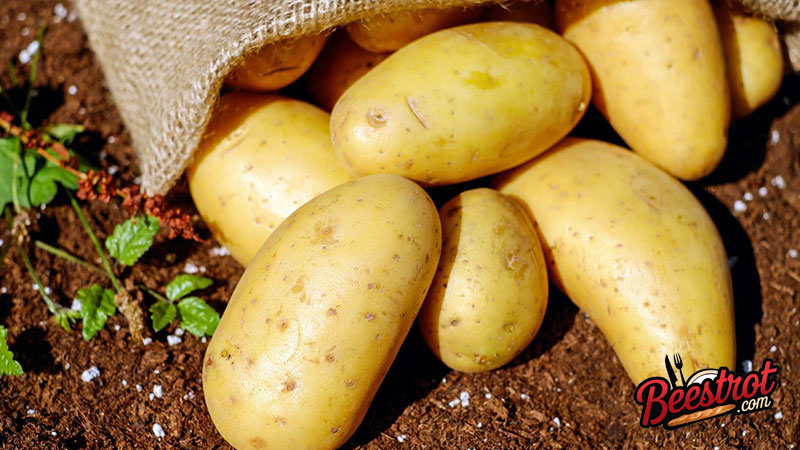
There is something almost deliberately unimpressive about a potato. It sits in a crate at the market looking like a geological accident, rough-skinned and irregular, the colour of the soil it came from. It does not smell of anything particular. It makes no promises. And yet this is the crop that broke the cycle of famine across northern Europe, doubled the population of Ireland within a century, fed Frederick the Great’s armies across the breadth of Prussia, and freed enough agricultural labour from the fields to fill the factories that built the modern world. The potato did not look like a revolution. It was one anyway.
The story starts in the Andes, where the potato was domesticated by indigenous Andean peoples roughly eight to ten thousand years ago at altitudes where almost nothing else could grow. The Spanish brought it back to Europe in the 1570s, and for nearly two centuries, Europeans largely refused to eat it. It grew underground, which many found suspicious. It was related to nightshade. It went unmentioned in the Bible. In France, it was blamed at various points for leprosy, fever, and general moral decline. Whole regions across Germany and France had to be ordered by law to plant it before farmers consented.
The Arithmetic That Changed Everything
What eventually won the argument was not promotion or propaganda but simple arithmetic. An acre of potatoes produced roughly two to four times more calories than an acre of wheat. It required less labour to cultivate. It stored in the ground until needed, reducing the problem of spoilage. It could be grown on marginal land that would not support grain. And it thrived in the cool, wet climates of northern Europe, precisely the places where grain yields were least reliable and famine most common.
Tom Standage’s examination of the foods that shaped civilisation in An Edible History of Humanity traces how the caloric efficiency of the potato transformed the demographic arithmetic of Europe. Where a farming family had previously needed most of its members working the land to produce enough food to survive, a potato patch of modest size could provide the same calories with a fraction of the labour. This did not immediately send people to the cities. But it created the precondition: a surplus of people who were no longer needed in the fields.
An acre of potatoes produced two to four times more calories than an acre of wheat, with less labour, on worse land, in wetter climates. The potato did not feed Europe slowly. It restructured what European agriculture could produce and who it required to produce it.
Frederick’s Potato and Parmentier’s Garden
The political history of the potato’s adoption in Europe is full of unlikely figures. Frederick the Great of Prussia issued a series of edicts in the mid-eighteenth century ordering Prussian farmers to plant potatoes, understanding that a crop capable of surviving what grain could not would protect his population and supply his armies through the wars he intended to fight. His farmers resisted. There are accounts of royal potato fields planted as demonstrations, with guards posted to discourage theft, with the result that farmers assumed the potato must be valuable and began stealing it themselves. Whether or not the story is entirely accurate, the underlying strategy was real: Prussia’s potato adoption gave Frederick a demographic and logistical advantage his opponents lacked.
In France, the equivalent figure was Antoine-Augustin Parmentier, a pharmacist who had been fed potatoes as a prisoner of war during the Seven Years’ War and returned convinced the French had made a categorical error in dismissing them. He spent years campaigning for acceptance, staging dinners at which potatoes appeared in every course, presenting bouquets of potato flowers to Louis XVI, and lobbying anyone who would listen. Michael Pollan’s account of the potato in The Botany of Desire places Parmentier’s campaign in the context of a deeper relationship between the plant and human desire for control: the potato was eventually adopted not because Europeans came to love it but because it solved problems they could not solve any other way.
The potato was not adopted because Europeans were persuaded it was delicious. It was adopted because it solved the recurring problem of famine in a way that grain, for all its cultural prestige, could not. Necessity drove the adoption that preference never would have.
Ireland, Dependence, and What the Famine Revealed
The country where the potato’s transformation was most complete and most catastrophic was Ireland. By the early nineteenth century, a significant portion of the Irish rural population depended almost entirely on a single variety of potato, the Lumper, for the majority of their calories. The potato had made this dependence possible by being so productive: a small plot could feed a family. It had also made it dangerous by encouraging a monoculture so complete that when the blight arrived, Phytophthora infestans, the water mould that devastated the Irish potato crop beginning in 1845, there was nothing to fall back on.
Larry Zuckerman’s detailed account of the potato’s economic and social impact in The Potato documents how the Great Famine killed roughly one million people and drove at least another million to emigrate in its immediate years, with emigration continuing for decades after. The Irish population fell by approximately twenty-five percent between 1845 and 1851. The famine was not only a natural disaster. It was the consequence of a dependency that the potato had made rational and an agricultural policy that had made it universal. The same crop that had fed the growth was the vector of the collapse.
By the 1840s, a significant proportion of Ireland’s rural population was subsisting almost entirely on a single potato variety. The productivity that had made this dependency rational also made it catastrophic when the blight arrived. The potato’s gift and the potato’s danger came from exactly the same source.
The Labour That Built the Factories
The connection between the potato and the Industrial Revolution is not a simple one, and historians continue to argue about the weight of different factors. But the broad outline of the argument is coherent: the potato’s caloric efficiency freed agricultural labour across northern Europe, particularly in Britain, Ireland, Germany, and Prussia, at precisely the moment that the factories of the industrial revolution required workers. The rural poor who flooded the mill towns of Lancashire, the coal mines of the Ruhr, and the manufacturing districts of the Low Countries were not leaving because farming had become unattractive. Many were leaving because the labour economics of a potato-supplemented agriculture no longer required them.
This is the connection that makes the potato something more than a food story. It sits at the intersection of botany, demography, economics, and political history in a way that very few crops do. The wheat that had fed Europe for millennia had shaped a world in which most of the population had to be employed growing food. The potato helped dismantle that constraint. What was built in its place is the world we currently live in. The crate at the market still looks unimpressive. It has earned the right.
Every dish has a past. I am just following it back to the beginning.
Jean Louis


Sources
- How the Potato Changed the World, History.com
- The History of the Potato, National Geographic
- How the potato changed the world, BBC News Magazine
- The Potato in the Eighteenth Century, Economic History Review, Salaman
- Great Famine, Encyclopaedia Britannica
More Delicious Reads

The Pretzel Was Invented by a Monk as a Reward for Children Who Learned Their Prayers. The Shape Is ...

Mayonnaise Was Almost Certainly Invented During a Military Siege. No Kitchen Was Involved.
The Temperature Secret That Separates Professional Cooking From Everything Else.
The Croissant Is Not French. Jean Louis Has Strong Feelings About This.

The Human Recipe: Why Emotion Wins Over AI in Storytelling
Smoked Paprika and Sweet Paprika Are Not the Same Thing. The Difference Changes Everything.

The Guide Escoffier: The Culinary Bible That Shaped Modern Cooking