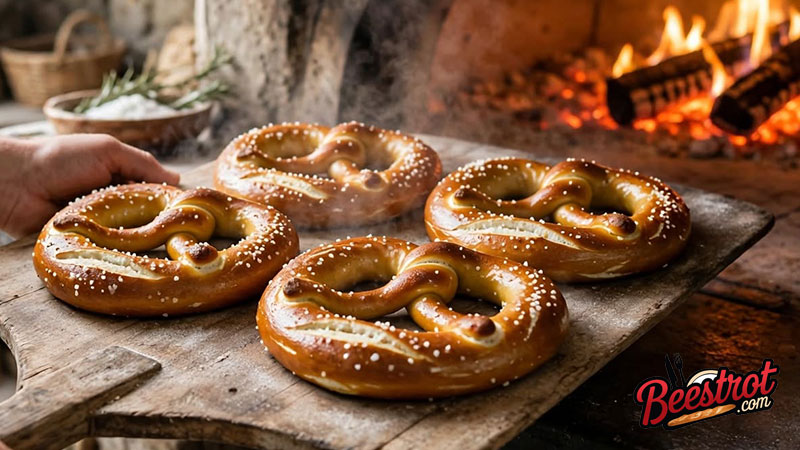
The shape is the first clue. Those two loops crossing at the center, the thing that makes a pretzel immediately recognizable at a distance, were not designed as decoration. The tradition that has persisted for over a thousand years holds that they were designed as hands: specifically, the arms of a child crossed over the chest in the posture of early Christian prayer, pressed into dough by a monk who wanted to give his young students something tangible to take home when they got the words right. The pretzel began as a reward. The shape was the lesson.
Whether the monk existed in exactly the form the story describes is a matter of debate among food historians. What is not debated is that the pretzel is among the oldest documented baked goods in the Western record, that it has been associated with Christian religious practice since at least the twelfth century, and that its shape has carried symbolic meaning far longer than its role as a snack food. The pretzel on the shelf at a motorway service station has a longer history than almost anything else available there.
The Story That Started It
The origin story most often told places the invention somewhere in southern Europe, around the seventh century, with a monk who had been teaching children to memorise their prayers. As a reward for those who recited correctly, he baked strips of dough folded to represent the crossed arms that children used when they prayed, before the steepled-hands gesture became the standard posture of Western Christian devotion. He called them pretiola, the Latin word for little reward, and the name is one proposed etymology for pretzel, alongside the German Brezel, which may derive from the Latin bracellus, meaning little arms.
The two proposed etymologies for “pretzel” both point to the same origin: one traces it to “pretiola,” little reward, and the other to “bracellus,” little arms. The shape and the name have always described the same thing.
The earliest known visual record of a pretzel appears in the Hortus Deliciarum, an illuminated manuscript compiled around 1190 by the abbess Herrad of Landsberg. The pretzel depicted there is recognisably the shape that exists today. By the time it appeared in that manuscript, it was already associated enough with Christian practice to appear in a religious educational text. H.E. Jacob’s survey of baking history in Six Thousand Years of Bread places the pretzel within the longer tradition of bread used as religious symbol and communal offering, a category that predates Christianity and into which the pretzel fits with unusual precision.
The Three Holes and Lent
The three holes created by the pretzel’s shape have been interpreted as a reference to the Holy Trinity, though this symbolism is more widely repeated than it is documented. What is well documented is the pretzel’s association with Lent, the forty-day Christian fasting period before Easter. The basic pretzel recipe, flour, water, and salt, contains no eggs, butter, or milk. It was one of the few baked goods that could be consumed during strict fasting periods when animal products were prohibited. Monks distributed pretzels during Lent, and the association between the pretzel and religious observance deepened accordingly.
In some parts of Germanic Europe, pretzels were hung on doors during Lent as a sign of the household’s observance. They also appeared at weddings, where couples in certain traditions broke a pretzel together as others break a wishbone, each making a wish on the larger piece. The phrase “tying the knot” has been connected by some historians to the pretzel’s knotted form, though the etymological chain is disputed. What is clear is that the pretzel functioned as a social and symbolic object long before it became a commercial product.
The pretzel’s recipe, flour, water, salt, with no animal products, made it one of the only baked goods suitable for Lenten fasting. Its association with religious observance was not accidental. It was structural, built into the ingredients.
What the Lye Bath Does
The pretzel’s distinctive dark, glossy crust and chewy interior are the result of a step that has no equivalent in ordinary bread-making: a brief submersion in a lye solution, a dilute bath of sodium hydroxide, before baking. The alkaline environment dramatically accelerates the Maillard reaction, the browning process that develops flavour in baked goods, producing a crust that is darker and more intensely flavoured than what the same dough would produce in an oven alone. The interior stays soft and dense while the exterior crisps into something that is almost lacquered.
Bee Wilson’s account of how techniques shape the foods we recognise in Consider the Fork touches on exactly this kind of case: a step that is chemically straightforward but historically specific, that produces an effect no other method replicates, and that became so associated with a particular food that the food is now unimaginable without it. The lye bath is not an optional refinement. It is what makes a pretzel a pretzel rather than a shaped bread roll.
Pennsylvania and the Hard Pretzel
The soft pretzel as it existed in European monasteries and markets was a perishable product. German immigrants who arrived in Pennsylvania in the eighteenth and nineteenth centuries brought the recipe with them, and it settled into the communities of Lancaster County and the surrounding region with unusual staying power. But at some point in Pennsylvania, the soft pretzel acquired a competitor: a version baked longer, dried until crisp, and shelf-stable for weeks. The hard pretzel was a practical innovation. It could be shipped, stored, and sold at a distance.
Julius Sturgis opened what is documented as the first commercial pretzel bakery in the United States in Lititz, Pennsylvania in 1861. The hard pretzel was the product that made commercial pretzel production viable, and Pennsylvania became the centre of an industry that now produces the majority of pretzels consumed in the United States. Max Miller’s exploration of food origin stories in Tasting History returns repeatedly to the moment when a domestic or artisanal food crosses into industrial production and what it retains and what it loses in that crossing. The pretzel retained its shape. It lost its softness, its brevity, and its original audience of children who had learned their prayers.
The soft pretzel and the hard pretzel are not the same food with different textures. They represent two different purposes: one made to be eaten the same day, the other made to last. Pennsylvania industrialised the second version and exported it to the world.
The shape, through all of this, has not changed. Whatever its precise origin, whatever the monk’s name or the children’s prayers, the crossed loops pressed into dough in the early medieval period are the crossed loops pressed into dough today. A food that began as a mnemonic, a shape designed to help children remember something, has itself become one of the most recognisable shapes in the world. It is the arms. It has always been the arms.
Every dish has a past. I am just following it back to the beginning.
Jean Louis


Sources
- A Brief History of the Pretzel, Smithsonian Magazine
- Pretzel, Encyclopaedia Britannica
- The History of Pretzels, PBS Food
- The Ancient History of the Pretzel, Atlas Obscura
- Pretzels, Food Timeline