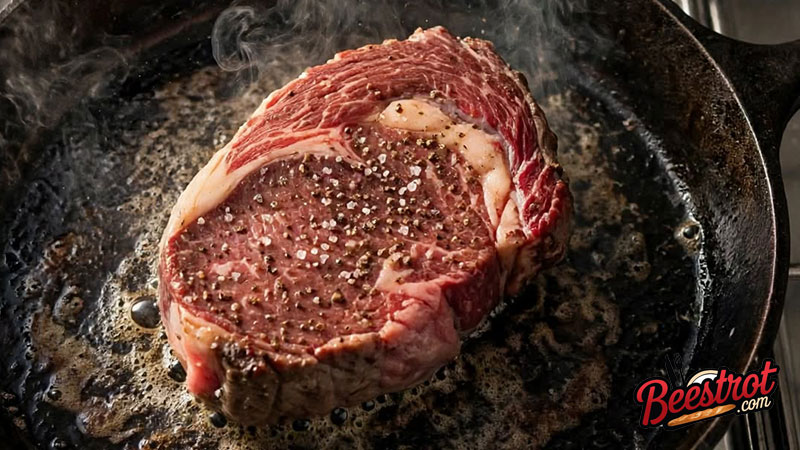
Professional kitchens do not say medium-high. They say 54 degrees. 63 degrees. 140 degrees before browning can begin. The gap between a restaurant kitchen and a home kitchen is mostly a gap in temperature knowledge, and it is smaller than most people think.
I cooked at home for a long time before I understood why my steaks were never quite right. The technique appeared correct: a hot pan, good beef, butter at the end. Then someone explained the pan to me. Not the heat. The pan itself. And everything that followed became clearer.
The Pan Before the Protein
The most common error in home cooking is adding protein to a pan that is not ready. A pan below the correct temperature causes meat to stick, steam, and lose moisture before the surface can develop. What you wanted was a sear. What happens instead is a grey, wet piece of protein that has surrendered its liquid to the pan and cannot recover it.
The surface of wet food cannot exceed 100°C as long as moisture is present. The water absorbs heat as it evaporates, holding the surface below the threshold where browning begins. A warm pan produces steaming, not searing. The protein sticks because the compounds that would otherwise bind, develop flavor, and release cleanly have dissolved into the surface moisture and left with it.
Professional cooks test the pan before anything enters it. A few drops of water on cast iron should skitter and vanish immediately. The protein goes in dry. Patting meat dry is the first act of cooking, not a detail that can be skipped.
What Browning Actually Requires
The Maillard reaction is the set of chemical reactions between amino acids and reducing sugars that produces the flavor and color of a proper sear. It requires approximately 140°C (285°F) to begin. It cannot occur in the presence of surface moisture, because moisture holds the surface below that threshold as long as it remains.
This is also why crowding a pan fails. Multiple pieces release moisture simultaneously. The temperature drops. Steam accumulates. The conditions required for browning are lost and cannot be recovered until the moisture is gone, by which point the interior has cooked further than intended. One piece at a time. There is no shortcut around the physics.
Harold McGee’s On Food and Cooking covers the Maillard reaction in full. The practical conclusion is short: wet cannot brown. Cold cannot brown. Dry and hot will brown, reliably, every time.
The Interior Is a Different Problem
Surface temperature and interior temperature are two separate problems. A pan at 260°C can be in contact with meat whose center is still below 10°C. The goal is to bring both to the right place at the right time, which requires understanding that they respond to heat at different rates.
Muscle proteins begin to contract and release moisture from around 60°C. A steak at 54°C internal is tender because the fibers have barely been disturbed. At 74°C, much of the moisture has been pressed outward. The difference between medium-rare and well-done is not preference. It is a measurable difference in moisture content, which is why well-done beef is consistently drier regardless of quality or technique.
The Culinary Institute of America’s The Professional Chef treats temperature targets for every major protein not as suggestions but as foundational knowledge. A kitchen thermometer is not optional. It is the tool that replaces estimation with accuracy.
Why Resting Is Not Optional
Protein pulled from heat does not stop cooking immediately. Heat continues moving from the hotter exterior toward the cooler center. This carry-over cooking raises the internal temperature by two to ten degrees depending on the size of the piece. Professional cooks pull protein from the heat before the target temperature is reached: a thick roast comes off eight to ten degrees early, a thin fillet two to three.
J. Kenji López-Alt’s The Food Lab documents resting through controlled experiments, slicing identical steaks at different intervals and measuring moisture loss. Rested meat retains more moisture when cut. The liquid that runs across the board when you cut too early does not come back. Rest the protein, and it stays in the meat.
The temperature is the technique. Every other instruction in a recipe, the timing, the visual cues, the doneness tests, is an approximation of a number a thermometer can measure directly. Learn to use one and the approximations become unnecessary.
A recipe is a promise. A technique is the truth behind it.
Jean Louis


Sources
- Maillard Reaction, Wikipedia
- Protein Denaturation, Wikipedia
- Carryover Cooking, Wikipedia
- The Food Lab, Serious Eats