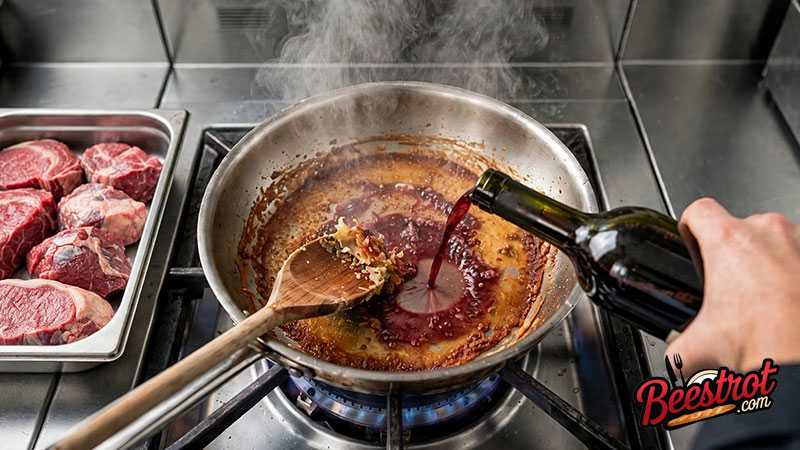
Every professional kitchen has a name for it. Fond. The French word for base, for foundation, for the bottom of something. It is the layer of browned, caramelized proteins and sugars that clings to the pan after you have seared a piece of meat or cooked down a handful of vegetables. It looks like residue. It is not residue. It is the most concentrated flavour in the entire pan, and most home cooks wash it away.
The habit makes sense from a certain angle. The pan looks dirty. The substance looks like something that went wrong. The instinct is to remove it. The instinct is incorrect, and understanding why requires a small piece of chemistry that most recipes never explain.
What You Are Actually Scrubbing Away
The fond forms because of a physical process that happens whenever protein meets a hot, dry surface. When meat hits a properly heated pan, the moisture on its exterior evaporates rapidly. As the contact temperature rises, the proteins and sugars react with each other and with the surface of the pan. The result is hundreds of new flavour compounds, most of them not present in the raw ingredient. The same process is responsible for the crust on a grilled steak, the skin of a roasted chicken, the surface of a well-cooked onion.
What sticks to the pan is the most intensely flavoured part of that reaction. It has less moisture than the meat itself, which is why it adheres to the surface rather than coming away with the protein when you lift it. It is not burnt. Burnt food is carbon, and it tastes like carbon. Fond is caramelized, complex, deeply savoury. The smell when you deglaze a good fond correctly is not the smell of something salvaged. It is the smell of the dish you were trying to make.
Harold McGee, in On Food and Cooking, provides the most thorough account available of what actually happens at the chemical level when protein is exposed to high heat, and why the compounds produced by browning account for so much of what we associate with cooked food tasting cooked. His explanation makes clear that the fond is not a byproduct of cooking. It is cooking. The browned crust and the layer it leaves on the pan are the same process. Washing one away while eating the other is a kind of selective attention that the professional kitchen has never practised.

Silpat Premium Non-Stick Baking Mat, Half Sheet
No parchment, no sticking, no waste. Cookies, pastries, roasted vegetables: everything releases perfectly. Used by professional pastry chefs everywhere.
View on Amazon
The Maillard Reaction: Why It Tastes That Way
Louis-Camille Maillard described the reaction that bears his name in 1912, in a paper submitted to the French Academy of Sciences. He was a chemist, not a cook. His interest was in the interaction of amino acids and reducing sugars at elevated temperatures. What he identified was a cascade of reactions producing hundreds of distinct flavour and aroma compounds, the precise combination depending on the specific proteins and sugars involved and the temperature at which the reaction occurs.
What matters for the cook is practical: the Maillard reaction requires dry heat. It does not occur in liquid. This is why braised meat tastes different from seared meat, why a wet pan produces a stew rather than a crust, and why the fond only exists when the pan is dry and hot enough. Add too much food to a cold pan and the temperature drops, moisture accumulates, and the surface steams rather than browns. The fond, and everything it represents, never develops.
Samin Nosrat, in Salt, Fat, Acid, Heat, argues that heat is the most misunderstood of the four fundamental elements of cooking, and that most home cooks consistently underheat their pans, underbrown their proteins, and then compensate with sauces purchased rather than built. The fond is the evidence. A pale, unstuck pan after searing means the temperature was wrong or the pan was crowded. A dark, richly stuck pan means the conditions were right. The difference between those two pans is the difference between a finished dish and a finished dish with a sauce.
How Professional Kitchens Use It
In a professional kitchen, nothing that has browned in a pan is wasted. The fond from a seared duck breast becomes the base of the sauce served alongside it. The fond from roasted vegetables is deglazed with wine or stock and reduced into the next preparation. Pans are not scrubbed between uses. They are deglazed. The residue is a resource, and the cook who throws it away is the cook who then reaches for a bottle to replace what they discarded.
The technique is called déglaçage in French. The principle is straightforward: add a small amount of liquid to a hot pan after the protein has been removed, allow it to hiss and bubble as it hits the surface, and scrape the fond loose with a wooden spoon as the liquid reduces. The result is a small quantity of intensely flavoured liquid that is the foundation of a pan sauce. It takes two minutes. It requires nothing that is not already in the pan.
J. Kenji López-Alt, in The Food Lab, applies systematic testing to the question of what actually improves a pan sauce and finds that the quality of the fond is the single most significant variable, more than the choice of wine, the type of stock, or the finishing butter. His experiments with controlled searing conditions show consistently that a well-developed fond produces a sauce with measurably more flavour compounds than one built on a lightly browned or pale pan. The technique is not a professional preference. It is a flavour outcome, and the difference is detectable.
The Technique: How to Deglaze
Remove the protein from the pan and set it aside to rest. The pan should be hot and the fond should be dark brown, not black. If it is black and smells acrid, it has gone past fond into actual burning, and the pan needs to be wiped before you continue. Dark brown, slightly stuck, with a complex savoury smell: that is what you are working with.
Add your liquid while the pan is still over heat. Dry wine is the classic choice. Stock works. Water works. Cider, beer, and dry vermouth all work and each leaves a different character. Start with roughly half a cup for a standard pan. It will hiss, reduce quickly, and lift the fond from the surface as you scrape. Use a wooden spoon or a flat spatula and work while the liquid is at a full boil. Once the fond has dissolved into the liquid, let it reduce by half, taste it, and finish with butter, fresh herbs, or a splash of cream as the dish calls for.
What you have at the end is a pan sauce. It took the two minutes you would have spent scrubbing. The flavour it contains was already there, in the pan, waiting to be dissolved rather than removed. The professional kitchen understood this a long time ago. The home kitchen is still, in many cases, reaching for the scrubbing pad.
A recipe is a promise. A technique is the truth behind it.
Jean Louis


Sources
- Maillard reaction, Wikipedia
- Deglazing, Wikipedia
- Searing, Wikipedia
- Caramelization, Wikipedia
- Stock, Wikipedia
More Delicious Reads
Carrots Were Not Always Orange. The Dutch Changed That for Political Reasons.
The One Ingredient Every Pastry Chef Adds to Desserts That Home Cooks Never Think Of.
Vanilla Is the Second Most Expensive Spice in the World. The Reason Is a Twelve-Year-Old Boy.
Mise en Place Is Not Organisation. It Is a Philosophy That Changes How You Experience Cooking.
If You Cook Seriously, Your Wedding Registry Is the Most Important Kitchen Decision You Will Make
Sushi Was Originally Street Food Sold in Less Than 30 Seconds. Here Is What Happened to It.

Knife Skills 101: Hold, Slice & Chop Like a Pro (Without Losing a Finger)

Champagne Was Invented by Accident. The Man Who Gets Credit for It Tried to Prevent It.
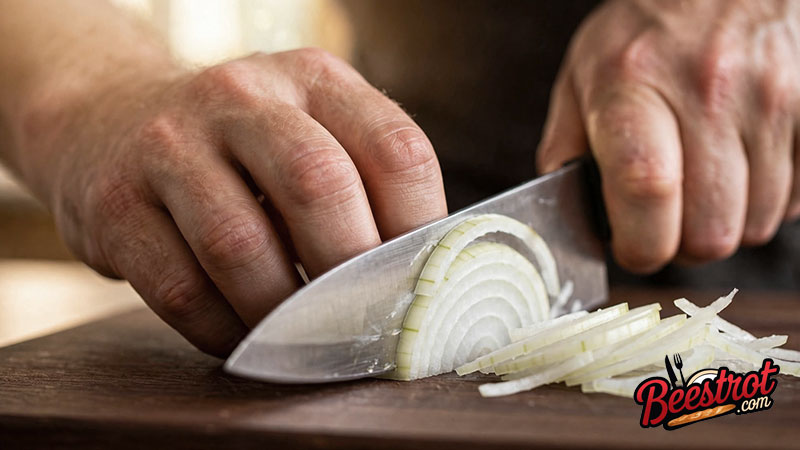
The Knife Skill That Changes Everything. Most Home Cooks Never Learn It Because Nobody Shows Them.