Dried rosemary sitting in a jar since last winter is more powerful than the fresh sprig you just cut from the garden. Most home cooks find this difficult to believe. Most recipes are written as though it is not true.
What Drying Does to an Herb
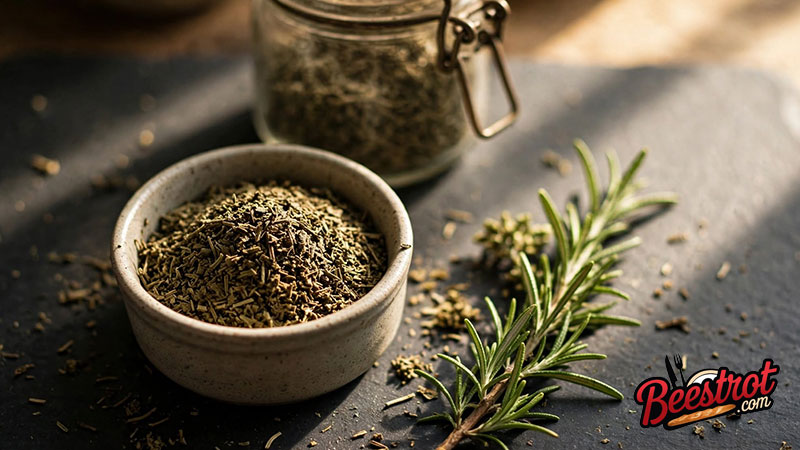
When rosemary dries, it loses most of its water weight, usually around 75 percent. The aromatic compounds that give the herb its character are concentrated into what remains. A teaspoon of dried rosemary contains the oils that were distributed across roughly three teaspoons of fresh rosemary. This is why the standard conversion exists: one teaspoon dried equals one tablespoon fresh.
The nuance is in which compounds survive the drying process. Fresh rosemary carries a spectrum of volatile aromatics: the bright, piney top notes that hit immediately when you bruise a fresh sprig, alongside more stable camphor and woodsy base notes. Drying allows some of those top notes to dissipate, but the more stable compounds, camphor and the deep resinous oils, concentrate and intensify. The result is an herb that is less complex in one direction and more powerful in another. Dried rosemary is blunter, heavier, and more concentrated in its dominant notes.
This distinction is not a matter of quality. It is a matter of chemistry, and it explains why choosing between fresh vs dried herbs is a question of application rather than preference.
Dried rosemary is not a weakened version of fresh rosemary. It is a different version: more concentrated in its resinous, camphor notes and without the bright volatile top notes that dissipate during drying. Knowing which version a dish needs is the professional’s first question.

Staub Cast Iron Round Cocotte, 4 Qt
Braises, stews, sourdough, tagines: the French-made cocotte that makes everything taste better. Beautiful enough to go straight from oven to table.
View on Amazon
When Fresh Rosemary Earns Its Place
Fresh rosemary belongs in dishes where the bright top notes matter and where the cooking time is short enough to preserve them. Herb oils are the clearest example: chopped fresh rosemary steeped in warm olive oil releases its full aromatic range within minutes. The same process with dried rosemary produces a harsher, more one-dimensional result that lacks the lift of the fresh herb.
Focaccia and flatbreads benefit from fresh rosemary pressed into the surface before baking. The needles soften, the oils bloom in the oven heat, and the aromatics infuse into the crust without the harsh woody texture that dried needles leave behind. Short marinades for lamb or chicken that will grill quickly also suit fresh rosemary, the bright notes transferring to the meat surface before the high heat burns them off.
The working rule for fresh rosemary: use it when you need brightness, when total cooking time is under twenty minutes, or when the herb will be tasted directly in the finished dish rather than absorbed into a long sauce or braise. Add it late in the cooking process whenever possible, so the volatile compounds do not have time to fully cook off before the dish reaches the table.
Fresh rosemary pressed into focaccia dough gives a different result than dried rosemary mixed into the same bread. The needles soften differently, the oils release at a different point in the bake, and the aromatic result is brighter and more complex. This is not about one being better. It is about using the right form for what the dish requires.
When Dried Rosemary Works Better
For long, slow cooking, dried rosemary is frequently the stronger choice. In a braise that will cook for two to three hours, the bright volatile compounds in fresh rosemary cook off within the first thirty minutes, leaving primarily the woodsy base notes and, in some cases, a slightly bitter edge from the stems. Dried rosemary hydrates gradually in the braising liquid and releases its concentrated oils slowly and evenly across the full cooking time.
A dry rub for roasted meat is another clear case. A dry rub needs to adhere to the surface and penetrate during roasting. Fresh rosemary needles sit on the surface and can char before the meat is properly cooked. Dried rosemary, particularly when crushed before use, distributes evenly, penetrates into scored surfaces, and handles oven heat without burning.
That crushing step is the one most home cooks skip. Whole dried rosemary needles are hard, woody, and unpleasant to bite into. A quick press in a mortar, or ten seconds between the palms, breaks them down enough to hydrate properly and disperse through the dish. It is a small step that changes the result significantly.
Whole dried rosemary needles added to a quick pan sauce never fully hydrate and remain harsh in the mouth. Crush them before they go into the pan. This takes ten seconds and resolves the most common complaint about cooking with dried rosemary.
Why Most Recipes Get the Ratio Wrong
The default in most home cookbooks is fresh herbs, partly because food photography favors the visual of a fresh green sprig and partly because fresh reads as more attentive, more considered. This produces recipes that call for fresh rosemary in long braises where it makes little practical difference, and recipes that specify dried rosemary in quick-cook dishes where it does not perform well.
The professional correction is straightforward. For any dish cooking longer than forty-five minutes, dried rosemary at the one-to-three conversion is at least as effective and often more reliable. For dishes under twenty minutes, fresh rosemary added in the final few minutes gives cleaner results. For dry rubs and spice blends, dried is almost always the right choice regardless of cooking time.
The quantity adjustment matters as much as the form. Never substitute dried rosemary for fresh using equal quantities. The concentration difference will overpower the dish. One teaspoon dried for one tablespoon fresh is the starting conversion, and dried rosemary varies in potency depending on storage time, so tasting before the full quantity goes in is not optional. The jar on the shelf is stronger than the sprig in the garden. Using it as though it were not is where most recipes go wrong.
Every spice carries a world inside it. I am just learning to listen.
Jean Louis
Sources
More Delicious Reads

Knife Skills 101: Hold, Slice & Chop Like a Pro (Without Losing a Finger)

If You Cook Seriously, Your Wedding Registry Is the Most Important Kitchen Decision You Will Make
Mise en Place Is Not Organisation. It Is a Philosophy That Changes How You Experience Cooking.

Worcestershire Sauce Was Left in a Barrel for Two Years by Accident. The Chemists Almost Poured It A...
Carrots Were Not Always Orange. The Dutch Changed That for Political Reasons.

McDonald's: The Brothers, The Salesman, and the Burger That Ate the World

Two New Pieces, and a Word on How This Works
The BLT Did Not Exist Before the 1920s. It Required Three Separate Agricultural Revolutions.
The Knife Skill That Changes Everything. Most Home Cooks Never Learn It Because Nobody Shows Them.