There is a smell that belongs, in most people’s minds, entirely to the twentieth century. Warm, faintly sweet, unmistakably buttery. It arrives before the film does, before the lights go down, while you are still finding your seat. Cinema invented that smell, the story goes, or at least gave it a permanent home.
The story is not quite right. The smell is far older than the projector. Older than the theater. Older, by several thousand years, than any building you could call a cinema.
A Grain That Learned to Explode
Maize did not begin as the tall, generous plant most of us picture. Its ancestor was teosinte, a wild grass native to Mexico with a modest seed head and a hard shell that resisted everything except the right conditions. Somewhere around nine thousand years ago, in the river valleys of what is now Oaxaca and Puebla, farmers began selecting for different traits. What they produced, across generations of careful cultivation, was one of the most useful plants in human history.
Popcorn came early in that story. Archaeological work at sites along the Peruvian coast has recovered popcorn remnants dating to roughly 4700 BCE, more than six thousand years ago. The coastal populations of what is now Peru were eating corn in a form we would recognise immediately, long before they had any of the tools that we associate with modern food preparation. They had fire, they had ceramic vessels, and they had a grain that, when heated fast enough, would turn itself inside out.
The popping is not a cooking technique so much as a structural fact. The moisture inside the kernel, when heated rapidly, becomes steam. The pressure builds until the hull gives way, the starch inside expands, and what was a hard seed becomes something soft, airy, and warm. It happens in under two seconds. It has been happening for thousands of years.
Charles C. Mann traces in 1491 the full complexity of pre-Columbian civilisation in the Americas, a world far more sophisticated and densely populated than European contact narratives tend to acknowledge. Food was central to all of it, and corn was central to food. Popcorn, as one of the simplest preparations, was almost certainly among the earliest.
Before the Projection Room
When Spanish chroniclers first encountered Aztec markets in the sixteenth century, they noted popcorn with some puzzlement. It was sold as food, used in ceremonial contexts, and worn as decoration during certain festivals. Aztec women danced with popcorn garlands during rituals dedicated to Tlaloc, the rain deity. The grain that exploded was associated with the sudden, transformative energy of water arriving after drought.
Betty Fussell’s The Story of Corn follows corn through its entire cultural history, from its sacred status in Mesoamerican civilisation through its transformation into a global commodity. What she finds, again and again, is that the preparations we think of as modern were nearly always ancient first. Corn tortillas. Hominy. Tamales. Popcorn. Each one arrives in the historical record accompanied by the quiet implication that it had been there far longer than anyone had thought to write it down.
By the time the first Europeans arrived in the Americas, popcorn had already traveled across two continents. It had fed people in the high Andes and on the Pacific coast. It had crossed the Gulf of Mexico. It had been eaten at festivals, offered at shrines, and sold in markets that rivaled anything contemporary Europe could offer. It was not a snack food waiting for its moment. It was a staple that had already had several thousand years of them.
North American indigenous peoples had their own long relationships with the grain. The Iroquois, the Algonquin, and many other nations had been preparing popcorn for generations before colonists encountered it. Some accounts suggest that popcorn appeared at the 1621 harvest feast that became mythologised as the first Thanksgiving, though the historical record is not precise enough to confirm it.
The Great Depression Changed Everything
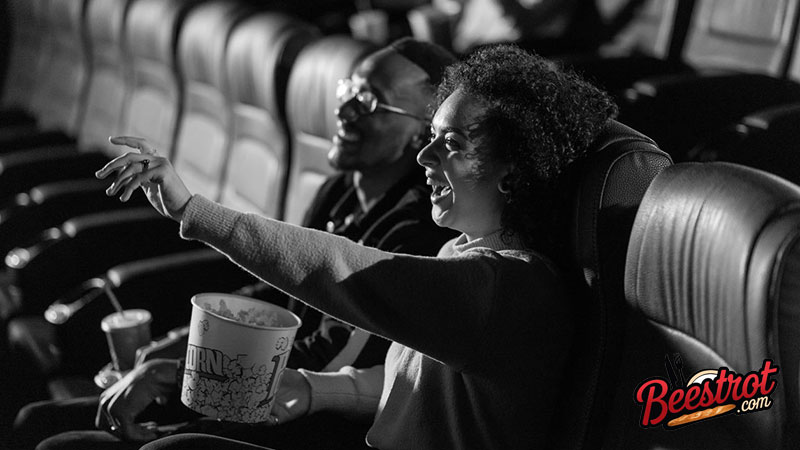
Cinema, when it arrived in the late nineteenth century, wanted nothing to do with popcorn. Early movie theaters were built to imitate legitimate theaters, with carpets, upholstered seats, and a self-conscious sense of occasion. Food was not part of that occasion. Theater owners worried about the noise of crunching, the smell of butter, the generalised mess of eating in the dark.
Street vendors saw the situation differently. They positioned themselves outside theater entrances with their carts and sold to audiences before they went in. The theaters could not stop them, and the audiences clearly wanted what they were selling.
What changed the calculation was the Depression. Popcorn cost almost nothing to produce, and it could be sold for a few cents a bag at a time when most luxuries had become inaccessible. Andrew F. Smith documents in Popped Culture the precise economic mechanics by which cinema owners, watching their revenues fall, eventually understood that the corn vendor outside their door was sitting on a revenue stream they had been refusing for years. By the late 1930s, most American cinemas had installed popcorn machines in their lobbies.
During the Second World War, sugar rationing made candy and soft drinks scarce. Popcorn had no such restrictions. Annual popcorn consumption in the United States tripled during the war years. The cinema-popcorn association, which had seemed like a temporary Depression-era accommodation, became something more durable: a cultural habit so deeply embedded that most people now assume it was always there.
It was not always there. It arrived, specifically, between 1934 and 1945, driven by economic pressure and a wartime shortage of alternatives. The smell we associate with the dark and the screen is younger than the cinema itself.
What the Ancient Grain Became
The microwave changed popcorn again in the 1980s. A product that had required a pot, oil, and attention became something you could prepare in two minutes without watching it. Consumption rose again. The flavour changed. The relationship between the eater and the preparation changed most of all: from something you made, with some care, to something you retrieved from a package.
The grain from the Peruvian coast did not require a package. It required fire, a vessel, and the patience to wait for the moment when the hull gave way. The people who ate it six thousand years ago understood something about it that we have largely traded for convenience: that the explosion is the point, and that the explosion was always worth waiting for.
Hollywood did not invent popcorn. It found a way to sell it. Those are related activities, but they are not the same thing.
Every dish has a past. I am just following it back to the beginning.
Jean Louis


Sources
- Popcorn, Wikipedia
- Maize, Wikipedia
- Huaca Prieta, Wikipedia
- History of Popcorn, Wikipedia
- Teosinte, Wikipedia