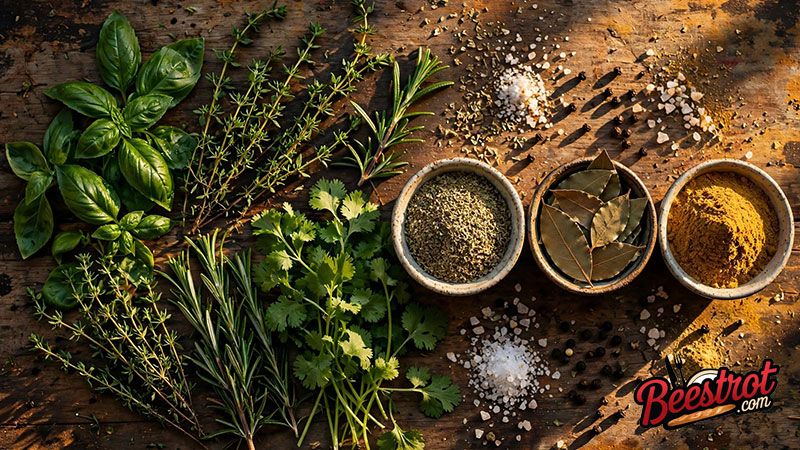
The recipe said two tablespoons of fresh basil. I had a jar of dried basil in the cupboard. I used it. The dish came out tasting of nothing in particular, a faint green suggestion where something vivid should have been. I did not understand what I had done wrong for quite a long time, because no one had told me. Most recipes do not explain. They assume you already know, or they assume it does not matter. It matters considerably.
There is a rule that professional cooks learn early and home cooks mostly piece together by accident over years of cooking. It is not complicated. It is not a secret. It is simply never written down in the place where it would be most useful, which is at the top of every recipe that calls for herbs.
What Heat Does to an Herb
Fresh herbs contain aromatic compounds, the volatile oils that give each plant its character. These compounds are called volatile for a reason. They evaporate. Apply heat, and they begin to leave. Apply sustained heat over thirty minutes, and most of what made the herb interesting is gone. What remains is a muted, sometimes slightly bitter echo of the original.
This is why tender fresh herbs, basil, parsley, tarragon, cilantro, chervil, belong at the end of cooking or not in the heat at all. Add them in the last thirty seconds. Scatter them over the plate. Fold them in after the pan comes off the flame. They are not there to cook. They are there to arrive.
Dried basil is perhaps the clearest illustration of the rule. The drying process that works well for hardy herbs destroys basil almost entirely, leaving behind a faint, dusty approximation that has almost no relationship to the fresh leaf. Professional kitchens rarely stock dried basil for this reason. When a sauce needs basil, they add fresh leaves at the end. When fresh basil is unavailable, they rethink the dish.
Hardy herbs are different. Thyme, rosemary, sage, oregano, bay leaf: the structure of these plants holds up under heat. Their aromatic compounds are more stable. You can add a sprig of thyme to a braise at the beginning and it will still be contributing flavor two hours later. Rosemary goes into the roasting pan with the lamb from the start. These herbs are built for the long cook.
Why Dried Can Be Better
There is a tendency to treat fresh as automatically superior to dried, and for tender herbs this is true. For hardy herbs, the picture is more complicated, and in certain cases the dried form is not just acceptable but preferable.
Dried oregano is the clearest example. The drying process concentrates certain compounds in oregano and transforms others, producing a flavor that is deeper, more resinous, and more complex than the fresh leaf. This is why the dried version is standard in southern Italian and Greek cooking. A Neapolitan pizza margherita uses dried oregano. A Greek salad dressing uses dried oregano. Using fresh oregano in these dishes would give you something technically correct but culinarily wrong.
The standard conversion ratio taught in culinary training is one teaspoon of dried herb for every tablespoon of fresh, a 1:3 ratio that accounts for the concentration of flavor that occurs when water is removed during drying. This ratio is a starting point, not a fixed law. Dried oregano punches harder than dried thyme. The best approach is to taste as you go, but the ratio keeps you from adding three times too much on the first pass.
Bay leaf is another case where dried is standard. Fresh bay leaves, particularly European bay laurel, can carry a slightly sharp, almost medicinal edge that mellows significantly with drying and cooking. Most professional kitchens keep dried bay leaves. The fresh ones appear occasionally, but the dried version is what goes into the stock, the braise, the bechamel.
The Bloom Technique
The single most misused herb in home cooking is dried parsley. It has almost no flavor in its dried form, contributes nothing to a dish, and gives a faint dusty green color that professional cooks associate with neglect. Every recipe that calls for dried parsley as a garnish or a seasoning would be improved by simply leaving it out. Fresh parsley, by contrast, is one of the most useful herbs in the kitchen: bright, clean, and able to lift almost anything it touches.
There is a third moment for dried herbs that most recipes skip entirely: the bloom. Before adding any liquid to a pan, after the aromatics have softened in oil or butter, dried herbs can be added directly to the fat for thirty seconds to a minute. The fat draws out the volatile oils that remain in the dried herb and distributes them through the dish in a way that adding them to liquid later never quite achieves.
This is standard practice in professional kitchens. A pinch of dried thyme goes into the oil with the onions before the broth arrives. Dried herbes de Provence meet the butter before the chicken. The technique takes almost no additional time and changes the depth of the final dish noticeably. The Flavor Bible by Karen Page and Andrew Dornenburg is the reference book for understanding why certain flavors work together, and the logic of the bloom fits directly into its framework: fat is a carrier of flavor, and using it deliberately to carry dried herbs into a dish is a small technique with outsized results.
Reading a Recipe Differently
Once the rule is understood, recipes become easier to read. When a recipe lists fresh thyme added at the start of a two-hour braise, you know it means the herb is there for structure and that dried will work as well or better. When a recipe lists fresh parsley scattered over the finished dish, you know the herb is there for brightness and that dried would give you neither the flavor nor the color. The recipe did not explain this. It assumed you knew. Now you do.
Samin Nosrat’s Salt, Fat, Acid, Heat approaches cooking through the lens of fundamental principles rather than individual recipes, and the fresh-versus-dried question fits neatly into that framework. Understanding why something works means you no longer need to memorize which herbs behave which way. The logic is simple enough to carry everywhere: tender herbs finish, hardy herbs cook, dried herbs bloom.
Mark Diacono’s Herb: A Cook’s Companion goes herb by herb through the full range of culinary plants, covering how each one grows, what it tastes like at different points in its life, and how cooking changes it. It is the book to read when you want to go past the rule and into the plant itself.
The jar of dried basil is still in many kitchens. It is not wrong to have it there. It is wrong to use it where fresh basil belongs, and to use fresh thyme where dried would serve better. The distinction between the two is not a matter of preference. It is a matter of understanding what an herb actually does, and when.
Every spice carries a world inside it. I am just learning to listen.
Jean Louis


Sources
- The Best Herbs for Cooking, Serious Eats
- Fresh vs. Dried Herbs, The Kitchn
- Fresh vs. Dried Herbs, America’s Test Kitchen
- Fresh vs. Dried Herbs, Bon Appetit