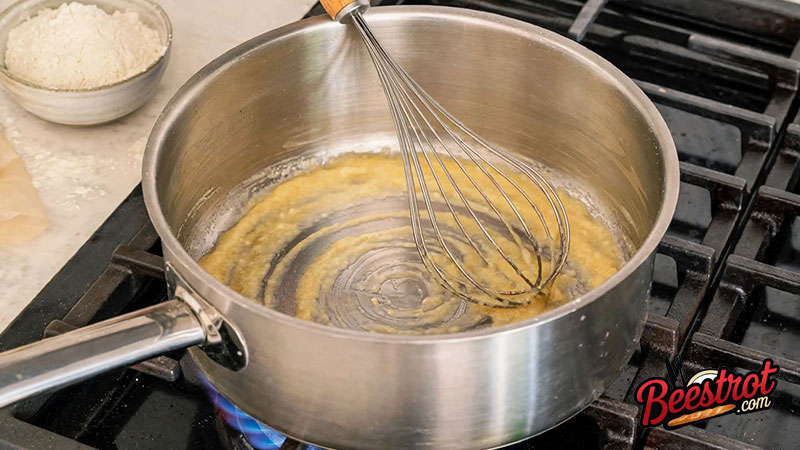
There is a moment in professional cooking school, usually in the first week, when the roux is explained. It takes about five minutes. After those five minutes, a substantial portion of classical French sauce-making makes sense in a way it did not before. The roux is not a secret and it is not complicated. It is two ingredients in a specific ratio, cooked together in a specific sequence, and it is the structural foundation of béchamel, velouté, espagnole, and dozens of sauces derived from them. Most home cooks have been making those sauces, or trying to, without anyone explaining what the roux is actually doing.
The ratio is equal parts fat and flour by weight. Not by volume: by weight. A tablespoon of butter and a tablespoon of flour are not equal by weight because flour is less dense than butter. The professional cook weighs both. At home, the closest practical approximation is to use the same number of tablespoons and accept a slight imbalance, but knowing the principle is weight-based changes how you think about scaling. Double the sauce, double both ingredients by the same factor. The ratio holds regardless of quantity.
What Happens When Fat Meets Flour Over Heat
The function of the roux is to thicken liquid without producing lumps. Raw flour added directly to a hot liquid clumps immediately: the starch granules on the outside of each flour particle absorb liquid and swell before the ones on the inside can separate, producing small dense masses that no amount of whisking will fully dissolve. Cooking the flour in fat first coats every starch granule in a layer of fat that slows its absorption of liquid. When a roux-thickened sauce is made correctly, each starch granule absorbs liquid gradually and evenly, swells uniformly, and produces a smooth, continuous texture rather than a lumpy one.
The fat also matters for flavour. Butter is the classic choice for most French applications because it contributes flavour of its own, the milk solids browning gently during the cooking process and adding a faint nuttiness to even a white roux. Clarified butter or oil is used when a neutral fat is preferred or when the roux needs to cook longer without the milk solids burning. Animal drippings are used for specific applications: a chicken roux for a chicken velouté, a beef dripping roux for a brown sauce. The fat is not just a cooking medium. It is a flavour decision.
Julia Child, Simone Beck, and Louisette Bertholle, in Mastering the Art of French Cooking, give the roux its proper structural position at the beginning of their sauce section and return to it repeatedly as they build through the classical sauce hierarchy, making clear that understanding the roux is not optional for anyone who wants to understand how French cooking works at a technical level. Their instruction is characteristically precise: the fat and flour must be cooked together long enough for the flour to lose its raw taste, but not so long that the roux darkens beyond the intended colour. The timing, they note, is a matter of observation, not of a timer.

OXO Good Grips Handheld Mandoline Slicer
Paper-thin slices in seconds — cucumbers, potatoes, zucchini, fennel. The kind of prep tool that makes you feel like a real chef.
View on Amazon
The Three Stages and What They Produce
A roux is not a single thing. It is a spectrum with three recognized stages, each producing different results. A white roux, cooked for one to two minutes only, is pale and barely coloured. It has a mild flavour and the full thickening power of the flour’s starch. It is used for béchamel and other cream-based sauces where a clean, neutral flavour is essential. A blond roux is cooked slightly longer, to a pale golden colour, and has a faintly nutty flavour. It is used for veloutés and other pale sauces. A brown roux is cooked until it reaches a deep brown colour with a pronounced nutty, almost toasted flavour. It is the base for espagnole and for Cajun and Creole gumbo, where the roux is cooked far longer than any French classical application would require.
The trade-off as colour develops is thickening power. The longer the roux cooks, the more the starch granules break down, reducing their capacity to absorb liquid. A brown roux thickens less than a white roux for the same quantity of fat and flour. Recipes that call for a brown roux compensate by using more of it. This is not a defect in the technique. It is the exchange: you trade thickening efficiency for depth of flavour, and you adjust the quantity accordingly. Knowing this makes it possible to modify a recipe intelligently rather than following it blindly.
James Peterson, in Sauces: Classical and Contemporary Sauce Making, covers the roux across multiple sauce families and addresses the thickening-power trade-off explicitly, noting that professional cooks calibrate the amount of roux in a recipe based not just on the desired consistency but on how far the roux has been cooked and what the sauce is meant to accompany. His treatment of the subject makes clear that the roux is not a fixed formula but a variable with several moving parts, and that a cook who understands those parts can produce the right sauce consistently rather than hoping the recipe works on a given day.
Where Home Cooks Lose the Sauce
Two mistakes account for most failed roux-based sauces at home. The first is adding cold liquid to a hot roux, or hot liquid to a cold roux. The temperature differential causes the starch to seize unevenly. The correct technique is to add warm liquid to a warm roux, or room-temperature liquid to either. The addition should be gradual: a small amount of liquid at first, whisked vigorously until fully incorporated, then more added in stages. The sauce will appear to seize and then relax as each addition is worked in. This is normal. The final addition of the remaining liquid can be faster once the sauce has established its consistency.
The second mistake is not cooking the raw flour taste out. A roux that has been cooked for thirty seconds has a detectable floury flavour that persists through the finished sauce. One to two minutes of cooking over medium heat, stirring constantly, is sufficient for a white roux. The raw smell will shift to something faintly biscuit-like when the flour is cooked. This is the cue to proceed, not the clock.
Jacques Pepin, in Jacques Pepin: New Complete Techniques, demonstrates the roux with the economy of motion that characterises his teaching: minimal equipment, direct observation, and the insistence that technique is learned through repetition rather than through reading. His point about the roux is simple and correct: the cook who makes it ten times understands it in a way that the cook who reads about it ten times does not. The ratio is memorizable in thirty seconds. The feel of a correctly made roux, how it moves in the pan, when it smells right, when the liquid is incorporating properly, comes from time at the stove, not from a recipe.
Why It Belongs in Every Kitchen
The roux is not a technique for special occasions or for ambitious weekend cooking. It is a ten-minute skill that unlocks a category of sauce-making that most home cooks treat as either too difficult or too mysterious to attempt. Béchamel is a white roux with milk. Mornay is a béchamel with cheese. Velouté is a blond roux with stock. These are not different techniques. They are the same technique with different liquids. The cook who understands the roux does not need a separate recipe for each one.
The two ingredients are fat and flour. The ratio is equal parts by weight. The sequence is fat first, then flour, then liquid added gradually to a warm base. The variables are how long you cook the roux, what fat you use, and what liquid you add. Everything else follows from those decisions. Five minutes to understand it, a few attempts to feel comfortable with it, and then it is simply part of how you cook.
A recipe is a promise. A technique is the truth behind it.
Jean Louis


Sources
- Roux, Wikipedia
- Bechamel sauce, Wikipedia
- Veloute sauce, Wikipedia
- Espagnole sauce, Wikipedia
- Maillard reaction, Wikipedia
More Delicious Reads

The Michelin Star Was Invented to Sell Tyres. The Brothers Had No Interest in Food.

The Industry Convinced You Breakfast Is the Most Important Meal of the Day. It Was an Ad Campaign.
Tabasco Sauce Was Born on a Louisiana Island After the Civil War. The Recipe Has Not Changed Since 1...
The Temperature Secret That Separates Professional Cooking From Everything Else.
The Potato Changed the Course of European History. Without It the Industrial Revolution Probably Doe...
You Have Been Cooking Scrambled Eggs Wrong. Here Is How Every Chef Actually Does It.
The Knife Skill That Changes Everything. Most Home Cooks Never Learn It Because Nobody Shows Them.
The Best Ingredient I Ever Added to My Kitchen Had Nothing to Do with Food
Your Steak Will Never Taste Like a Restaurant Steak. Unless You Do This One Thing Differently.