Last Updated on October 8, 2026 by Jean Louis
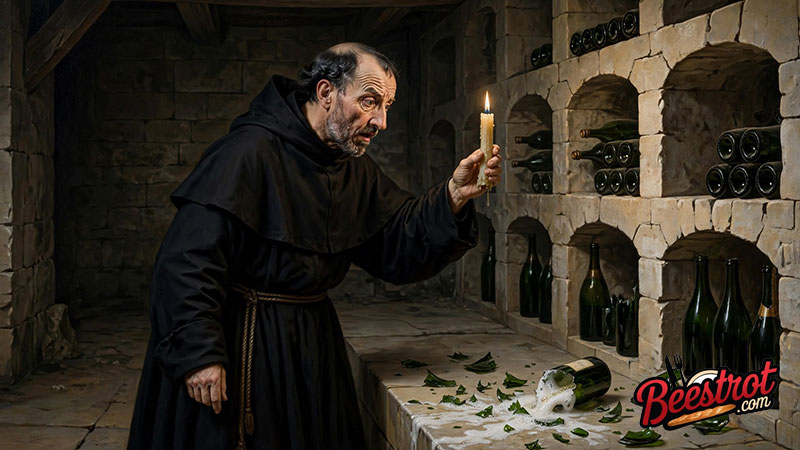
Pierre Perignon was a problem solver. He was also, by all accounts, a meticulous and deeply serious man. In 1668, he became the cellar master at the Benedictine Abbey of Hautvillers in the Champagne region of France, and he immediately set about addressing what the local winemakers considered their most pressing and embarrassing problem.
Their wine kept exploding.
Every spring, as temperatures in the cellars rose, bottles that had been sealed over winter would spontaneously burst. The cause was a secondary fermentation happening inside the sealed bottle, producing carbon dioxide that had nowhere to go. The pressure built until the glass gave way. Winemakers called it the diable, the devil, and they hated it. Broken bottles meant lost wine, lost money, and the constant danger of a chain reaction in which one exploding bottle triggered its neighbours in a cascade of destruction. A bad spring could wipe out a significant portion of a cellar.
Pierre Perignon spent years trying to stop this from happening. He experimented obsessively with blending grapes from different vineyards to produce a more stable wine. He developed techniques for filtering and fining the wine to reduce the residual sugars that fed the secondary fermentation. He was one of the first winemakers to use cork stoppers systematically, which he held in place with wire, partly as a way of containing the pressure when he could not prevent it entirely. He was trying, with every tool available to him, to make a still wine of exceptional quality. The bubbles were not part of the plan. They were the enemy he never quite defeated.
Meanwhile, across the Channel in England, something important was happening. English glassmakers had developed a stronger bottle than anything produced in France, using coal-fired furnaces that produced higher temperatures and denser glass. English merchants who imported wine from Champagne had noticed that the wine sometimes arrived with a slight effervescence and found, to their surprise, that they rather enjoyed it. They began deliberately bottling the wine in winter before the secondary fermentation had finished, trapping the bubbles on purpose. The English, not the French, were the first to drink sparkling wine intentionally.
It was an Englishman, Christopher Merret, who in 1662 presented a paper to the Royal Society describing the deliberate addition of sugar and molasses to wine to produce a second fermentation in the bottle. This is the process now known as the methode champenoise. Merret described it fourteen years before Dom Perignon joined the abbey. The French had the grapes, the English had the technique, and the man whose name ended up on the label was trying to eliminate the whole phenomenon.
The famous quote attributed to Dom Perignon, upon tasting sparkling wine for the first time, is: “Come quickly, I am drinking the stars.” It is beautiful. It is also almost certainly invented. No contemporary source records it. The earliest known appearance of the phrase dates to an 1821 advertisement for Moet champagne, more than a century after Perignon’s death. By then, the Champagne houses had understood that the story of a visionary monk discovering effervescence by accident was considerably better for business than the more accurate story of an English scientific paper and a wine problem that nobody intended to solve. The marketing invented the moment. The moment became the history.
What Dom Perignon did contribute, and it was genuinely significant, was an extraordinary palate and a systematic approach to blending. He is widely credited with being among the first to blend grapes from multiple plots to achieve consistency and complexity, and his still wines were considered among the finest in the region. He also worked with thicker bottles and improved cork techniques that made it more practical to handle the pressure when bubbles were present. He did not invent champagne. He invented the conditions under which champagne could eventually become reliable.
The transformation of sparkling wine from a winemaking defect into a luxury product took most of the 18th century, driven largely by the Champagne houses and by the French court, where the effervescence became fashionable among aristocrats who had the thick English bottles to drink it from safely. By the time of Louis XIV, champagne was a status symbol. By the time of Napoleon, it was a military tradition. The emperor allegedly said he needed champagne whether in victory or defeat, in the first case to celebrate, in the second to console himself.
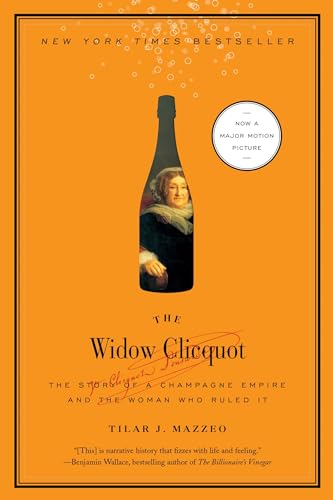
The real genius of what happened in Champagne is not the accidental discovery of bubbles. It is the century of work that followed, transforming an unpredictable defect into a controlled, reproducible product of extraordinary quality. The riddling racks, the dosage, the disgorgement, the specific blend of pinot noir and chardonnay, the second fermentation managed to precise tolerances: all of this came later, most of it in the 19th century, much of it due to the Widow Clicquot, who invented the riddling rack in 1816 and transformed champagne production from an art into an industry. She is the reason your champagne is clear rather than cloudy. She deserves at least as much credit as the monk who was trying to stop the whole thing.
Pierre Perignon died in 1715. He spent 47 years at Hautvillers working on his wine. His still wines were celebrated. His sparkling wines, the ones that escaped his control, became one of the most recognised products on Earth. His name is on a bottle that sells for hundreds of euros and is opened at every celebration worth calling one.
He would have found the whole thing deeply ironic. Or perhaps, by the end, he had made his peace with the devil.
The kitchen never lies. History sometimes does.
Jean Louis
Every dish has a past. These books will take you further into it.

Sources
- BBC Future. The Surprising Truth About Who Invented Champagne. Christopher Merret 1662, English bottles, Dom Perignon revisionist history.
- Decanter. Dom Perignon: Fact and Fiction. 1821 Moet advertisement, “drinking the stars” origin, what Perignon actually contributed.
- Smithsonian Magazine. The History of Champagne’s Bubbles. Diable problem, English glass technology, Widow Clicquot riddling rack 1816.