Last Updated on October 13, 2026 by Jean Louis
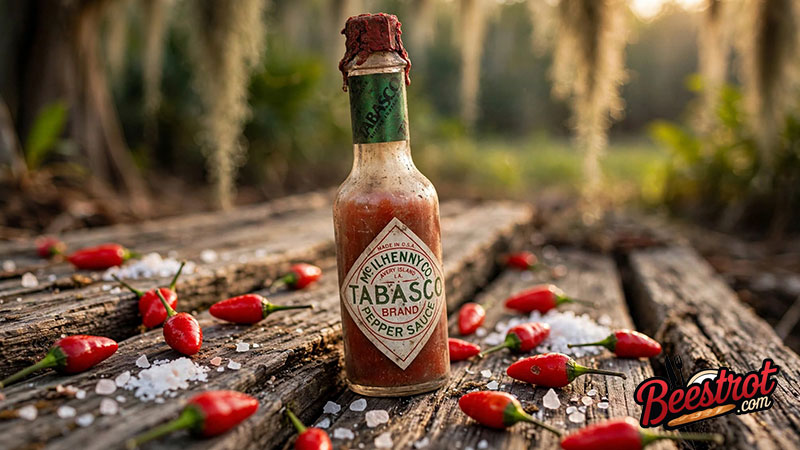
Avery Island is not really an island. It sits in the middle of the Louisiana bayou, a salt dome rising out of the flat marshland of Iberia Parish, connected to the mainland by a causeway. It is roughly two miles across. It has been owned by the same two families, the Averys and the McIlhennys, since before the Civil War. And it is where every drop of Tabasco sauce in the world has been made since 1868.
The story begins with Edmund McIlhenny, a Maryland-born banker who married into the Avery family and found himself on the island after the war with a ruined bank account, a surviving pepper plant, and not much else. The Union army had occupied Avery Island during the war. The salt mines beneath the island were strategically valuable. When the McIlhennys returned after the conflict, they found the plantation destroyed and the fields stripped. What survived, reportedly, were some capsicum pepper plants growing on the property before the war.
McIlhenny mashed the peppers. He added Avery Island salt. He aged the mash in small barrels. He added French white wine vinegar. He strained it, bottled it in cologne bottles sourced from a New Orleans supplier, and sent samples to 658 grocers and general stores around the country in 1868.
He received orders from most of them.
The Formula That Did Not Move
What McIlhenny had made was not complicated. Three ingredients: aged red pepper mash, Avery Island salt, distilled vinegar. The proportions were his. The aging process was his. The decision to strain it fine and bottle it small, like a condiment rather than a cooking sauce, was his.
The current McIlhenny Company, now in its fifth generation of family ownership, still harvests peppers, still salts the mash in the same ratio, still ages it in white oak barrels, still adds the same vinegar at the same proportion. The bottles changed. Everything inside is 1868.
The pepper seeds present a wrinkle. The Tabasco pepper, a variety of Capsicum frutescens, no longer grows in sufficient quantities on Avery Island itself. The climate has changed, the land is too small, and the demand is too large. McIlhenny Company now contracts pepper farmers in Central and South America, primarily in Honduras and Colombia, to grow the peppers. The seeds those farmers plant come from Avery Island. The mash those peppers produce is still aged on the island. The connection to the original plant is unbroken, just stretched across geography.
The Barrels Remember
The aging warehouse on Avery Island holds thousands of white oak barrels at any given time. These are not new barrels. They are former bourbon barrels, sourced from Kentucky distilleries, which impart a faint secondary character to the mash during the three-year rest. The barrels are inspected, repaired, and reused. Some of them have been in service for decades.
Each barrel is sealed with a layer of Avery Island salt after filling. The salt crust is checked periodically. If the salt crust cracks or shows unusual color, the batch is examined. This quality check is unchanged since McIlhenny devised it in the nineteenth century.
The master taster, a role that has existed in the company since the beginning, samples each batch before release. No instrument has replaced this. A human palate, trained over years, makes the final call on whether the mash is ready. The current master taster is a McIlhenny family member.
What the Civil War Made Possible
There is a version of this story in which Tabasco does not exist. If the Union army had not occupied Avery Island, the McIlhenny fortune might have survived intact and Edmund might have returned to banking. If the pepper plants had not survived, there would have been nothing to work with.
The war that wrecked the plantation produced the sauce. Destruction left him with almost nothing except a patch of surviving peppers and enough desperation to try something new.
By 1870 McIlhenny had a patent. By 1872 he had opened a London office. Tabasco was on Royal Navy ships before the end of the nineteenth century, which meant it circled the globe on the same vessels that moved the British Empire. It was in soldiers’ kits in both World Wars.
It is in the International Space Station’s food supply today. One of the few condiments approved for use in microgravity, because its viscosity does not float in drops that could damage equipment. A bottle of pepper sauce made on a Louisiana salt dome travels to orbit.
All of that came from a man with leftover peppers and a borrowed cologne bottle, mixing something in a ruined Louisiana plantation in 1868. The recipe has not changed. The island is still there. The barrels are still aging.
Every dish has a past. These books will take you further into it.
Jean Louis