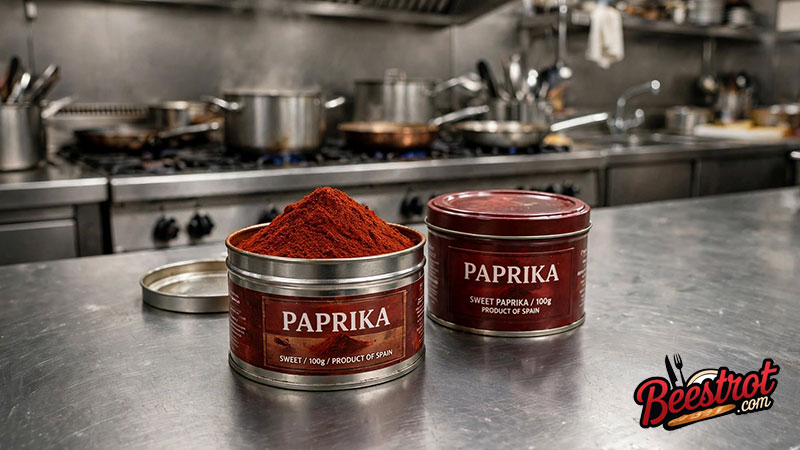
The tins look nearly identical. Both are red, both say paprika on the label, and in a supermarket spice aisle they sit two inches apart. Most home cooks reach for whichever one is closer. The dish they make will be fine. But it will not be what the recipe intended, and the cook will never quite understand why something is missing. Smoked paprika and sweet paprika are made from related peppers and share a name and a color. Everything else about them is different, and the difference is not subtle once you know what to taste for.
Where Sweet Paprika Comes From
Sweet paprika, the version that dominates Hungarian cooking and fills most European spice racks, is made from fully ripened Capsicum annuum peppers that are dried in air and then ground. The seeds and inner veins, which carry most of the heat, are largely removed before grinding. What remains is a powder that is bright brick-red, faintly sweet, and built almost entirely for color. The flavor it brings to a dish is mild and slightly fruity. It does not assert itself. It gives a goulash its characteristic deep red without introducing any competing note that might disturb the balance of the broth.
Hungary became the defining source of this style of paprika after the pepper arrived in Europe from the Americas in the sixteenth century, traveling through the Ottoman Empire before taking root in Central European kitchens. Jack Turner traces the larger history of how spices moved through the world in Spice: History of a Temptation, and the paprika story fits the broader pattern he describes: a plant that originated far from where it would become culturally essential, transformed by the people who adopted it into something their neighbors could not have imagined.
Sweet paprika is made from air-dried, fully ripened Capsicum annuum peppers with seeds and veins removed. Its flavor is mild and slightly fruity. Its primary function in the kitchen is color. It does not smoke, it does not heat, and it does not carry the deep earthy complexity that distinguishes its Spanish counterpart.
Where Smoked Paprika Comes From
Smoked paprika, known in Spain as pimenton, is a different process entirely. The peppers are harvested in the autumn in the La Vera region of Extremadura, in western Spain, and then dried slowly over smoldering oak wood for ten to fifteen days. During that time, the smoke penetrates the flesh of the pepper completely before it is ground. The result is not paprika that has been flavored with smoke as an afterthought. The smoke is structural. It is built into every particle of the powder at a molecular level, and no amount of ordinary paprika with liquid smoke stirred in will replicate it.
Pimenton de la Vera holds a Protected Designation of Origin, which means that legally, the name can only be used for paprika produced in that specific valley using that specific method. The oak smoking gives the final product a flavor profile that is simultaneously sweet, earthy, and faintly meaty, a quality that makes it extraordinarily useful in vegetarian and vegan cooking. Lior Lev Sercarz, who profiles individual spices in depth in The Spice Companion, notes that smoked paprika carries compounds from the Maillard reaction that give it this meaty character, something no unsmoked paprika can produce.
Pimenton de la Vera, Spain’s Protected Designation of Origin smoked paprika, is produced by drying peppers over oak fires for ten to fifteen days before grinding. The smoking is not a finishing step. It is the defining step, and the resulting compounds are irreplaceable by any blending or additive method.
What Happens When You Swap Them
The mistake goes in both directions. A recipe for patatas bravas or Spanish chorizo that calls for smoked paprika and receives sweet paprika instead will produce a dish that is technically correct in color and structure but missing its defining characteristic. The smokiness in a proper patatas bravas is not decoration. It is the dish. A romesco sauce made with sweet paprika tastes like tomato. Made with smoked paprika it tastes like Spain. The reverse substitution also fails: Hungarian goulash made with smoked paprika develops a smoky intensity that overwhelms the slow-cooked beef, competing with the broth rather than deepening it.
Nik Sharma explores how individual flavor compounds interact and compound in Season: Big Flavors, Beautiful Food, and the paprika distinction fits his central argument: the difference between good and extraordinary cooking often lies in understanding not just what an ingredient is, but what it does and why. Smoked paprika and sweet paprika are not interchangeable any more than butter and ghee are interchangeable. They come from the same source. What has been done to them since changes everything about how they behave in a pan.
How Each One Belongs in the Kitchen
Sweet paprika belongs with fat and heat, ideally at the beginning of cooking. Hungarian technique calls for blooming paprika in oil or lard before adding any liquid, a step that activates the fat-soluble pigments and flavor compounds and prevents the bitterness that raw paprika can develop. It cannot handle very high heat for long periods without scorching and turning acrid, which is why experienced cooks add it off the heat or with immediate liquid to follow. Its role is to color and to provide a backdrop of mild sweetness against which other flavors can develop.
Sweet paprika should be bloomed in fat before liquid is added. Smoked paprika can be added at any stage and holds its character through longer cooking. Both scorch at very high heat and turn bitter. The difference is that smoked paprika, once it scorches, loses something that cannot be replaced; sweet paprika loses mostly color and softness.
The Version Worth Buying
For smoked paprika, the label matters more than it does for almost any other spice. Generic smoked paprika from a large commercial producer is often made with artificial smoke flavoring applied to ordinary paprika, which produces a shrill, one-dimensional smokiness without the underlying sweetness and complexity of the real thing. Look for pimenton de la Vera with the PDO designation, and within that category, choose dulce (mild) for general cooking, agridulce (medium) when the dish has enough body to handle more intensity, and picante (hot) only when the recipe calls for heat as well as smoke. La Chinata is widely available and consistently reliable. For sweet paprika, Hungarian origin is a reasonable quality signal, and the tin should smell of sweet pepper, not dust.
The two tins can live on the same shelf. They should. But they cannot do each other’s work, and treating them as though they can is the small, persistent mistake that explains why a dish keeps coming out almost right but never quite there.
Every spice carries a world inside it. I am just learning to listen.
Jean Louis


Sources
- Paprika, Wikipedia
- Pimenton, Wikipedia
- Capsicum annuum, Wikipedia
- Hungarian Cuisine, Wikipedia
- La Vera, Wikipedia