 The bottle sitting in most kitchens has a label that has barely changed in nearly two centuries. The sauce inside is dark, pungent, and deeply savory in a way that is difficult to describe precisely because it has no obvious single flavor. It contains anchovies, and tamarind, and molasses, and vinegar, and a mixture of spices the company still does not publish in full. What it also has, though the label does not mention this, is an origin story involving a barrel that was left in a cellar and very nearly thrown away.
The year was 1837. The place was Worcester, England. The chemists were John Wheeley Lea and William Henry Perrins.
The Recipe That Came Back From India
The story begins with a request. A nobleman, most accounts name him as Lord Marcus Sandys, a former Governor of Bengal, walked into the pharmacy of Lea and Perrins on Broad Street in Worcester with a recipe he had brought back from India. He wanted the chemists to reproduce it. The recipe was for a sauce he had encountered during his time in the subcontinent, something built from fermented ingredients and spices that had long been common in Bengali cooking. He wanted it made up. He wanted to taste it again.
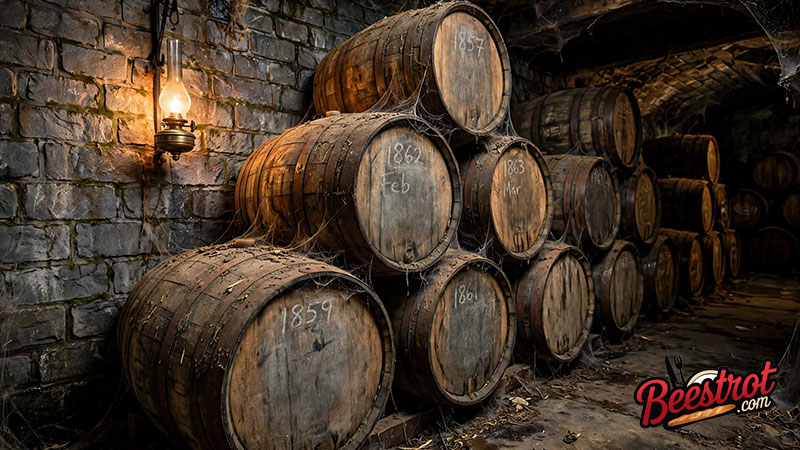
Lea and Perrins made it up. They followed the recipe. The result, by all historical accounts, was not what anyone had hoped for. The sauce was sharp, pungent, and not particularly pleasant to eat. It was not what the nobleman remembered. It was not, apparently, what anyone wanted. A quantity was left over after the initial batch, and rather than discard it immediately, the barrels were moved to the cellar and forgotten.
This is where the accident begins.

KitchenAid 5-Speed Ultra Power Hand Mixer
Whip cream, beat eggs, mix batter in half the time. Lightweight, powerful, and comes in every colour your kitchen deserves.
View on AmazonThe Barrel Nobody Opened
Somewhere between one and two years later, Lea and Perrins were clearing out their cellar. They found the barrels. The question of whether to dispose of them came up. Someone opened one first.
The sauce inside was not what they had made. The long fermentation, the time in the barrel, the interaction between the anchovies and the vinegar and the tamarind had done something that no recipe had intended. The sauce had matured. The sharp edges had softened. The flavors had integrated into something complex and deeply savory, the kind of thing that is easier to taste than to describe, and that the word umami, coined much later, begins to approach but does not fully capture.
Lea and Perrins tasted it. They did not throw it away.
Harold McGee, in On Food and Cooking, explains that fermented fish sauces have been made and valued since ancient Rome, where garum, a sauce produced by salting and fermenting fish over months, was used as a fundamental seasoning across the empire. The same transformation that made garum is what made Worcestershire: time, salt, and anaerobic fermentation converting proteins into glutamates, producing the savory depth that is now understood as umami. The chemists who left their barrel in the cellar were not innovating. They were accidentally repeating something the ancient world had known for centuries.
What Fermentation Actually Did
The key ingredient in Worcestershire sauce is anchovies. This surprises people who do not read labels, and it surprises vegetarians who assume a bottled condiment sold in every supermarket is likely to be animal-free. The anchovies, packed in salt, undergo a slow enzymatic breakdown during the aging process. The proteins dissolve. The fish flavor mostly disappears. What remains is glutamate, the molecule responsible for the savory quality that makes the sauce taste as though it deepens everything it touches.
The tamarind contributes acidity and a faint fruitiness. The molasses adds depth and a little sweetness. The vinegar preserves and brightens. The spices, whatever they are, add complexity. None of these things, combined and tasted immediately, produces the finished sauce. Time is the ingredient the recipe does not list.
Tom Standage, in An Edible History of Humanity, traces how fermented condiments shaped trade routes and culinary cultures across the ancient world, arguing that the appetite for deeply savory flavors is not a modern preference but a consistent thread through human food history. The sauce Lord Sandys brought back from Bengal was itself descended from a tradition of fermented fish sauces that had moved from Rome through the spice routes to the Indian subcontinent over centuries. The Worcester chemists were not creating something new. They were receiving something very old.
How a Pharmacy Became a Factory
Lea and Perrins began selling the sauce in 1838. The initial market was local: grocers in Worcester and the households of people who had already tasted it. The response was good enough to justify continued production. The recipe was kept internal. The aging process, the two years in the barrel that had been an accident the first time, became the method.
What drove the spread of Worcestershire sauce beyond its local origins was, in large part, the British merchant navy. Sailors carried bottles on voyages. The sauce appeared in the kitchens of British colonists in India, in Australia, in the Caribbean, in North America. The word spread that it made meat taste better, that it improved stews and soups, that it was worth seeking out. By the mid-nineteenth century it was being exported. By the end of the century it was globally recognized.
Mark Kurlansky, in Salt: A World History, describes how salt-based preservation technologies shaped trade and empire as much as any spice, because preserved food meant ships could travel further and armies could move faster. Worcestershire sauce, built on salted anchovies and vinegar, was a product of the same logic: a dense, shelf-stable, intensely flavored ingredient that survived long voyages and rewarded the cook who used it. It traveled well because the fermentation that made it had designed it, without anyone intending this, to do exactly that.
The Recipe That Was Never Published
The full ingredient list of Worcestershire sauce has never been officially released by Lea and Perrins. The company, now owned by Kraft Heinz, maintains that the precise spice composition is a trade secret. What is known is that the sauce contains malt vinegar, spirit vinegar, molasses, sugar, salt, anchovies, tamarind extract, onions, garlic, spice, and flavoring. The last two categories cover whatever it is that makes the sauce taste the way it does.
The barrel that was nearly discarded in 1837 started something that now produces hundreds of millions of bottles a year. The cellar in Worcester is long gone. The pharmacy on Broad Street is now something else entirely. But the sauce that came out of that barrel is still being made, still aged before bottling, still following a process that was an accident before it was a recipe.
Every dish has a past. I am just following it back to the beginning.
Jean Louis


Sources
- Lea and Perrins, Our Story (official)
- Worcestershire sauce, BBC Food
- Worcestershire sauce, Encyclopaedia Britannica
- The accidental invention of Worcestershire sauce, Atlas Obscura
- Worcestershire sauce, Wikipedia
More Delicious Reads

How to Boil an Egg Perfectly (Tutorial with Timers & No Cracks)
Professional Kitchens Never Use Extra Virgin Olive Oil for Cooking. Here Is What They Use Instead.

McDonald's: The Brothers, The Salesman, and the Burger That Ate the World
Mayonnaise Was Almost Certainly Invented During a Military Siege. No Kitchen Was Involved.

The Michelin Star Was Invented to Sell Tyres. The Brothers Had No Interest in Food.
The Temperature Secret That Separates Professional Cooking From Everything Else.
Fresh vs. Dried Herbs. The Rule Every Professional Cook Knows and Nobody Teaches.
Coffee Was Banned in Three Continents at Different Points in History. The Reasons Were Always Politi...

The Croissant Is Not French. Jean Louis Has Strong Feelings About This.