Pad Thai
Click here to learn about our image policy and how to submit your own!
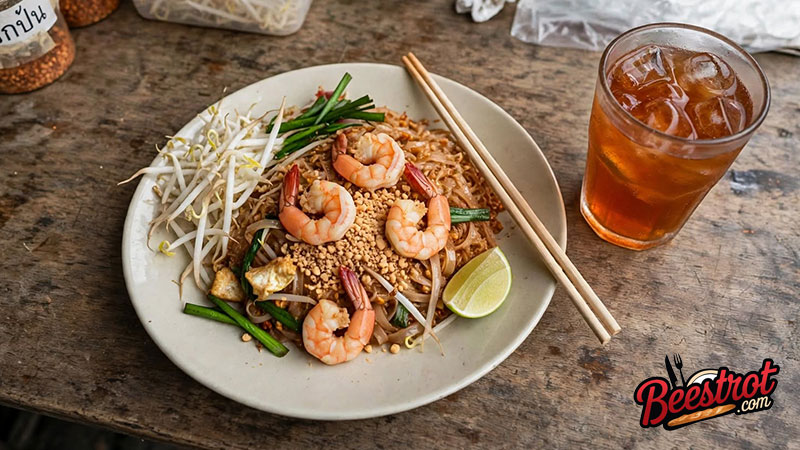
Pad Thai is Thailand's most famous export and the dish that introduced an entire generation of Westerners to Southeast Asian cooking. Despite its global ubiquity, the real version - stir-fried rice noodles with egg, prawns or tofu, tamarind paste, fish sauce, and a crown of crushed peanuts - is still revelatory when made properly at home. The dish was actually promoted by the Thai government in the 1930s as a national identity dish, replacing Chinese noodle dishes with something distinctly Thai. That a government food campaign produced one of the world's most beloved recipes is one of culinary history's better accidents.
Time & Quantities
Method & Ingredients
Required Equipment: Wok or large skillet, wok spatula, small bowl for sauce
Clever little kitchen tools that cost less than your last takeout.
The kind of find that makes you wonder how you cooked without it. Useful, affordable, ships fast.
Browse Kitchen FindsCooking Method: Stovetop - Sauteing
Ingredients
- 250g dried thin rice noodles (sen lek)
- 300g raw prawns (peeled and deveined)
- 3 eggs
- 150g firm tofu (pressed and cubed)
- 3 shallots (sliced)
- 3 garlic cloves (minced)
- 3 tbsp tamarind paste
- 3 tbsp fish sauce
- 1 tbsp oyster sauce
- 2 tsp palm sugar (or brown sugar)
- 3 tbsp vegetable oil
- 100g bean sprouts
- 3 spring onions (cut into 2 cm pieces)
- For serving: 80g roasted peanuts (roughly crushed)
- 1 lime (cut into wedges)
- dried chili flakes
- extra bean sprouts
- fish sauce on the side
Instructions
- Soak rice noodles in room-temperature water for 30 minutes until pliable but still firm - they will finish cooking in the wok. Do not use boiling water or they will turn to mush before they even meet the heat.
- Mix tamarind paste, fish sauce, oyster sauce, and palm sugar in a small bowl. Taste it - this is your entire flavor base and it should be a balance of sour, salty, and sweet. Adjust until it makes you close your eyes slightly.
- Heat wok over the highest heat your stove will produce. Add oil. When it just begins to smoke, add shallots and garlic and stir-fry 30 seconds.
- Add prawns and tofu, stir-fry 2 minutes until prawns are just pink. Push everything to the side of the wok.
- Crack eggs into the empty space, scramble briefly, then fold into the other ingredients before fully set.
- Add drained noodles and pour sauce over. Toss everything together vigorously for 2 minutes, letting the noodles absorb the sauce. If noodles stick, add a splash of water - not more sauce.
- Add bean sprouts and spring onions, toss 30 seconds. The sprouts should stay crunchy.
- Plate immediately and top with crushed peanuts, lime wedge, and chili flakes. Pad Thai waits for no one - eat it straight from the wok while the edges are still slightly crispy.
Storage & Make-Ahead
Storage Advice: Refrigerate up to 2 days. Noodles absorb moisture and clump when cold - reheat in a hot wok with a splash of water. Never microwave Pad Thai.
Make-Ahead & Freezing Tips: Not ideal for freezing - rice noodle texture degrades significantly. Make fresh for best results. Sauce mixture can be made ahead and stored refrigerated for 2 weeks.
Nutritional & Dietary Information
Nutritional Information:
- Calories: 480
- Protein: 28g
- Fat: 16g (Saturated: 3g)
- Carbohydrates: 56g (Fiber: 3g / Sugar: 8g)
- Vitamin A: 10% DV
- Vitamin C: 15% DV
- Calcium: 10% DV
- Iron: 14% DV
Allergen Information: Contains shellfish (prawns), eggs, peanuts (tree nuts), fish (fish sauce, oyster sauce), soy (tofu). Gluten in oyster sauce.
Dietary Information: Contains shellfish, eggs, peanuts, fish, and soy. Contains gluten from oyster sauce - use gluten-free oyster sauce or tamari to adapt. Not suitable for nut-free or shellfish-free diets without substitutions.
Serving & Variations
Serving Suggestions: Serve on a flat plate, never a deep bowl - Pad Thai needs surface area. Place peanuts, lime, chili, and extra bean sprouts in small dishes alongside so each person customizes their own bowl. A cold Thai iced tea alongside is the street-food way.
Wine or Drink Pairing: A cold Singha or Chang lager is the most authentic pairing - the light bitterness cuts through the tamarind sweetness perfectly. For wine, an off-dry Riesling from Mosel handles the sweet-sour-salty complexity without breaking a sweat.
Possible Recipe Variations: Beestrot Signature: Before plating, press the noodles flat against the hot wok surface for 30 seconds without stirring - this creates crispy caramelized edges on the bottom layer that add a textural dimension most restaurant versions skip entirely. Variations: Vegetarian Pad Thai - replace prawns with extra tofu and mushrooms, replace fish sauce with soy sauce. Chicken Pad Thai - substitute thinly sliced chicken thigh for the prawns. Pad Thai with Crab - use fresh blue swimmer crab meat for a luxurious version popular in coastal Thailand.
Additional Notes: Tamarind paste is the soul of Pad Thai - do not substitute lemon juice. Find it at any Asian grocery store. The high heat is non-negotiable: a timid flame produces steamed noodles, not stir-fried ones.