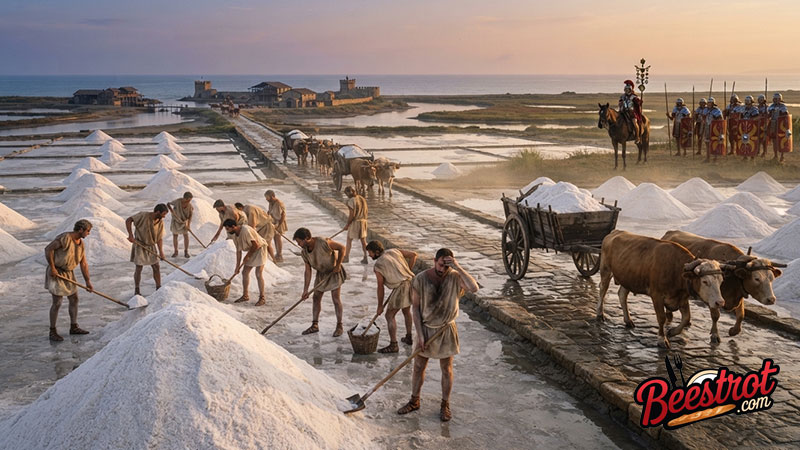
The price of salt at the market today is so small it barely registers on the receipt. A kilo of sea salt costs less than the pen used to price it. This was not always the case. There was a period in human history when the ability to control, distribute, or simply possess large quantities of salt determined the fate of armies, the borders of empires, and the vocabulary of civilizations that would not dissolve for another two thousand years.
The word salary, the one that appears on every paycheck ever issued, comes directly from the Latin word for salt.
That is not a coincidence. It is a measure of how central this mineral was to the world that invented the institution of paid work.
What Salt Actually Meant
Salt is a preservative. That sounds obvious from where we stand now. But in a world without refrigeration, without hermetic sealing, without the industrial food preservation systems that keep modern supply chains running, the ability to cure meat and fish was the difference between feeding an army and watching it starve before it reached the battlefield.
The Romans built roads specifically for salt transport. The Via Salaria, the Salt Road, ran from Rome to the Adriatic coast, where salt was harvested from the flats at Ostia. The same road that moved legions moved salt. The two were inseparable, because one without the other did not function over distance.

Instant Pot Duo 7-in-1, 6 Qt
Pressure cooker, slow cooker, rice cooker, steamer, sauté, yogurt maker and warmer, all in one. The kitchen workhorse that changed how millions of people cook.
View on AmazonSalt occupied the ancient Mediterranean alongside olive oil as one of the two essential commodities of the ancient world. Where olive oil lubricated, perfumed, and illuminated, salt preserved. The two dominated ancient trade for the same reason: everything that mattered, they made possible. Neither was optional.
The Romans built dedicated roads for salt transport. The Via Salaria ran from Rome to the Adriatic coast, where salt flats supplied the city and the legions. What moved armies also moved salt, because without salt, the armies could not be fed far from home.
The Salary
The Latin word salarium is the origin of the English word salary. The debate among classicists about whether Roman soldiers were literally paid in salt, or paid money specifically allocated for purchasing salt, has continued for centuries. What is not in dispute is that salt was sufficiently valuable that it anchored the language of compensation itself.
The historian Pliny the Elder wrote in Natural History that in early Rome, salt played a role in military pay. The exact form this took is contested. What is clear from Pliny and from several later Roman sources is that the connection between salt and military wages was real, well understood by Roman contemporaries, and significant enough to encode permanently in the word they invented for the concept of being paid.
The word did not drift toward salt by accident. Salt was chosen because it represented value that everyone understood and no one disputed. When you receive a salary today, you are using a word that a Roman administrator would have recognized immediately.
When Pliny the Elder wrote about salt in Natural History, he was describing something that soldiers, traders, and officials already thought about every day. The word salarium did not need explaining to a Roman. The idea that pay could be measured in salt made complete sense in a world where salt was essential and scarce.
The Empires That Built Themselves on the Right to Tax It
The French gabelle was a salt tax that ran, in various forms, from the fourteenth century to the Revolution. It was not a minor administrative measure. At its peak, the gabelle required all French subjects above a certain age to purchase a minimum quantity of salt per year at a government-fixed price, regardless of whether they needed it. Regions that produced their own salt were taxed at different rates from regions that did not, creating wildly unequal burdens across the country. Smuggling salt became one of the most common crimes in pre-Revolutionary France. The gabelle was named explicitly in the cahiers de doleances, the grievance lists drawn up before 1789.
The British salt tax in India operated on similar logic. When Gandhi chose to march to the sea in 1930 to make salt in defiance of the British monopoly, he was not selecting a symbol arbitrarily. Salt was taxed under colonial law. Poor Indians who could not afford the tax still required salt to survive. The act of collecting naturally occurring salt from the sea was illegal. Gandhi’s march to Dandi made the mechanism of extraction visible in a way that abstract arguments about sovereignty could not.
China operated one of the longest-running salt monopolies in recorded history, beginning during the Han dynasty and continuing in various forms for over two thousand years. The state controlled production, distribution, and pricing across a territory that fed hundreds of millions of people. Officials who administered the salt trade were among the most powerful in the imperial bureaucracy. Salt revenue financed wars, canals, and dynasties.
Gandhi did not choose salt as a symbol because it was poetic. He chose it because the British salt tax was a direct, measurable burden on the poorest Indians. The march to Dandi in 1930 made the mechanism of colonial extraction visible in a way that abstract arguments about sovereignty could not reach.
What Changed and What Did Not
Industrial salt production in the twentieth century collapsed the price so completely that the political logic of salt monopolies became impossible to sustain. When a commodity is cheap enough that everyone can afford it without restriction, taxing its existence becomes difficult to justify and even harder to enforce.
What did not change is salt’s role in food itself. The modern food industry depends on salt for the same reasons the Roman legions did: food preservation, flavor development, and the control of microbial activity in products that need to travel and sit on shelves. The function has not changed. The scarcity has.
The spice trade of the medieval period moved black pepper, cinnamon, and nutmeg across continents for some of the same reasons salt had moved along the Via Salaria: because flavor and preservation were worth enormous sums to people who could afford to pay. What spices and salt shared was not their chemistry but their position in the economy of necessity. Both were worth fighting for. Both built fortunes. Both fell.
Salt was not special in having been valuable. It was special in having been essential. The two are not the same thing, and history treats them very differently. What is merely valuable can be replaced. What is essential leaves a word behind.
Every dish has a past. I am just following it back to the beginning.
Jean Louis
Sources
- Online Etymology Dictionary, “salary”
- Encyclopaedia Britannica, “Gabelle”
- History.com, “Salt March”
- Pliny the Elder, Natural History, Project Gutenberg
More Delicious Reads

How to Grow Basil Indoors and Actually Keep It Alive Past Two Weeks.

Pizza Was Peasant Food Eaten With the Hands in the Street. The Version the World Loves Was Invented ...
The Fork Was Considered Sinful in Medieval Europe. The Church Had Opinions.

The Spice Trade Killed More People Than Most Wars. Nutmeg Was the Reason the Dutch Massacred an Enti...

The Knife Skill That Changes Everything. Most Home Cooks Never Learn It Because Nobody Shows Them.

Resting Your Meat Is Not Optional. Here Is What Actually Happens If You Skip It.

You Have Been Storing Your Spices Wrong. Here Is What a Chef Actually Does.

The One Ingredient Every Pastry Chef Adds to Desserts That Home Cooks Never Think Of.

Mayonnaise Was Almost Certainly Invented During a Military Siege. No Kitchen Was Involved.