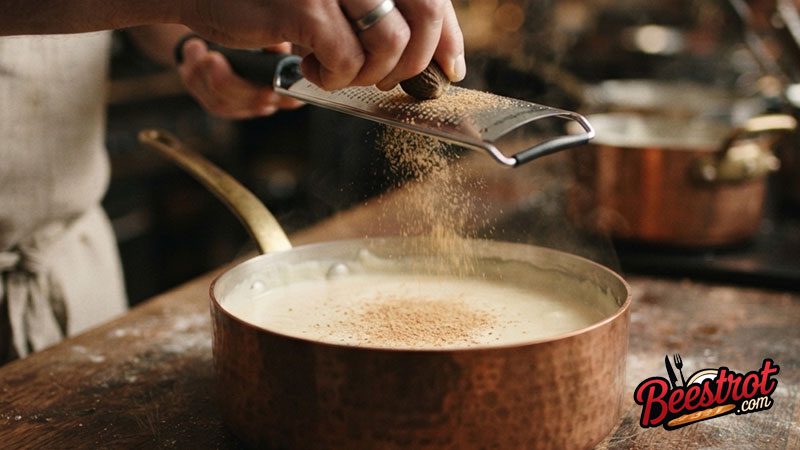
nut megThe jar of nutmeg at the back of most spice racks has been there for a long time. It smells of something distant, faintly sweet, and very faint indeed. Open a fresh whole nutmeg and grate it directly into a béchamel sauce, and the room changes. The two products share a name. They share almost nothing else.
This is not a matter of preference or habit. It is a matter of chemistry, and the chemistry is not subtle. What most home kitchens use as nutmeg is not really nutmeg any more. It is what nutmeg was, before the grinding and the packaging and the months of shelf time.
What Disappears When Nutmeg Is Ground
Nutmeg contains a family of volatile aromatic compounds: myristicin, elemicin, and several terpenes. These compounds are what give freshly grated nutmeg its distinctive warmth and floral character. They are also volatile, meaning they evaporate continuously into the air at room temperature. The moment the spice is ground, the exposed surface area multiplies enormously, and those compounds begin to escape.
Pre-ground nutmeg has already been through that process by the time it reaches a shelf. It was ground in a facility, packaged, transported, warehoused, then shelved. The volatile compounds have been evaporating at every stage. What remains is the inert fiber of the spice, some residual color, and a faint memory of the flavor that was once present.
The same logic applies to dried herbs: once the cellular structure that holds the aromatic oils is compromised, the oils escape. With dried herbs, drying is the compromise. With pre-ground spices, grinding is the compromise. The principle is identical, and the result is the same: a reduced, faded version of the original ingredient.

Cuisinart Custom 14-Cup Food Processor
Chops, slices, shreds, purees, handles anything from pastry dough to coleslaw. The food processor that turns 30-minute prep into 5 minutes.
View on AmazonThe timeline of freshness loss is faster than most people assume. Ground nutmeg begins losing its potency immediately after grinding. By six months, most of what made it interesting is gone. By a year, the jar contains a neutral brown powder with minimal culinary value. Most jars in home kitchens are significantly older than that.
Fresh nutmeg contains volatile aromatic compounds that evaporate rapidly after grinding. By the time pre-ground nutmeg reaches your kitchen, months of storage and transit have already removed most of what made the spice worth using. The jar on your shelf contains the shape of nutmeg, not the substance.
What Whole Nutmeg Keeps
A whole nutmeg is sealed. The hard shell protects the oils inside from contact with air. Those volatile compounds sit dormant until the moment the nutmeg is broken or grated. When you grate directly into the dish, you release them at their peak concentration, into the food.
The practice of storing spices whole, rather than buying them pre-ground, extends their useful life dramatically. Whole nutmegs kept away from heat and light last for several years without meaningful loss of potency. The same principle applies to black pepper, cumin, and coriander: the whole seed or berry retains its aromatic content far longer than its ground equivalent. What the shell does for nutmeg, the seed coat does for pepper.
The technique of toasting spices before use releases additional volatile compounds. Heat drives the aromatic oils to the surface of the cell walls, intensifying what escapes into the food during cooking. For nutmeg, light toasting before grating is an option worth trying. The base argument, however, is simply that grating from whole is not a refinement. It is the standard that pre-ground has been unable to meet.
When you grate a whole nutmeg over a dish, you are using the actual spice. The smell is immediate and unmistakable: warm, floral, slightly sweet, with a depth that pre-ground cannot replicate. That smell is the volatile compounds doing their work at the moment they are released. That is the ingredient the recipe was written for.
A whole nutmeg can last for years in proper storage. The shell seals the volatile oils inside until the moment of use. Pre-ground nutmeg loses most of its potency within months of opening. The difference is not freshness in the marketing sense. It is chemistry.
The Setup Requires Almost Nothing
The practical barrier to grating nutmeg fresh is minimal. A whole nutmeg is small and hard, and grates easily on any fine grater or microplane. The process takes less time than measuring a quantity of pre-ground. A single whole nutmeg yields more grated spice than most recipes call for in a full session of cooking.
Chefs in professional kitchens do not keep pre-ground nutmeg. The reason is not tradition or snobbery. It is that freshly grated nutmeg behaves like a different ingredient. A béchamel made with pre-ground nutmeg has a faint, slightly stale warmth. The same sauce made with freshly grated nutmeg has a floral, warm, identifiable character that the dish was designed to carry.
Whole nutmegs are also inexpensive. A small quantity costs very little and lasts far longer than a comparable jar of pre-ground. The economics favor the whole spice. So does the flavor. The only thing that favors pre-ground is the familiarity of the jar on the shelf, which looks like it contains a usable spice and is therefore rarely questioned.
Professional kitchens grate nutmeg fresh to order. The reason is that the freshly grated version behaves like a different ingredient from pre-ground. A béchamel made with fresh nutmeg and one made with pre-ground are not the same sauce. One was made with the spice. The other was made with its residue.
The Dishes Where It Matters Most
Nutmeg appears in a narrow set of dishes, which makes the case for grating fresh more urgent. Béchamel and cream sauces, spiced cakes and cookies, mulled wine, custards, and some pasta doughs: in each of these, nutmeg carries a specific aromatic responsibility. It is not background noise. It is part of the architecture of what the dish is meant to smell and taste like.
Using pre-ground nutmeg in these contexts is equivalent to using a spice that has already done its work elsewhere. The flavor registers at a fraction of its intended intensity. Recipes calling for a quarter teaspoon of nutmeg were calibrated for a fresh, potent spice. With pre-ground, you are adding a quarter teaspoon of something that resembles the spice in name and color only.
The comparison between fresh and pre-ground also reveals something about how most people relate to spices in general. Because the decline in pre-ground spices is gradual, and because there is usually no reference point for what has been lost, the jar gets used, the dish gets made, and the results seem normal. They are not normal. They are what cooking with spent spices produces.
The only reason most kitchens still have a jar of pre-ground nutmeg is that no one ever made the comparison visible. The switch takes five seconds and costs almost nothing. The result, in a cream sauce or a spiced cake or a cup of mulled wine, is immediately and unmistakably different. What you have been calling nutmeg and what nutmeg actually is are not the same thing.
Every spice carries a world inside it. I am just learning to listen.
Jean Louis
Sources
- Encyclopaedia Britannica, “Nutmeg”
- Serious Eats, “Spice Storage Mistakes to Avoid”
- BBC Good Food, “Ingredient focus: Nutmeg”
More Delicious Reads

Olive Oil Has Been Produced for 8,000 Years. The Way It Is Sold Today Would Have Been Considered Fra...

If You Cook Seriously, Your Wedding Registry Is the Most Important Kitchen Decision You Will Make
Tarragon Is the Most Underrated Herb in Western Cooking. Jean Louis Makes His Case.
You Are Washing Your Pan Wrong. The Brown Bits You Scrub Away Are the Best Part.
Sushi Was Originally Street Food Sold in Less Than 30 Seconds. Here Is What Happened to It.
Your Vegetables Lose Their Colour and Flavour Because You Skip Ten Seconds.

The Waffle Was a Medieval Communion Tool Before It Became Breakfast. The Sweet Version Was an Accide...

The One Ingredient Every Pastry Chef Adds to Desserts That Home Cooks Never Think Of.
How You Cut Garlic Changes What It Tastes Like. Four Cuts, Four Flavours.