Watch a green vegetable go into boiling water and something happens in the first thirty seconds. The color intensifies. Broccoli becomes a shade of green you did not expect. Green beans look alive in a way they did not in the colander.
Then, if you leave them too long, the opposite happens. The color fades. The vibrant green moves toward olive, then toward something grayer. By the time most home cooks drain the pan, the vegetables have already begun the journey to dull.
The difference between that first bright moment and what ends up on the plate is not about the boiling. It is about what happens in the ten seconds after.
What Changes Inside the Vegetable
Green vegetables get their color from chlorophyll, the compound that drives photosynthesis. Chlorophyll sits inside structures called chloroplasts, surrounded by tiny pockets of air. When heat hits the vegetable, those air pockets collapse. The chlorophyll moves closer to the surface. The color appears to intensify.
That is the first thirty seconds. After that, something else begins. Heat is acidic in its effect on chlorophyll: it displaces the magnesium atom at the center of the molecule, replacing it with hydrogen. The resulting compound, called pheophytin, is olive-colored rather than green. The brighter the original green, the more obvious the shift becomes.

Vitamix E310 Explorian Blender
Silky smooth soups, nut butters, smoothies and sauces. Variable speed, self-cleaning, built for decades of use. The blender serious cooks actually buy.
View on AmazonThe same sustained heat that briefly makes vegetables look extraordinary is also destroying the volatile aromatics responsible for their flavor. Enzymes that should have been deactivated continue working instead, breaking down texture and taste. The window between vivid and ruined is narrow, and most home cooks stay in the pan past it without realising what has already happened.
Chlorophyll begins converting to pheophytin within ninety seconds to two minutes of sustained heat exposure, depending on the vegetable and water temperature. The color change is irreversible. Once the magnesium is displaced, there is no way to restore the original green.
What the Ice Bath Actually Does
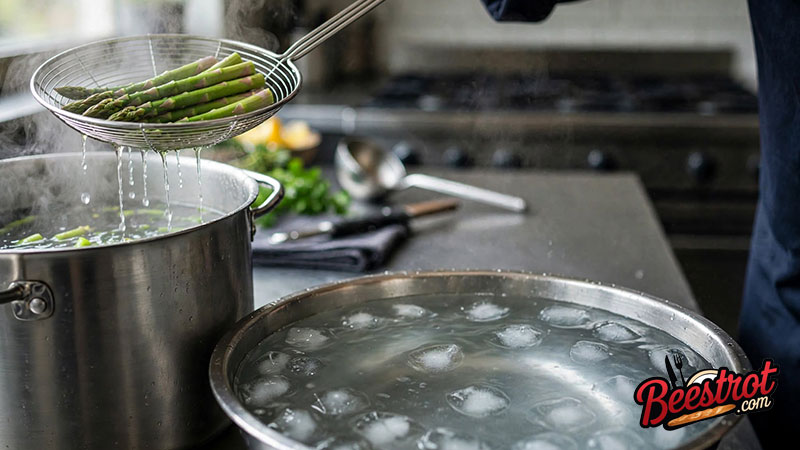
Professional kitchens use a two-stage process for green vegetables: blanch briefly in heavily salted boiling water, then transfer immediately to a bowl of ice water. The ice bath is not a suggestion. It is the entire point of the technique.
The boiling water does one job: it deactivates the surface enzymes and briefly sets the color by collapsing those air pockets. The ice bath does the other job: it stops the cooking process before sustained heat can destroy what the boiling just created.
Ten seconds in ice water is enough for a thin vegetable like a green bean or a snow pea. Denser vegetables need longer. What matters is that the transfer happens immediately, within seconds of the vegetable leaving the boiling water, while residual heat is still moving through the cells. Wait to drain, wait to arrange, wait to find the ice tray: the vegetable continues cooking in its own heat. The window closes.
The salt in blanching water serves a double function: it seasons the vegetable from the outside in during a contact time too brief for subtlety. Professional kitchens salt blanching water heavily, often to what tastes like seawater, because only aggressive seasoning penetrates in under two minutes.
What You Are Skipping
Most home cooks skip the ice bath because it feels like an extra step, and in a kitchen without a large bowl prepared and ice already in it, it is easy to tell yourself the vegetables will be fine. They will be edible. Fine is not the same thing.
The vegetables that arrive bright green at a restaurant, that hold their texture after sitting on a plate for two minutes, were shocked in ice water. The dull, slightly soft result of home cooking is the outcome of skipping that step.
The technique also extends beyond the moment of service. Blanched and shocked vegetables can be prepared hours in advance and held in the refrigerator without continuing to cook. This is how professional kitchens handle service for large numbers of people. The vegetable is finished, stable, and ready. At service, it needs only a brief pass through hot butter or a quick reheat. That is the full secret: the ice bath is not primarily about color. It is about control over the cooking process.
Blanching followed by ice shock is standard mise en place for green vegetables in professional kitchens. It decouples preparation from service, allows vegetables to be cooked perfectly in advance, and removes the guesswork of timing during a busy service entirely.
The Ten Seconds
For a thin, tender vegetable, ten seconds in ice water is the difference between a color that holds and one that continues fading on the plate. The technique requires nothing beyond a large bowl and ice. It adds no meaningful time to preparation. It is skipped because it is not visible in a recipe.
Recipes say “blanch until tender.” They rarely say “shock immediately in ice water for at least ten seconds, using enough ice to actually lower the temperature of the water.” That instruction is assumed in professional training. It is invisible to everyone else.
Fill the bowl before you start the blanching water. Have the ice ready. Set the bowl next to the stove. When the vegetables come out of the boiling water, they go directly into the ice. Do not drain first. Do not move them to a colander. Transfer them from boiling water to ice water in a single motion.
The color you see at the end of those ten seconds is the color you will serve.
A recipe is a promise. A technique is the truth behind it.
Jean Louis
Sources
- Serious Eats, The Food Lab, Water Salting and Blanching Techniques
- ScienceDirect, Chlorophyll Degradation in Food Science
- America’s Test Kitchen, Guide to Blanching Vegetables
- ChefSteps, How to Blanch and Shock Vegetables
- BBC Good Food, How to Blanch Vegetables
More Delicious Reads
The Fork Was Considered Sinful in Medieval Europe. The Church Had Opinions.

KFC: The 65-Year-Old Failure Who Built a Billion-Dollar Chicken Empire
Why Bakery Bread Cannot Be Replicated at Home. And the One Thing You Can Do About It.
The Best Ingredient I Ever Added to My Kitchen Had Nothing to Do with Food
Workers Who Built the Pyramids Were Paid in Garlic and Onions. A Strike Stopped Construction When th...
Tarragon Is the Most Underrated Herb in Western Cooking. Jean Louis Makes His Case.
Tabasco Sauce Was Born on a Louisiana Island After the Civil War. The Recipe Has Not Changed Since 1...
The Temperature Secret That Separates Professional Cooking From Everything Else.

The One Ingredient Every Pastry Chef Adds to Desserts That Home Cooks Never Think Of.