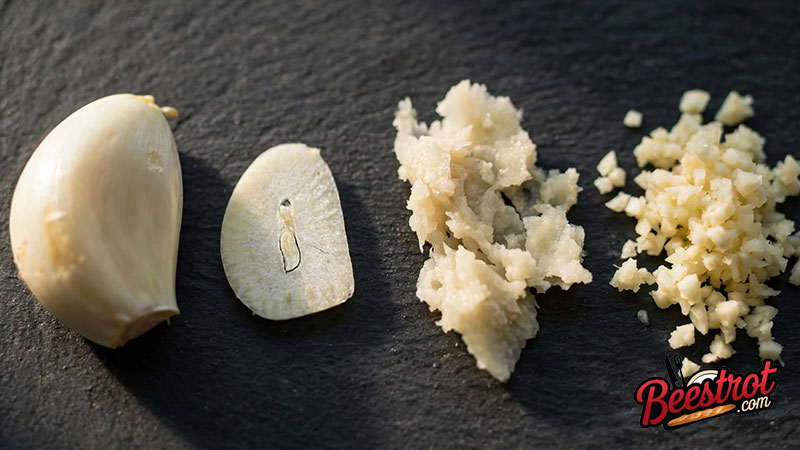
Take a single clove of garlic. Cut it four different ways and you get four different ingredients. Not four versions of the same thing: four genuinely distinct flavours, different intensities, different textures, different roles in a dish. The garlic you mince is not the garlic you slice. The garlic you crush is not the garlic you leave whole. Professional kitchens have known this for a long time. Most home cooks have not been told.
The reason comes down to chemistry. Garlic contains two compounds that are stored separately: an amino acid called alliin, and an enzyme called alliinase. As long as the cell walls stay intact, nothing happens. The moment you break those cells, the two compounds meet. The reaction produces allicin, which is the molecule responsible for the sharp, pungent, unmistakable smell of garlic. The more cells you break, the more allicin you produce. The more allicin, the more intense the flavour. Your knife is a chemical instrument. The cut controls the reaction.
Garlic stores its two reactive compounds in separate compartments. The moment cell walls break, alliin and alliinase meet and produce allicin. A fine mince breaks every cell. A whole clove breaks none. What you cut determines what you taste.
Harold McGee explains the mechanism in On Food and Cooking with the kind of precision that makes you look at a bulb of garlic differently. The chemistry is not a curiosity. It is the operating principle behind every garlic technique in every cuisine that uses it, whether or not the people using those techniques have ever heard the word allicin.
The Whole Clove
A whole garlic clove placed in a pan releases almost no allicin until it begins to break down from heat. The outer cells rupture slowly. The interior stays largely intact for a long time. The flavour that develops is mild, sweet, and nutty, almost unrecognisable as garlic to anyone who only knows it minced. The classic French preparation of forty cloves of garlic confited in oil works precisely because the cloves stay whole. They become soft, spreadable, and gentle. The quantity sounds alarming. The result is not.
Whole roasted garlic, where the entire head is placed in an oven until soft, follows the same logic. The heat breaks down the allicin over time and converts harsh compounds into sweeter molecules. The result is a paste that can go on bread, into mashed potatoes, or into a sauce without the sharpness that raw or quickly cooked minced garlic produces. If you have never understood why a dish calls for forty cloves, the answer is that these are not forty doses of garlic. They are one mild flavour spread across forty pieces.
The Slice
A thin slice cuts across the cell structure rather than crushing it. You break some cells cleanly. The allicin production is moderate, not maximum. A sliced clove produces a sharper flavour than a whole one but nothing like the intensity of a mince. It also delivers texture that a mince cannot: you can see it in the dish, it develops slight caramelisation at the edges when sauteed, and it releases its flavour gradually rather than immediately.
Sliced garlic sauteed in olive oil until golden produces a flavour that minced garlic cannot replicate: slightly sweet at the edges, present but not aggressive, and complex in a way that develops during cooking rather than front-loading the heat.
Sliced garlic is the choice when you want garlic to play a supporting role rather than dominate. The aglio e olio tradition uses sliced garlic sauteed in oil precisely for this reason: the goal is flavoured oil with garlic presence, not raw garlic intensity hitting the palate before anything else. The slice controls how much flavour transfers into the oil, and how fast.
The Crush
Crushing garlic with the flat of a knife breaks many cells at once but does not mince them. The result sits between a slice and a fine mince in intensity. More importantly, a crushed clove can be easily removed from a dish after cooking, making it the technique of choice when you want the flavour of garlic in a sauce or oil but not the texture or the visual presence. Many classic French and Italian braises start with crushed garlic added to hot oil for thirty seconds, then removed entirely before anything else goes in.
The Flavor Bible by Karen Page and Andrew Dornenburg, which catalogues how professional chefs think about ingredient relationships, lists garlic as one of the most versatile flavour agents in the kitchen, but the nuance is in application. The Flavor Bible records that experienced chefs distinguish sharply between raw garlic, cooked garlic, and roasted garlic as though they are different ingredients, because in practice they are. The crush sits in this system as a transitional technique: more controlled than a mince, more immediate than a whole clove.
The Fine Mince
A fine mince breaks every cell. The allicin reaction runs at maximum output. The result is sharp, aggressive, and immediate. Raw minced garlic in a dressing or a marinade is a different ingredient from cooked minced garlic in a sauce, even though both start from the same mince. Raw allicin is harsh and penetrating. Heat converts it and softens it, but the conversion happens faster when there is more surface area, which means minced garlic cooked even briefly becomes less sharp than sliced garlic cooked for longer.
A fine mince is the technique for maximum intensity. It is also the technique most likely to burn, because the small surface area browns quickly in oil. Thirty seconds too long in a hot pan and a mince goes from fragrant to bitter. The precision required is the point.
Tamar Adler’s approach in An Everlasting Meal captures something important about how attentive cooks actually work: they pay attention to what an ingredient is doing, not just what they planned to do with it. Minced garlic going into a hot pan demands your attention in a way that a whole clove in a low oven does not. The technique matches the level of care required. A mince is commitment to watching what happens.
Why Professional Kitchens Distinguish This
The reason this distinction matters in a professional kitchen is not elegance. It is reproducibility. A recipe that says “add garlic” is ambiguous. A recipe that specifies the cut produces the same result every time, regardless of who is at the stove. Professional kitchens run on this kind of precision because the dish needs to taste the same whether the head chef is there or not. The garlic cut is not a detail. It is part of the specification.
Home cooking has traditionally compressed this knowledge because most recipes are written to be accessible, not precise. The instruction “mince the garlic” appears everywhere because it is easy to describe and produces a familiar result. What it does not communicate is that this is one choice among several, each producing a genuinely different dish. The same recipe with sliced garlic is a different recipe. Both can be correct. The question is what flavour you are building toward.
Cut a clove four ways this week and cook each one separately in a small amount of oil until fragrant. Taste them side by side. The garlic you thought you knew will turn out to be four different things. That gap between what you assumed was true and what you actually taste is exactly where cooking gets interesting.
A recipe is a promise. A technique is the truth behind it.
Jean Louis


Sources
- Allicin formation in garlic: The influence of cutting, Food Chemistry
- Garlic, Encyclopaedia Britannica
- How to Mince Garlic, Serious Eats
- 6 Things to Know About Cooking with Garlic, Serious Eats
- Garlic cooking techniques and recipes, BBC Good Food