The first time someone puts a bowl of Sichuan hot pot in front of you, the heat feels primordial. Like something the land itself invented, like the mountains insisted on it over centuries of cold and altitude. That feeling is almost entirely wrong, and understanding why changes how you see the whole food map of Asia.
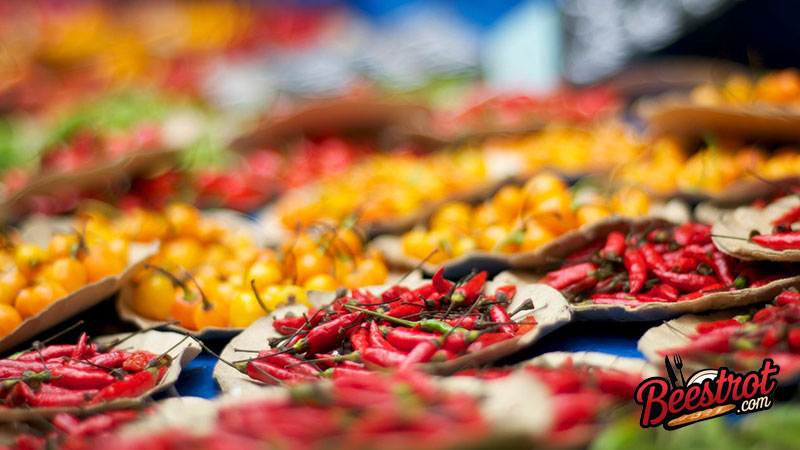
Chilli peppers are not Asian. They never were. They are American, cultivated in what is now Mexico and Central America for at least six thousand years before a European ship ever crossed the Pacific. The heat you associate with Thai cooking, Korean kimchi, Indian curries, and Sichuan cuisine, every tradition that now seems inseparable from the burn of capsaicin, none of it existed in its current form five centuries ago. That burn arrived by boat.
What Burned Before
Asian cooking was never without heat. That is the first thing to understand, because the story is not about a continent that discovered spice. Long pepper, now largely forgotten in Western kitchens, was the preferred heat source across India and Southeast Asia for centuries. Black pepper from Kerala was traded along routes that reached Rome. Ginger, galangal, and white pepper gave warmth of different characters to different traditions. In China, Sichuan peppercorns delivered the distinctive numbing sensation, but without capsaicin layered on top, the mala profile meant something quite different.
Long pepper was a staple of the ancient spice trade, valued across the Roman Empire and through the medieval courts of Europe. In India, it had been the primary heat source for longer than written records go. The chilli did not arrive into a blank palate. It arrived into kitchens already fluent in spice.
The cuisines of Asia were fully formed, sophisticated, and deeply regional before the chilli appeared. They were simply not hot in the way we now take for granted. Which raises the question of how the chilli traveled, why it spread so quickly, and what happened to the ingredients it eventually displaced.

Lodge Cast Iron Skillet, 10.25"
Sears, bakes, fries, goes from stovetop to oven. Pre-seasoned, virtually indestructible, improves with every use. The pan that never leaves the kitchen.
View on AmazonThe Portuguese Route
Vasco da Gama reached India in 1498. The Portuguese were looking for spices, and they found them. But they also carried something the subcontinent had never encountered. The chilli pepper, which had traveled from the Americas aboard Spanish ships in the years after Columbus, arrived on Indian shores through the Portuguese trading post at Goa in the first decade of the sixteenth century. What happened next happened fast.
Within decades, the chilli had moved inland from Goa across the subcontinent. It reached Bengal, then the Deccan, then the far south. It replaced long pepper in region after region, not by force but by preference. Something about the way it hit the palate, the way it built slowly and then bloomed, the ease with which it grew in warm climates, made the adoption almost irresistible.
From India, the chilli moved east along established spice trade networks into Southeast Asia, and north toward China, reaching Korea in the late sixteenth century. The adoption happened with a speed that food historians still find remarkable. It was not a slow creep. It was a wave.
Stuart Walton documents this movement in The Devil’s Dinner, a history of the chilli that tracks its passage across the world. Korea is one of the most striking cases. Kimchi as Koreans eat it today, the red-fermented vegetable that has become a symbol of Korean food culture worldwide, did not exist before the chilli arrived. Pre-chilli kimchi was fermented and seasoned, but pale and mild by comparison. The heat in that jar is a recent development.
Five Centuries Is Not a Long Time
The kimchi timeline lands differently when you sit with it. Five hundred years sounds like antiquity. In the context of human cooking history, which stretches back hundreds of thousands of years, five centuries is remarkably recent. It is the distance between now and the early 1500s. Korea had a sophisticated food culture for millennia before gochugaru appeared. That red paste is not ancient. It is modern, and the distinction matters.
Thailand presents the same paradox. The fire of a green curry, the depth of a nam prik, the heat in a pad kra pao, these dishes that foreign visitors now identify most immediately with Thai identity, are built around an ingredient that Thai cooks first encountered roughly four hundred years ago. That is not deep time. It is closer to us than it is to the founding of the cuisine itself.
Sichuan cuisine’s defining mala flavor requires two ingredients from entirely different parts of the world: the Sichuan peppercorn, native to China, and the chilli, native to the Americas. That marriage is roughly four hundred years old. Before it, Sichuan cooking was already complex and regional, built on long traditions. But it was a different kind of complex.
What the Adoption Actually Means
There is something quietly disorienting about this if you follow it through. The heat that much of the world now experiences as the most irreducibly local quality of Asian food, the thing that feels most elemental when you eat in Bangkok or Seoul or Chengdu, is a transplant. A transplant so successful that it raises a real question about what authenticity in food actually means.
This is not a story about inauthenticity. It is a story about how living food cultures work. They absorb what they encounter. They take a new ingredient and give it a character that nobody in its homeland ever imagined. Korean gochugaru is not Mexican ancho. Thai bird’s eye chillies are not Indian Kashmiri. The chilli became Asian not because it pretended to belong there, but because Asian cooks made it into something entirely their own. They received a seed and grew it into a thousand distinct cuisines.
The Portuguese traders who carried the chilli across the Indian Ocean were not gifting Asia with fire. They were handing over a raw material. What came back, over the centuries that followed, was culture. The gap between that seed and the dish on your table is shorter than most people assume, and stranger than any mythology about ancient traditions is willing to admit.
Every dish has a past. I am just following it back to the beginning.
Jean Louis


Sources
- Chili pepper, Wikipedia
- The Columbian Exchange, Wikipedia
- Kimchi, Wikipedia
- Sichuan cuisine, Wikipedia
- Long pepper, Wikipedia
More Delicious Reads
The French Did Not Invent French Fries. Belgium Is Still Angry About This.
Cheese Was Discovered by Accident Inside a Dead Animal's Stomach. It Became the Most Traded Food in ...
Mayonnaise Was Almost Certainly Invented During a Military Siege. No Kitchen Was Involved.

Subway: The $1,000 Bet That Built and Nearly Buried an Empire
Saffron Is the Most Expensive Spice in the World. Here Is Why It Is Worth Every Cent.
Coffee Was Banned in Three Continents at Different Points in History. The Reasons Were Always Politi...
Carrots Were Not Always Orange. The Dutch Changed That for Political Reasons.
Professional Pastry Is Weighed to the Gram. Volume Measures Are Why Your Baking Is Inconsistent.
Ketchup Was a Fermented Fish Sauce Invented in Asia. Heinz Turned It Into Something Entirely Differe...