Last Updated on October 6, 2026 by Jean Louis
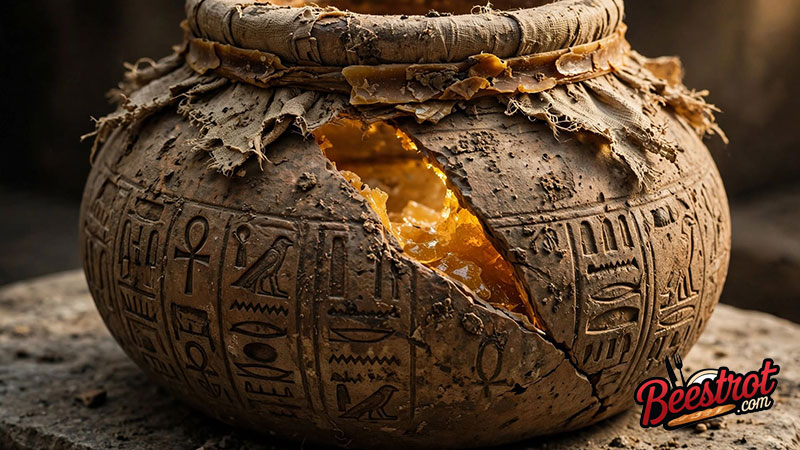
When Howard Carter opened Tutankhamun’s tomb in 1922, he found something that stopped him. Among the gold and the lapis lazuli and the elaborate furniture of a dead king, there were sealed clay pots containing honey. The honey was approximately 3,000 years old. It was still edible.
This surprises people. It should not surprise a cook. Any cook who understands what honey actually is would find this entirely predictable. It is one of those cases where a fact that sounds miraculous turns out, on examination, to be simple chemistry doing exactly what chemistry does.
Let me explain what honey is before I explain why it does not spoil.
Honey begins as nectar, a thin sugary liquid that is roughly 80 percent water. Bees collect it, carry it back to the hive, and then do something remarkable: they evaporate almost all of the water out of it. Worker bees fan their wings over the nectar for days, driving off moisture until the water content drops below 17 percent. This is not incidental. It is the whole point. The resulting substance is so concentrated in sugar that it creates what chemists call osmotic pressure, an environment so hostile to water that any bacterium or microorganism that lands in it has the moisture drawn out of its cells almost immediately. It desiccates. It dies. Honey does not kill bacteria with poison. It kills them with geometry. There is simply no water available for life to use.
This is the first mechanism. The second is acidity. Honey has a pH between 3 and 4.5, which places it in roughly the same territory as vinegar. Most bacteria cannot survive in an environment that acidic. They require a pH closer to neutral, around 7, to function. Honey offers them nothing.
The third mechanism is the most elegant, and it comes from the bees themselves. When bees process nectar, they add an enzyme called glucose oxidase. This enzyme, when honey is diluted even slightly with water, produces hydrogen peroxide, the same compound used to disinfect wounds. It is present in honey in very low concentrations, not enough to taste or smell, but enough to act as a continuous low-level antimicrobial. This is why honey has been used as a wound dressing across every ancient medical tradition that ever encountered it. The Sumerians prescribed it in roughly a third of all their medical texts. Egyptian physicians used it for eye ailments and skin wounds. Modern hospitals use a product called Medihoney, a medical-grade honey dressing, for burns and slow-healing sores. Three thousand years of empirical observation, eventually confirmed by biochemistry.
The tomb honey survived because of one additional factor: the lid. Honey is hygroscopic, which means it actively absorbs moisture from the surrounding air. Open a jar of honey in a humid kitchen and leave it long enough and it will eventually absorb enough water to allow yeast to begin fermenting it. This is actually how mead is made: honey is deliberately diluted with water to allow fermentation to begin. The tomb honey was sealed. No moisture entered. The three protective mechanisms, low water content, high acidity, hydrogen peroxide, operated undisturbed for three millennia. The lid was the difference between wine and eternity.
There is a cooking lesson here that goes beyond honey. Every traditional preservation technique, salt-curing, pickling, fermentation, drying, smoking, is doing one of a small number of things: removing water, changing pH, creating antimicrobial compounds, or removing oxygen. Ancient kitchens did not have the chemistry to explain why these techniques worked. They had thousands of years of observation to know that they did. The Egyptian who sealed that clay pot of honey in 1323 BCE did not know about glucose oxidase. He knew that sealed honey lasted. He was right. The chemistry came later.
Honey crystallises over time, even sealed. The glucose in it precipitates out of solution and forms crystals, which is why very old honey appears thick or solid rather than liquid. This does not mean it has spoiled. It means it is doing what supersaturated glucose solutions do. A gentle warming will return it to liquid. The tomb honey, had anyone chosen to eat it, would have required nothing more than a warm bowl of water and patience.
I keep a jar of raw honey from a beekeeper in Provence on my kitchen counter. It is from last autumn. The honey from Tutankhamun’s tomb is from 1323 BCE. Both are, chemically speaking, in the same condition: low water, acidic, laced with glucose oxidase, waiting for someone to open them. The only difference is the age of the jar. The honey inside is operating on the same principles it has always operated on, the same ones the bees evolved to exploit long before there were tombs to put it in, long before there were kings to bury, long before there was anyone to be surprised by any of this.
The kitchen is full of these moments, where something that seems remarkable turns out to be ancient chemistry doing its job. Honey is perhaps the purest example. It does not last forever by accident. It lasts forever because of exactly what it is.
Put the lid back on the jar.
The kitchen never lies. History sometimes does.
Jean Louis
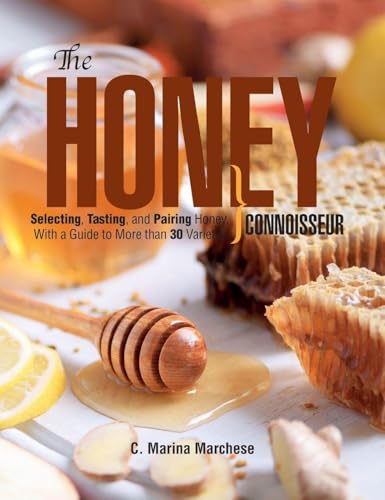
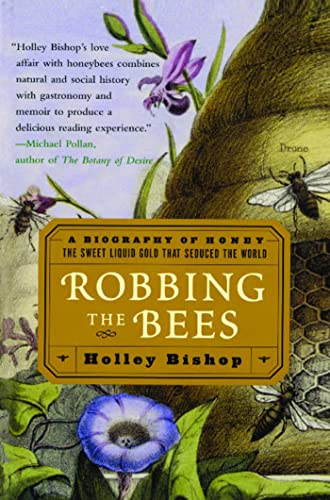
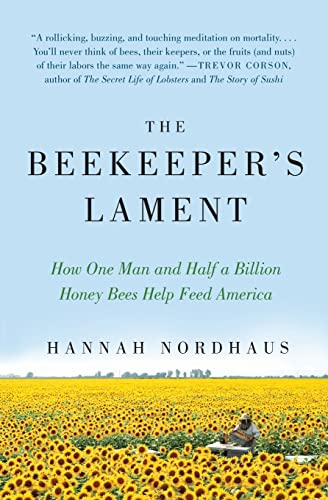
Every dish has a past. These books will take you further into it.
Sources
- Boing Boing. Honey from Sealed Egyptian Tombs Is Still Edible After 3,000 Years. Low water content, hydrogen peroxide, Medihoney wound dressing.
- Oddly Human. A 3,000-Year-Old Honey Jar Found in Tutankhamun’s Tomb Was Still Edible. pH levels, osmotic pressure, hygroscopic properties.
- Open Culture. Why Ancient Egyptian Honey Remains Edible After 3,000 Years. Neolithic cave painting, Egyptian beekeeping history, glucose oxidase mechanism.