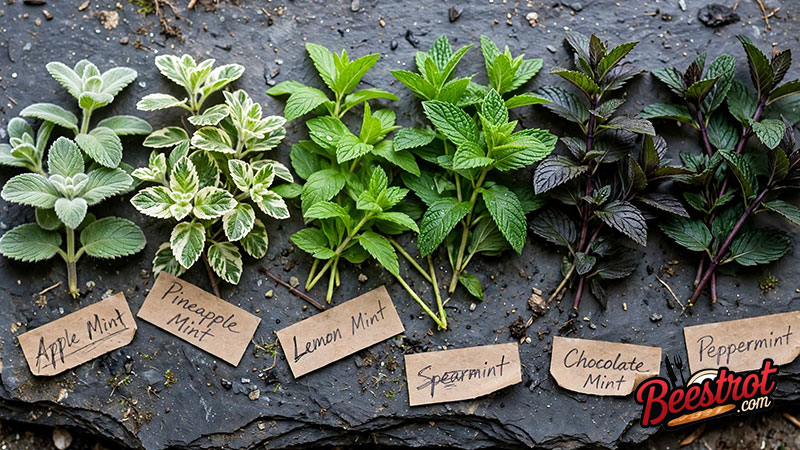
The supermarket sells it under a single label. The recipe calls for it by a single name. You pick up a bunch of mint, bring it home, and use it. This works, in the sense that the dish is edible and vaguely minty. It does not always work in the sense that the dish tastes the way it was supposed to. The reason is that the word mint covers more than six hundred varieties, and the ones that matter most for cooking taste nothing alike.
I started paying attention to this problem after a tabbouleh that tasted medicinal. The mint in the market had been peppermint, not spearmint. The dish called for spearmint, as authentic tabbouleh always does. Peppermint has a menthol intensity that overwhelms the parsley and bulgur rather than lifting them. It was not a bad bunch of mint. It was the wrong bunch of mint.
The genus Mentha contains between thirteen and twenty-four recognised species depending on which botanist you consult. Natural hybridisation between those species has produced cultivars and varieties that push the working count well past six hundred. Most of those are ornamental, medicinal, or found only in specialist herb gardens. But the ones that reach the kitchen matter more than most cooks realise, because they are not interchangeable.
Understanding the difference starts with two compounds. Spearmint is dominated by L-carvone, a molecule with a sweet, grassy character and no significant cooling effect on the palate. Peppermint is dominated by menthol, which triggers the cold-sensitive receptors in the mouth and creates the intense cooling sensation associated with toothpaste, breath mints, and the word mint in its most recognisable cultural form. These are different flavour experiences, produced by different chemistry, appropriate for different dishes. Knowing which you have changes what you can do with it.
The Two Mints Every Cook Needs to Know
Spearmint (Mentha spicata) is what most culinary traditions mean when they say mint. It is the mint in a mojito when the drink is made correctly, the mint in tabbouleh, the mint in an English mint sauce served with lamb, the mint in Greek tzatziki, the mint scattered over Vietnamese spring rolls. Its flavour is bright and green without any medicinal edge. It plays well with acid, with salt, with fresh vegetables, and with grilled meat. It does not overpower. It lifts.

OXO Good Grips Handheld Mandoline Slicer
Paper-thin slices in seconds — cucumbers, potatoes, zucchini, fennel. The kind of prep tool that makes you feel like a real chef.
View on AmazonPeppermint (Mentha x piperita) is a natural hybrid of spearmint and water mint. Its menthol content is significantly higher, and that menthol dominates every dish it enters. This is exactly what you want in a chocolate mint dessert, a peppermint tea, a candy, or a sauce designed to cut through the richness of dark chocolate. It is not what you want in a grain salad or a yoghurt dip. The cooling sensation that makes peppermint useful in confectionery makes it aggressive in savoury contexts where the other ingredients cannot match its intensity.
Most supermarkets sell whichever variety their supplier grows most easily, often without labelling it as spearmint or peppermint. The simplest way to tell them apart before you buy is to crush a leaf between your fingers. Spearmint smells sweet and grassy. Peppermint delivers an immediate sharp coolness that you can feel as much as smell. If your mouth waters slightly at the scent, that is peppermint. If the scent is pleasant but mild, that is spearmint.
Getting this distinction right resolves most of the mint confusion that happens in home kitchens. The recipe that asks for mint and produces a dish that tastes medicinal has almost always been made with peppermint where spearmint was intended. Recipes developed in culinary traditions where spearmint is the default assume that default without stating it. The assumption travels invisibly into kitchens where peppermint is what the market happened to stock that week.
The Others Worth Knowing
Beyond spearmint and peppermint, a small number of herb varieties are worth understanding for specific culinary uses. Apple mint (Mentha suaveolens) has a softer, slightly rounded character with a faint fruitiness that suits fruit salads, light summer drinks, and desserts where a standard spearmint might read as too green. Its leaves are rounder and fuzzier than spearmint, which makes it easy to identify in an herb garden.
Mojito mint, sometimes sold as Cuban mint and botanically classified as Mentha x villosa, is what a traditional mojito is built on. It has the brightness of spearmint with a slightly more floral, less sharp character. In a cocktail that relies on fresh herbs to balance rum and citrus, that difference is perceptible. Using standard spearmint in a mojito produces a good drink. Using Mentha x villosa produces the specific drink the recipe was designed around.
Chocolate mint is a cultivar of peppermint with a flavour that genuinely suggests dark chocolate alongside the menthol. It has found a niche in desserts and in herb gardens maintained by bakers. It is real, it is useful, and it is exactly as specific in its application as the name suggests.
One variety that appears on herb market stalls under the mint label and is not mint at all: Vietnamese mint, also called Vietnamese coriander. It belongs to the genus Persicaria, not Mentha. It has a sharp, peppery, slightly citrus character that is essential to Vietnamese and Southeast Asian cooking and is genuinely irreplaceable in a Vietnamese prawn salad. But it contains no menthol and shares no chemistry with the Mentha genus. Calling it mint is a convenience label. Understanding it as a separate fresh herb used in a different culinary context will improve what you do with it.
How to Choose and Use the Right One
The practical starting point is to stock spearmint as your everyday kitchen herb. It is the more versatile of the two main varieties and the one assumed by the majority of savoury recipes. If you have access to a farmers market or a specialist herb nursery, learning to grow mint in a container is worth the small effort. Mint spreads aggressively in open ground but stays manageable in a pot, produces reliably through the growing season, and gives you access to fresh herbs that supermarkets rarely carry, including apple mint and mojito mint.
When buying fresh herbs without clear labelling, use the crush test described above. The smell of a crushed leaf is the most reliable quick guide to which variety you are holding. Herb storage for mint follows the same principle as for other tender fresh herbs: trim the stems, stand the bunch in a glass of water, cover loosely, and refrigerate. Good herb storage extends usable life significantly. Treated this way, fresh mint stays usable for up to a week. Keeping it in a sealed plastic bag accelerates deterioration rather than preventing it.
When a recipe specifies peppermint, that specification exists for a reason. It has been tested against the intensity of menthol and built around it. Substituting spearmint produces a flatter result. When a recipe says mint without qualification, default to spearmint. The culinary traditions that developed most of those recipes did.
The six hundred varieties are not a reason to feel overwhelmed. Most of them are not in any market. The two that matter most are distinguishable by smell in thirty seconds. The others are worth learning one at a time, as you encounter them, in the specific contexts where they are native. Mint is not one herb. But the version that is right for your dish is usually findable, once you know what you are looking for.
Every spice carries a world inside it. I am just learning to listen.
Jean Louis
Sources
- Wikipedia, Mentha
- Wikipedia, Spearmint
- Wikipedia, Peppermint
- Royal Botanic Gardens Kew, Mint
- BBC Good Food, Spearmint vs Peppermint
More Delicious Reads
You Have Been Storing Your Spices Wrong. Here Is What a Chef Actually Does.
The One Ingredient Every Pastry Chef Adds to Desserts That Home Cooks Never Think Of.

The Hot Dog Bun Was Invented at a World's Fair by a Vendor Who Ran Out of Gloves. It Was Not Meant t...
Workers Who Built the Pyramids Were Paid in Garlic and Onions. A Strike Stopped Construction When th...
Resting Your Meat Is Not Optional. Here Is What Actually Happens If You Skip It.
The Spice Trade Killed More People Than Most Wars. Nutmeg Was the Reason the Dutch Massacred an Enti...
Your Vegetables Lose Their Colour and Flavour Because You Skip Ten Seconds.

The Art of the Perfect Sauce: Foundations Every Home Chef Should Master
Why Restaurant Fish Never Sticks to the Pan and Yours Does. One Step, Before the Fish Goes In.