Last Updated on October 14, 2026 by Jean Louis
There is a moment in every cook’s education when someone cuts into a steak too early. The board floods. The meat looks dry before the first bite is taken. And the cook stands there wondering what went wrong, because the internal temperature was right, the crust was perfect, and the recipe said nothing about waiting.
The recipe almost never does. Resting is treated as a footnote, something vague and optional, a suggestion buried after the real instructions. It is not a footnote. It is the last step of cooking, and skipping it undoes everything that came before.
What Heat Does Inside the Muscle
Meat is mostly water and protein. When you apply heat, the muscle fibers contract. This is not a gentle process. The proteins, primarily myosin and actin, tighten under heat the way a wet cloth wrings itself out. The moisture inside the muscle does not evaporate immediately. It migrates. It is pushed inward, toward the cooler center of the cut, where it accumulates under pressure.
By the time a steak reaches 130 degrees Fahrenheit at its center, the outer layers have been contracting for several minutes. The center is under significant hydraulic pressure from all that displaced moisture. The muscle fibers there are taut, coiled, waiting.
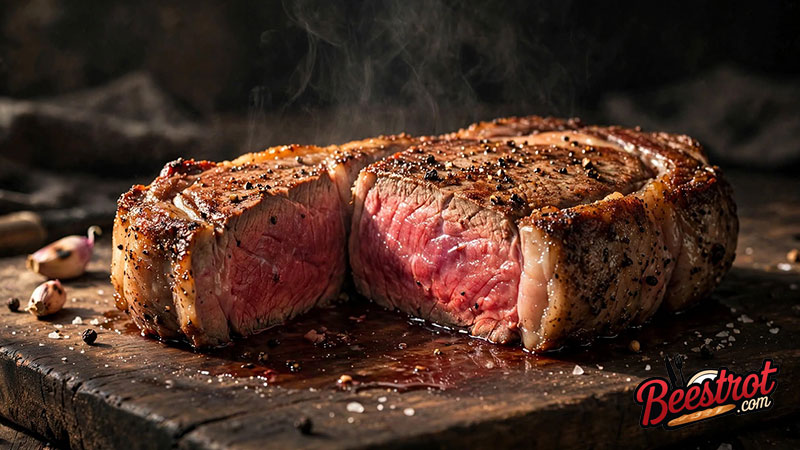
Cut into a steak the moment it leaves the pan and you are not serving meat. You are serving pressurized liquid looking for an exit. The juice that pools on your cutting board is not excess moisture. It is the interior of the steak, redistributed by your knife.
This is the thing no one explains clearly. The loss is not about the cooking. It is about the timing of the cut.
The Science of Redistribution
Rest gives the muscle fibers time to relax. As the meat sits off the heat, the proteins begin to uncoil. The temperature gradient between the crust and the center starts to equalize. And critically, the moisture that was forced toward the center begins to redistribute back through the muscle tissue.
This is not a slow process. A ribeye steak resting for five to seven minutes undergoes measurable changes in moisture distribution. A leg of lamb resting for twenty minutes tells a completely different story at the knife than the same cut carved immediately. The difference is not subtle. Anyone who has done both, side by side, stops debating the science and starts building rest time into their schedule.
Research on muscle fiber behavior after cooking shows that a rested steak can retain significantly more juice than one carved immediately, with some studies pointing to losses of up to 40 percent when the rest is skipped entirely. That number is not a rounding error. It is the difference between a good meal and a memorable one.
The mechanism is straightforward once you understand it. The question is why so many recipes still treat it as optional.
Carryover Cooking Is Happening Whether You Plan for It or Not
There is a second reason to rest meat that has nothing to do with moisture. It is called carryover cooking, and it means exactly what it sounds like. When you pull a roast from the oven, the cooking does not stop. The heat stored in the outer layers continues moving inward. The internal temperature of a large roast can rise by ten to fifteen degrees Fahrenheit after it leaves the oven.
This changes the math on every recipe that gives you a target temperature. If you want your roast at 135 degrees, you pull it at 120 and let carryover do the rest. Cooks who understand this work more accurately than those who chase a number on a thermometer and carve immediately. They are working with physics rather than against it.
The larger the cut, the more significant the carryover. A whole roasted chicken can gain five degrees after leaving the oven. A standing rib roast can gain fifteen. Ignore this and you will consistently overcook large cuts while trying to hit the right temperature.
Resting and carryover are not the same thing, but they happen at the same time. One is about juice retention. The other is about thermal momentum. Both require patience, and both reward it.
How Long Is Actually Long Enough
The answer depends on the cut, not on a universal rule. A thin chicken breast needs three minutes. A thick ribeye needs seven to ten. A bone-in leg of lamb needs fifteen to twenty. A whole roasted bird needs at least fifteen, and thirty is better. A standing rib roast resting for forty-five minutes is not a roast gone cold. It is a roast finishing itself.
The fear of cold meat is real but mostly unfounded. A properly rested large cut does not drop to room temperature in twenty minutes. The mass of the meat retains heat far longer than most home cooks expect. Tent it loosely with foil, not tightly, because a tight seal traps steam and softens the crust you spent time building. Loose foil slows the heat loss without sacrificing texture.
The one rule that holds across all cuts is this: rest it longer than you think you need to. The cost of an extra three minutes is almost nothing. The cost of cutting too soon is the entire meal.
What You Are Actually Tasting When You Skip It
When a cook skips the rest and plates immediately, the diner is eating a different dish than intended. The texture is firmer at the center, where the muscle fibers never had a chance to relax. The surface is drier, because the moisture that should have redistributed is now on the cutting board. The flavor is flatter, because juice carries flavor compounds, and those compounds are no longer in the meat.
None of this is dramatic or irreversible. The steak is still edible. But it is not the steak it could have been, and the difference is not technique or skill or expensive equipment. It is five minutes of stillness and the discipline to use them.
A recipe is a promise. A technique is the truth behind it.
Jean Louis


Sources
- The Food Lab, Complete Guide to Pan-Seared Steaks, Serious Eats
- Ask the Food Lab, Do I Need to Rest My Steak, Serious Eats
- Beef Food Safety, USDA Food Safety and Inspection Service
- The Importance of Resting Meat, Cook’s Illustrated
- On Food and Cooking, Harold McGee, Amazon