Most people who toast spices do it because a recipe told them to. The step gets treated like “season to taste”: an instruction that travels without its explanation. The cook who wrote the recipe understood what was happening. The person following it often does not. Toasting spices is not a ritual. It is a chemical process with measurable, specific effects, and knowing what is actually occurring inside the spice changes both how you approach it and why skipping it costs more than you realise.
The same spice, toasted and untoasted, is not the same ingredient. The cumin seeds going into a dal, the coriander seeds in a spice rub, the cardamom pods in a rice dish: each one carries aromatic compounds that the heat of toasting fundamentally transforms. Understanding why is not academic. It is the difference between a dish that smells right and one that merely smells like its ingredients.
What Is Actually Happening Inside the Spice
Whole spices contain aromatic compounds locked inside essential oil glands in their cellular structure. The compounds responsible for smell and flavour, terpenes, terpenoids, aldehydes, and esters depending on the spice, are volatile. They want to escape. Under normal storage conditions they escape slowly, through the intact surface of the spice, which is why old spices eventually smell like nothing. The cellular wall holds the rest in.
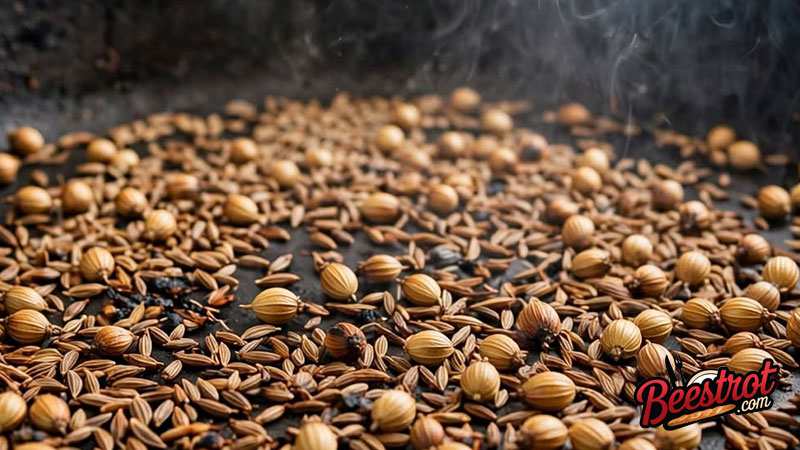
Heat accelerates this release, but not simply by driving compounds out of the spice. The more important effect is structural: heat ruptures cell walls, releases the essential oils onto the surface of the spice, and allows them to volatilise into the air above the pan. Simultaneously, moisture trapped inside the spice evaporates. Moisture suppresses aromatics; removing it makes the remaining compounds more concentrated and more perceptible. At higher temperatures, a modified Maillard reaction occurs at the spice’s surface, producing new flavour compounds that did not exist in the raw state. What you smell rising from the pan is not the spice itself. It is the spice becoming something it could not have been without heat.
Karen Page and Andrew Dornenburg, in The Flavor Bible, document how the aromatic character of a spice determines what it can pair with and what it will clash against, and how that character shifts based on how the spice has been treated before it reaches the dish. An untoasted cumin seed carries a sharp, slightly raw note that dominates whatever it touches. A toasted one carries depth, warmth, and a range of secondary notes that open up possibilities the raw spice cannot access. The pairing logic changes entirely because the ingredient itself has changed.

Lodge Cast Iron Skillet, 10.25"
Sears, bakes, fries, goes from stovetop to oven. Pre-seasoned, virtually indestructible, improves with every use. The pan that never leaves the kitchen.
View on Amazon
The Window: Why Getting It Wrong Goes Fast
The volatile compounds released by toasting are, by definition, volatile. They evaporate. The window between under-toasted and over-toasted is narrow. Under-toasted means the cell walls are still largely intact, the moisture is still present, and the aromatic compounds have not fully released. Over-toasted means the released compounds have evaporated or converted, through pyrolysis, into bitter and acrid notes that no dish can recover from.
For most whole spices in a dry pan over medium heat, the window falls somewhere between two and four minutes. The reliable cues are smell and colour, not time. A correctly toasted spice smells intensely of itself, brighter and deeper than it did raw. The colour deepens by one or two shades. The moment it starts to smell sharp or acrid, it is past the point. Time varies too much between pan weights, heat sources, and spice densities to be a useful guide. Attention is the only tool that reliably works.
Jack Turner, in Spice: The History of a Temptation, traces the lengths to which medieval and early modern traders, sailors, and merchants went to bring aromatic spices across continents and oceans, most of the value lying entirely in the volatile compounds that made them smell and taste as they did. The irony is that the most prized quality of a spice, the aromatic intensity that made it worth trading across the known world, is also the most fragile. It survives long sea voyages sealed in a cargo hold better than it survives two minutes of inattention in a dry pan. The same volatility that made spices valuable makes them easy to destroy.
Blooming in Oil: The Second Method Nobody Explains
Toasting in a dry pan is not the only technique, and for some spices it is not the best one. Blooming, the technique of heating whole or ground spices directly in oil or fat before adding any other ingredient, works through a different mechanism. Fat acts as a solvent for the fat-soluble aromatic compounds in the spice. Rather than volatilising into the air above the pan as they do during dry toasting, the released compounds dissolve directly into the cooking fat. The fat then carries those compounds throughout the dish. Every subsequent ingredient added to that oil is seasoned by what the spice released into it.
The two methods produce different results and serve different purposes. Dry toasting is appropriate when the spice will be ground and added to a dry rub, used as a finishing element, or featured in a preparation where its own concentrated aroma is the point. Blooming is appropriate when the spice is a background flavour meant to pervade the dish rather than declare itself. Most professional cooks use both techniques depending on the dish, not one as a default.
Lior Lev Sercarz, in The Spice Companion, details the specific treatment each spice responds to best, drawing on his experience blending and working with spices professionally, and distinguishes clearly between spices that benefit primarily from dry heat and those that release their character more fully into fat. His observations make clear that there is no single correct technique: the question is always what the spice contains, how that compound behaves under heat, and what role the spice is playing in the specific dish. The generalist instruction to toast your spices is a starting point, not a complete answer.
What It Means for Ground Spices
Pre-ground spices have already lost a significant portion of their volatile compounds before they reach the pan. The grinding process ruptures cell walls and exposes the aromatic oils to oxygen. Oxidation degrades them. The finer the grind, the larger the surface area, and the faster the degradation. A jar of ground cumin that has been open for six months contains measurably fewer aromatic compounds than the same cumin freshly ground from whole seeds toasted that morning.
This does not mean pre-ground spices cannot be bloomed or briefly toasted. A minute in a dry pan or thirty seconds in hot oil can still activate what remains. But the starting point is lower, the window is shorter, and the result will not match what whole spices toasted and ground fresh can produce. This is the reason professional kitchens that take spice work seriously keep whole spices and grind to order. The gap between the two is not a matter of preference. It is chemistry.
The instruction to toast your spices is good advice. The reason it is good advice is what most recipes never explain. Inside the spice, before the pan gets hot, is an aromatic system built over centuries of cultivation and trade, locked behind a cell wall and waiting for the right amount of heat. Too little and the lock holds. Too much and what was inside is gone. The window is real, the chemistry is specific, and the two minutes it takes to get it right are worth understanding before you spend them.
Every spice carries a world inside it. I am just learning to listen.
Jean Louis


Sources
- Spice, Wikipedia
- Essential oil, Wikipedia
- Maillard reaction, Wikipedia
- Terpene, Wikipedia
- Pyrolysis, Wikipedia
More Delicious Reads
The BLT Did Not Exist Before the 1920s. It Required Three Separate Agricultural Revolutions.

Popcorn Was Being Eaten in the Americas 5,000 Years Before Cinema Existed. Hollywood Did Not Invent ...
The Best Ingredient I Ever Added to My Kitchen Had Nothing to Do with Food
Sushi Was Originally Street Food Sold in Less Than 30 Seconds. Here Is What Happened to It.
Canned Food Was Invented 50 Years Before the Can Opener. People Used Hammers and Chisels. Nobody Saw...
Pasta Did Not Come From China. The Marco Polo Story Is a Myth. Here Is the Real One.
Professional Pastry Is Weighed to the Gram. Volume Measures Are Why Your Baking Is Inconsistent.
The Michelin Star Was Invented to Sell Tyres. The Brothers Had No Interest in Food.
Tarragon Is the Most Underrated Herb in Western Cooking. Jean Louis Makes His Case.