Last Updated on September 28, 2026 by Jean Louis
I have been making scrambled eggs professionally for thirty years. I have watched home cooks describe their scrambled eggs as “fine.” Perfectly fine. Not bad. Decent enough.
Fine is not what scrambled eggs should taste like. I am going to fix that.
The problem is not the eggs. The problem is almost certainly the heat, the timing, and one specific mistake that home cooks make in the final thirty seconds that ruins everything they have built up to that point. Let me start there.
The single most common error in home scrambled eggs is cooking them too hot and too fast. High heat does two things to eggs: it drives out moisture quickly, creating a dry, rubbery curd, and it gives you almost no time to control the result before it is too late. By the time the eggs look done on high heat, they are already overcooked. Eggs continue cooking after they leave the heat. If they look perfect in the pan, they will be overdone on the plate. You must pull them before they are ready. This is the rule. Nobody tells it to home cooks.
There is a debate in professional kitchens about the correct method for scrambled eggs, and I am going to be honest about it rather than pretend there is one universal truth. The debate is essentially between two schools.
The first school, which I associate with the French classical tradition and with chefs like Heston Blumenthal, uses a bain-marie: a bowl set over simmering water. You whisk the eggs with butter and a small amount of cream, place them over the indirect heat, and stir constantly for fifteen to twenty minutes. The result is extraordinary. The texture is liquid silk. The curds are impossibly small and creamy. It requires patience, attention, and a level of care that is not practical for a Tuesday morning but is absolutely worth it when you have the time.
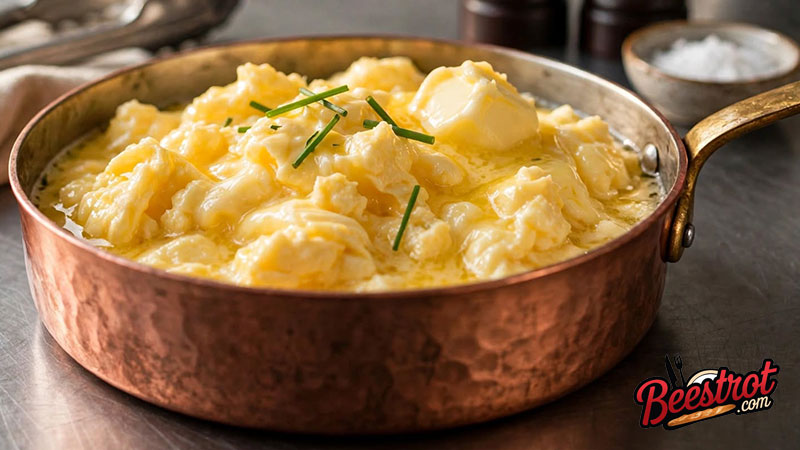
The second school, which Gordon Ramsay has made famous and which is closer to what I use in a working kitchen, operates on a different principle. On and off the heat. Cold eggs cracked directly into a cold pan with cold butter. Heat on, stir constantly with a rubber spatula, and after thirty seconds, heat off. Keep stirring. Heat back on. Repeat three or four times over three minutes total. Remove from the heat slightly before they look done. Finish with a small spoonful of crème fraîche or sour cream, which stops the cooking and adds a final layer of richness. Season only at the end. Salt added early draws water out of the eggs and makes them grey and watery.
Both methods share the same underlying principles: low or controlled heat, constant movement, and pulling the eggs before they appear ready. The bain-marie is the more refined approach. The on-off method is the more practical one. I use the bain-marie on weekends when I am cooking for people I want to impress. I use the on-off method every other day of the week.
What neither school does is what most home cooks do: whisk the eggs in a bowl, pour them into a hot buttered pan, and stir them occasionally until they look set. This method produces scrambled eggs that are edible. It does not produce scrambled eggs that are good.
Three specific things that will change your results immediately, regardless of which method you choose.
First: do not pre-whisk if you are using the on-off method. Crack the eggs directly into the pan. Whisking beforehand introduces too much air and produces a lighter, slightly grainier texture. The rubber spatula breaks the yolks and combines the eggs as they cook. The result is richer and more cohesive.
Second: do not season at the start. Salt is hygroscopic. It draws water out of whatever it touches. Add salt to raw eggs and you will see the mixture become watery within minutes. The proteins also begin to denature slightly before cooking, which affects the texture of the final curd. Season at the very end, off the heat, just before you plate. This is standard professional practice. It is almost never mentioned in home recipes.
Third: stop cooking before you think you should. The eggs will look underdone when you pull them. They will finish cooking in the residual heat on the way to the plate. If they look perfect in the pan, they are already ten seconds past perfect. This takes practice to trust. Trust it anyway.
One last thing. The crème fraîche at the end is not optional if you want restaurant results. A small spoonful, stirred in off the heat in the final moment, does two things: it stops the cooking immediately by dropping the temperature, and it adds a dairy richness that makes the eggs taste finished rather than plain. Jacques Pépin uses a reserve of raw beaten egg mixed with cream for the same purpose. The principle is identical: introduce cold fat at the end to arrest the cooking and add creaminess.
Make these tomorrow morning. Use three eggs, a knob of cold butter, and a pan that is not too large. Pay attention for four minutes. Taste what happens.
Then come back and tell me they are fine.
The kitchen never lies. History sometimes does.
Jean Louis
Want to cook like a professional? These books will close the gap.
Sources
- Food Republic. Gordon Ramsay Never Whisks His Scrambled Eggs. The on-off heat method explained.
- The Daily Meal. How Celebrity Chefs Make Perfect Scrambled Eggs. Ramsay, Blumenthal, Child, Pépin methods compared.
- Fine Dining Lovers. Gordon Ramsay Scrambled Eggs Recipe. Step-by-step technique with timing.