Last Updated on October 4, 2026 by Jean Louis
The most expensive restaurant meal I have ever eaten was sushi. A small room in Tokyo. A counter seating eight people. A chef who had trained for a decade before being allowed to touch the fish. Twelve courses over two hours. The reverence in the room was such that people spoke in lowered voices, as if in a museum.
I thought about Hanaya Yohei a lot that evening.
Yohei was a street food vendor in Edo, the city we now call Tokyo. In 1810, he set up a stall between two famous temples in the Asakusa district, in one of the most crowded parts of the city. Edo was enormous by the standards of the time, already one of the largest cities in the world, with a population of over a million people constantly moving through its streets. They were hungry and in a hurry. Yohei had an answer.
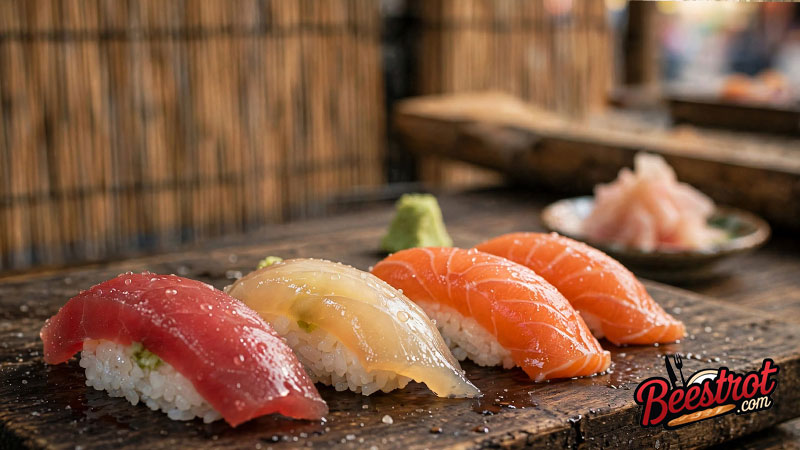
He pressed a small mound of vinegared rice together with two fingers, laid a piece of fresh raw fish from Tokyo Bay directly on top, and handed it over. The whole operation took less than thirty seconds. The customer ate it standing at the stall, paid, and moved on. There were no chopsticks, no plates, no soy sauce poured into a small ceramic dish, no ceremony of any kind. Yohei had invented nigiri sushi as the Edo equivalent of a hot dog stand. It was designed to be consumed in the time it took to catch your breath between appointments.
The key innovation was the fresh fish. Previous forms of sushi in Japan used preserved or fermented fish, which was shelf-stable but took months to prepare and had a strong flavour that required the rice as a counterbalance. Yohei was operating near Tokyo Bay, which was packed with fish. He realised that using raw fish directly from the morning catch meant the sushi could be assembled to order in seconds, and the flavour was cleaner and more immediate than anything previously on offer. Customers gathered to watch him work. The speed was part of the attraction. He was, by the standards of the day, performing.
Nigiri became a sensation. Within years, vendors were setting up across Edo, and the style spread to other cities. The street stalls multiplied. Sushi was the fast food of 19th-century Japan, accessible to working people, eaten on the street, cheap, quick, and delicious. For most of the Edo period, it occupied roughly the same cultural position as a sandwich does in modern London or a taco in modern Mexico City. Satisfying, familiar, ubiquitous, and decidedly unglamorous.
Then came September 1, 1923. The Great Kanto Earthquake struck the Tokyo metropolitan area with a magnitude of 7.9. The fires that followed the quake burned for two days and destroyed an estimated 381,000 buildings. Tokyo was levelled. More than 100,000 people died. And among the casualties were virtually every sushi stall and street vendor in the city. When the city was rebuilt, the street food culture that had been the natural habitat of sushi did not return in its old form. The vendors who survived moved indoors. The indoor version of the sushi stall became the sushi restaurant. And once you are indoors, with walls and a roof and tables and chairs, a different set of expectations comes with the territory.
The shift from outdoor stall to indoor restaurant brought with it the slow accretion of formality. Better crockery. Proper seating. A menu. Then, over the following decades, the concept of the itamae, the master chef, whose years of training justified a premium price. The refrigeration technology that arrived in the mid-20th century made it possible to handle fish with more precision and offer a broader range of varieties. The export of sushi to the West in the 1960s and 1970s, initially through Japanese immigrant communities in Los Angeles, turned it into an international phenomenon and, in the process, elevated its status further. By the time sushi reached the fine dining rooms of New York and Paris, it carried the cultural weight of centuries of Japanese culinary tradition, most of which had been attached to it relatively recently.
The California roll, invented in Los Angeles in the 1970s by a Japanese chef who substituted avocado for tuna because fresh tuna was unavailable, is today considered an aberration by purists. It would have seemed perfectly normal to Yohei. He was also adapting to what was available and what his customers wanted. The difference is that he was working at a street stall and had no idea his improvisation would one day be discussed in terms of authenticity.
The conveyor belt sushi restaurant, known in Japan as kaiten-zushi, was invented in 1958 by Yoshiaki Shiraishi, who got the idea from watching beer bottles move along a conveyor belt at an Asahi brewery. He opened the first kaiten-zushi restaurant in Osaka that year. It was, in spirit, the closest thing to Yohei’s original vision that the modern world has produced: fast, accessible, unpretentious, and focused entirely on getting good fish in front of hungry people as quickly and cheaply as possible. The wheel had turned. The hot dog stand had come back.
The evening at the counter in Tokyo was extraordinary. The fish was extraordinary. The craft was extraordinary. I would go back without hesitation. But I also think Yohei, if he could have seen it, would have found the whole thing baffling. He invented nigiri as street food. He would not have recognised the reverence.
He probably would have told us to eat faster.
The kitchen never lies. History sometimes does.
Jean Louis
Every dish has a past. These books will take you further into it.
Sources
- Nippon.com. When Sushi Became a New Fast Food in Edo. Hanaya Yohei 1810, yatai stalls, Asakusa district, fast food origins.
- Unseen Japan. Edomae Sushi. From street food to fine dining, Tokyo Bay fish markets, omakase transformation.
- Vital Choice. The Origin of Sushi. Great Kanto Earthquake 1923, indoor restaurants, California roll, kaiten-zushi invention.