There is a photograph that circulates regularly online: a golden latte in a ceramic cup, sprinkled with turmeric, sitting on a marble counter beside a sprig of something decorative. The caption varies. The substance does not: turmeric has arrived. A new superfood. An ancient secret the wellness industry has unlocked. The articles that follow describe anti-inflammatory properties, antioxidant effects, the compound curcumin and its promising research profile. They use words like “discover” and “reveal” without apparent awareness that what they are describing was documented in Ayurvedic texts three thousand years before anyone on the internet was born.
Turmeric, Curcuma longa, has been cultivated in South Asia for at least four thousand years. It is documented in Sanskrit medical treatises from around 1500 BCE. It appears in the Sushruta Samhita, one of the foundational texts of Ayurvedic medicine, as a treatment for respiratory conditions, digestive complaints, skin disease, and inflammation. It was used in Indian religious ceremonies, as a dye for fabric, as a preservative for food. It was a daily kitchen ingredient across India, Southeast Asia, and much of East Asia for millennia. The idea that its properties were hidden, waiting for a Western laboratory to expose them, belongs to a particular kind of historical imagination that tends to locate discovery in the moment it arrives at a certain kind of address.
The spice that the wellness industry calls a discovery has been in daily use in Indian cooking for four thousand years. What changed is not the spice. What changed is who is paying attention.
The Root Before the Powder
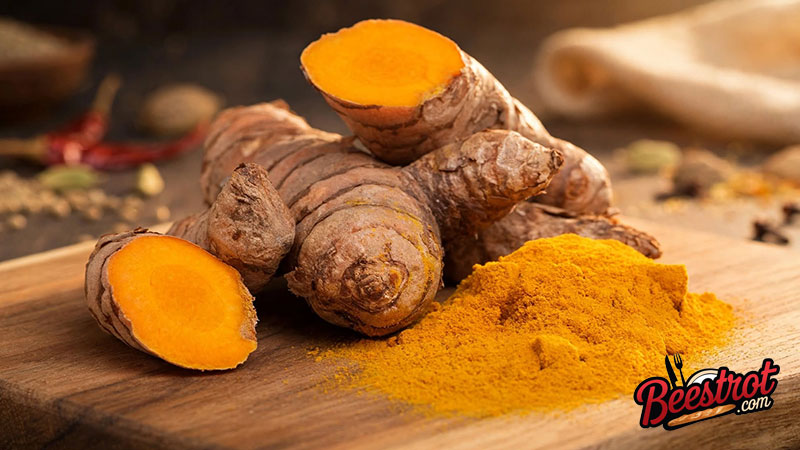
Fresh turmeric root looks like a smaller, more intensely orange relative of ginger, which is, in fact, its botanical cousin. The powder most people know is the dried and ground version of that root, and the drying process concentrates the color and the flavor while reducing the volatile oils that give fresh turmeric its slightly different character. In Indian cooking, fresh turmeric appears in pickles, chutneys, and specific regional dishes where its earthier, slightly bitter freshness is the point. In most everyday cooking, the powder is what goes into the dal, the curry, the rice dish, the vegetable preparation.
The color is the first thing. Turmeric stains everything it contacts: cutting boards, fingers, cloth, ceramic. This is not a side effect. It was for much of its history a primary feature. The yellow-orange color turmeric produces was used in Hindu religious ritual, where it marks auspicious occasions, and in South and Southeast Asian textile dyeing for centuries before synthetic colorants existed. Jack Turner, in Spice: The History of a Temptation, traces how the spice trade shaped European history, and the colors these spices could produce were part of what made them valuable. Turmeric’s pigment, curcumin, is the same compound that laboratories are now studying for its biological activity. The ancient dyers did not know why it was yellow. They knew that it was, and that it lasted.
What the Texts Already Said
Ayurveda, the traditional medicine system that developed in India over several thousand years, classified turmeric as a substance with broad therapeutic application. It appeared under the Sanskrit names haridra and kanchani. The Charaka Samhita, compiled approximately two thousand years ago and drawing on older oral traditions, lists turmeric among its primary medicinal plants. Its recorded uses include treatment of jaundice, liver disorders, skin conditions, wounds, and respiratory illness. It was administered as a paste, a decoction, in warm milk, mixed with ghee. The warm milk preparation is essentially what the contemporary wellness industry now sells as “golden milk.”
Bharat B. Aggarwal, in Healing Spices, documents the contemporary scientific research into curcumin alongside the historical record of traditional use. The juxtaposition is instructive. The traditional medical systems were observational over very long periods. They could not isolate curcumin or explain the mechanism of action at the molecular level. What they could do was record, across generations and centuries, what happened when people used this root consistently. The pattern they documented and the patterns researchers are now identifying in laboratories are not the same kind of knowledge, but they are not unrelated either.
Ayurvedic texts documented turmeric’s effects on inflammation two thousand years before the word “curcumin” existed. The science caught up to the observation. The observation was not waiting for the science.
The Routes That Carried It
Turmeric moved through the ancient spice trade along routes that connected South Asia to the Arab world, East Africa, and eventually Europe. Arab traders knew it well; medieval European texts mention it, though often confusedly, conflated with saffron under names like “Indian saffron.” The confusion is revealing: European observers encountered turmeric’s color and reached for their nearest equivalent. They were not thinking about the medicinal tradition behind it, the culinary complexity it carried in its origin region, or the thousands of years of use that preceded its arrival in their markets.
John Keay, in The Spice Route: A History, maps the trade networks that carried spices from production regions to consumption markets across centuries, and the economic and political pressures that shaped those networks. The spice trade was never only about flavor. It was about preservation, medicine, status, and the enormous profits available to whoever controlled the chain between the plant and the plate. Turmeric moved through those networks as a dye, a medicine, and a culinary ingredient simultaneously, its value shifting depending on where in the world it arrived and who was buying it.
What “Discovery” Actually Means
The contemporary Western interest in turmeric follows a recognizable pattern. A food substance used traditionally in another culture is identified by researchers or popularized in the wellness press. It is framed as newly discovered, ancient wisdom revealed, a secret unlocked. The framing positions the receiving culture as the one doing the discovering and the source culture as the one holding something in reserve, waiting to be found out. The effect is to erase the people who were using it all along, who developed the knowledge of how to use it, who passed that knowledge through generations in texts and kitchens and family practice.
In Indian households, turmeric is not a supplement or a wellness trend. It is an ingredient so basic that its absence would be noticeable the way the absence of salt would be noticeable. It goes into lentils and vegetables and rice and marinades and drinks. It is rubbed onto meat before cooking. It is applied to the skin in traditional skincare preparations. It is present at weddings and religious ceremonies. Its anti-inflammatory properties are not news. They are assumptions, built into a culinary tradition over such a long period that they have become invisible, which is exactly what happens to things that work and stick around long enough.
A spice does not need to be discovered to be real. It only needs to be used. The kitchens of India have been using it for four thousand years without waiting for confirmation.
Every spice carries a world inside it. I am just learning to listen.
Jean Louis


Sources
- Turmeric, the Golden Spice, National Institutes of Health
- Turmeric, Encyclopaedia Britannica
- Ingredient Focus: Turmeric, BBC Good Food
- The Long History of Turmeric, SBS Food
- A Golden Past: The History of Turmeric, Smithsonian Magazine