If you have ever eaten a banana-flavored candy, a banana popsicle, or the banana version of anything mass-produced before the 1980s, you have tasted a banana that you can no longer buy. The artificial banana flavor in those products was not invented to replicate the yellow fruit sitting in your kitchen right now. It was based on a different banana entirely. One that most people today have never encountered. One that the food industry quietly replaced and then forgot to mention.
The Banana That Built the Trade
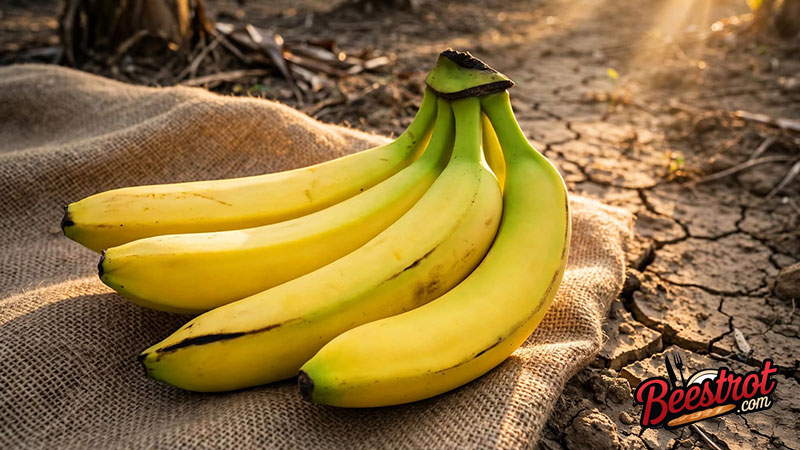
The Gros Michel (French term), known in the trade as Big Mike, was the dominant commercial banana for most of the twentieth century. Thicker-skinned than what replaced it, creamier in texture, sweeter, with a flavor that food writers and botanists consistently describe as richer and more complex. It bruised less readily. It lasted longer in transit. And because it did not require refrigeration at the same level as its successor, it was significantly easier and cheaper to ship across oceans.
The banana industry, led by companies like United Fruit, built entire plantation systems around the Gros Michel. Recipes for banana pudding and banana cream pie written before 1960 were designed with that specific variety in mind. The chemists who developed artificial banana flavoring in the mid-twentieth century worked from the Gros Michel, which is why artificial banana tastes nothing like the fruit you buy today. It tastes like the fruit your grandparents bought.
By 1960, Gros Michel banana production had been devastated by a soil fungus that the industry had watched spreading for decades before taking action. Estimates of the financial losses from the Panama disease epidemic range as high as $2.3 billion, equivalent to roughly $18.2 billion today.
How Monoculture Farming Made the Disaster Inevitable
The Gros Michel banana is a sterile triploid hybrid. It produces no viable seeds. Every banana plant on every plantation was grown from a cutting taken from another plant. Which means every banana plant on every plantation was genetically identical to every other banana plant on every plantation on earth.
What home cooks are actually buying on Amazon right now.
Updated hourly. Real purchases, real kitchens, the most trusted list on the internet.
See What's HotThis is what monoculture farming does at scale. It standardizes. It optimizes. And it removes the one thing that allows a living species to survive a novel threat: variation. When a soil pathogen called Fusarium oxysporum cubense, the fungus responsible for Panama disease, began spreading through banana-growing regions in Central America and the Caribbean in the early twentieth century, it found something extraordinary. Fields containing millions of plants with no genetic difference between them. No resistance in one. No resistance in any.
Researchers identified disease-resistant banana varieties as early as 1910. According to historical accounts, the U.S. banana companies that dominated the export trade did not begin replacing the Gros Michel until the late 1950s. The crop variety problem was understood. The industry continued monoculture farming for decades anyway.
Plantations were abandoned and new jungle cleared as companies tried to outrun the fungus. The disease followed. The strategy bought time and nothing else.
The Replacement Nobody Announced
The Cavendish banana, the variety you eat today, was selected as the industry’s replacement because it had one useful property: resistance to Race 1, the strain of Fusarium oxysporum that had destroyed the Gros Michel. The first Cavendish varieties used commercially were collected in Southeast Asia. They were not beloved. Industry executives worried in the early 1960s that consumers would reject the new banana because it did not taste like the one they knew.
They did not reject it. Partly because they had no choice, and partly because nobody explained that anything had changed. The Cavendish arrived in supermarkets under the same name, in the same shape, at roughly the same price. Consumers were not informed that the banana they had eaten their entire lives had been replaced by a different variety with a different flavor profile. It was a form of food fraud by omission: technically legal, commercially motivated, and never explained to the people eating it.
The Gros Michel did not go extinct. It still grows. You can find it in parts of Central America and Southeast Asia. It is simply no longer viable for mass commercial agriculture at the scale the industry requires. The crop variety exists. The industry abandoned it and replaced it with something easier to manage, then said nothing.
What Was Actually Lost
Recipes developed before 1960 describe a banana that is noticeably sweeter, with a creamier texture and what many accounts describe as a more pronounced flavor. The Gros Michel’s thicker peel meant it arrived at market in better condition and lasted longer on the shelf. The flavor loss with the Cavendish transition was real and was acknowledged within the industry at the time. Dan Koeppel, in Banana: The Fate of the Fruit That Changed the World, traces this history in detail, drawing on company records and agricultural history that document exactly how the transition happened and what it cost in terms of flavor and crop variety.
Adam Leith Gollner, in The Fruit Hunters, found Gros Michel bananas growing in Central America and described them as genuinely different from anything available commercially. Sweeter. Richer. The kind of difference that makes you understand why people talk about them the way people talk about heirloom tomatoes. Something was there before. Something was removed. The removal was silent.
The Cavendish Has the Same Problem Now
Tropical Race 4, known as TR4, is a new strain of the same Fusarium fungus. The Cavendish has no meaningful resistance to it. TR4 has spread through banana-growing regions across Asia, Australia, the Middle East, Africa, and reached Colombia in 2019. In the Philippines alone, losses have totaled $400 million.
The mechanism is identical to what destroyed the Gros Michel. Monoculture farming. Genetically uniform plants. A pathogen finding no variation, no resistance, nothing to slow it down. Dan Saladino, in Eating to Extinction, places the banana’s situation within a broader argument about what industrial agriculture has done to the genetic diversity of the food supply. The banana is not an isolated case. It is a demonstration of the logic.
The food system chose the Gros Michel because it was convenient, grew it as a monoculture because monoculture is efficient, lost it to a fungus that exploited the uniformity, replaced it with a different variety that was also grown as a monoculture, and is now watching the same fungus doing the same thing to the replacement. The crop variety problem was identified in 1910. It was understood in the 1950s when the Gros Michel collapsed. It is understood now.
The banana on your shelf is a clone. Every Cavendish on earth is genetically identical to every other Cavendish on earth. TR4 is a soil pathogen that can persist for decades. Once it reaches Latin America’s major growing regions, the trade faces the same crisis it faced in the 1950s, with no obvious replacement waiting.
What You Are Actually Eating
The banana you buy today is the product of a crisis response from sixty years ago. It was selected not because it tasted better than what it replaced, but because it survived a disease the industry had refused to plan for. The flavor you think of as banana flavor is the flavor of the replacement. The banana you would call a banana if you had grown up eating the original would taste different. Noticeably, recognizably different.
This is not a small thing. The Gros Michel was the dominant commercial fruit of the twentieth century. It shaped the flavor expectations of multiple generations. It was replaced without explanation, in an operation that required the coordinated replanting of millions of acres of tropical agriculture, and nobody thought to tell the consumer that anything had changed. The fruit on your plate has a history it was never required to disclose.
Every dish has a past. I am just following it back to the beginning.
Jean Louis
Sources
- The Beloved, Bedeviled Banana, JSTOR Daily
- Panama Disease, Wikipedia
- The Quest to Save the Banana from Extinction, World Economic Forum
- Banana Extinction: Panama Disease Has Returned, Newsweek
- Gros Michel Banana, Wikipedia
More Delicious Reads
How You Cut Garlic Changes What It Tastes Like. Four Cuts, Four Flavours.
Two New Pieces, and a Word on How This Works
The Temperature Secret That Separates Professional Cooking From Everything Else.

Ice Cream Was a Luxury Only Kings Could Afford for 200 Years. Then One Invention Changed Everything.
Why Bakery Bread Cannot Be Replicated at Home. And the One Thing You Can Do About It.
Lobster Was Fed to Prisoners in Colonial America. Laws Were Passed to Stop Servants Being Served It ...
The Industry Convinced You Breakfast Is the Most Important Meal of the Day. It Was an Ad Campaign.
Mayonnaise Was Almost Certainly Invented During a Military Siege. No Kitchen Was Involved.
The Waffle Was a Medieval Communion Tool Before It Became Breakfast. The Sweet Version Was an Accide...