Most home cooks who have made stock and found it disappointing have done everything the recipe told them to do. They used a good chicken. They added vegetables. They simmered it for hours. The result tasted thin and flat, like hot water with ambition. The problem was not the recipe. The problem was what the recipe did not say.
The Temperature Problem
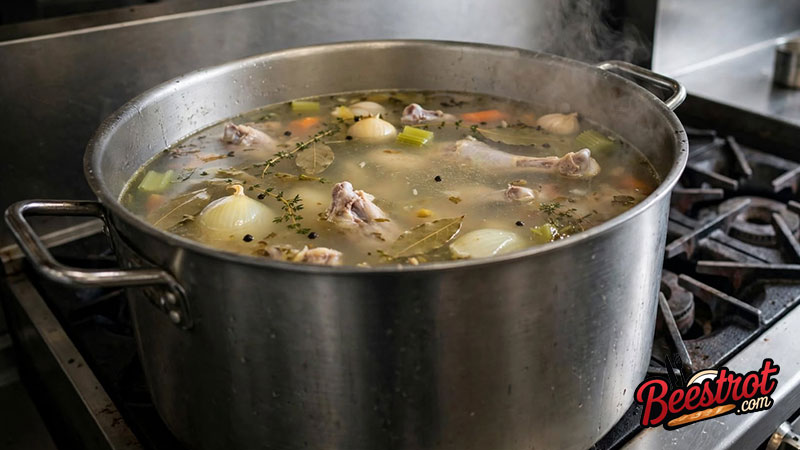
The single most common reason homemade stock tastes like water is boiling. Most home cooks bring the pot to a boil and either leave it there or pull it back only slightly. Professional kitchens never boil stock. They simmer it, which means the surface of the liquid should be barely moving: an occasional lazy bubble rising, nothing more.
The reason this matters is both visual and chemical. A rolling boil forces proteins and fats into emulsification, producing a cloudy, greasy liquid with a slightly bitter edge. A gentle simmer allows those proteins to rise to the surface as grey foam, where they can be skimmed off cleanly. The result is a clear, clean stock with nothing muddying the flavor.
The practical test is simple: if the liquid is visibly agitated, the temperature is too high. Turn it down until the movement almost stops, then find the lowest setting that maintains a steady heat. The difference between a simmer and a boil is perhaps ten degrees. The difference in the finished stock is not subtle.
A rolling boil produces cloudy, bitter stock. A gentle simmer produces a clear one. The difference in temperature is perhaps ten degrees. The difference in result is everything.

Vitamix E310 Explorian Blender
Silky smooth soups, nut butters, smoothies and sauces. Variable speed, self-cleaning, built for decades of use. The blender serious cooks actually buy.
View on Amazon
Start in Cold Water, Not Hot
The second rule is one that feels counterintuitive: start the bones in cold water, then bring the temperature up slowly. Many home cooks add bones to boiling or already-hot water, wanting to save time. This seals the surface of the bone quickly, trapping the impurities and collagen inside rather than drawing them out.
Starting in cold water and rising slowly allows the proteins and minerals inside the bone to migrate gradually into the surrounding liquid. The grey foam that appears in the first twenty minutes is those impurities leaving the bones. Skim it off and discard it. Once the foam stops appearing, the cleaning phase is complete and the extraction phase begins in earnest.
This is also when time becomes important. Chicken stock needs three to four hours at a steady simmer to fully extract the gelatin from the bones. A stock pulled at forty-five minutes has extracted very little collagen and will taste thin regardless of how good the bones were. Professional kitchens make stock overnight or across a full service day. They are not in a hurry, and the results are not accidental.
Starting bones in cold water is not about saving energy. It is about allowing the structure of the bone to open gradually and release everything it holds into the surrounding liquid. Hot water closes that door before it has a chance to open.
The Two Steps Most Recipes Leave Out
For dark stocks, brown stock, beef stock, veal stock, roast the bones first. This is non-negotiable in a professional kitchen and treated as optional, usually omitted, in most home recipes. Roasting develops Maillard reaction compounds across the bone surface, adding depth, color, and the complex savory notes that separate a rich stock from a pale one. Spread the bones on a hot oven tray at around 220 degrees Celsius until properly colored. Pale bones produce pale results.
For white stocks, chicken or veal, blanch the bones first: cover in cold water, bring to a boil, discard the water, rinse the bones, and begin again. This removes the grey scum in one clean pass rather than skimming it across an hour. It costs fifteen minutes and most home recipes cut it out. Professional kitchens do not.
The aromatics follow a timing rule as well. Add vegetables in the final ninety minutes to two hours, not at the beginning. Vegetables cooked for three or four hours in simmering stock turn bitter and release off-flavors that flatten and cloud the result. The mise en place principle applies here: everything prepared and added at the right moment, not all at once because the recipe lists them together.
Roasting the bones before you begin is the step that separates a brown stock from hot water with vegetables in it. It takes twenty minutes in a hot oven and cannot be replaced by reducing time or adding more seasoning at the end.
Salt and Water: The Two Rules That Never Change
Never salt your stock. This is an absolute rule in professional kitchens with no exception. Stock is a base that will be reduced, adjusted, and seasoned at a later stage. Salt added during cooking concentrates as the liquid reduces. A stock seasoned at the beginning becomes a sauce too salty to use by the time it has reduced by half. Salt the finished dish, not the foundation.
The water ratio is equally fixed. Too much water produces a dilute stock regardless of the quality of the bones. The correct proportion for chicken stock is roughly one kilogram of bones to one litre of cold water. Home cooks who want more stock add more water. Professional kitchens add more bones.
If the finished stock tastes thin, reduce it. Return the strained stock to the heat and simmer uncovered until the flavor concentrates. This reduction intensifies everything the bones contributed and is the foundation from which almost every classical sauce begins. The home cook who learns to roast the bones, start in cold water, never boil, and reduce at the end has learned the fundamentals of professional stock-making from a single pot. The five rules are not complicated. They are just rarely explained.
A recipe is a promise. A technique is the truth behind it.
Jean Louis
Sources
More Delicious Reads

The Michelin Star Was Invented to Sell Tyres. The Brothers Had No Interest in Food.

Honey Found in Egyptian Tombs Is Still Edible. Jean Louis Explains Why That Is Not Surprising.

Popcorn Was Being Eaten in the Americas 5,000 Years Before Cinema Existed. Hollywood Did Not Invent ...
The French Did Not Invent French Fries. Belgium Is Still Angry About This.
Pasta Did Not Come From China. The Marco Polo Story Is a Myth. Here Is the Real One.
How to Grow Basil Indoors and Actually Keep It Alive Past Two Weeks.

Coffee Was Banned in Three Continents at Different Points in History. The Reasons Were Always Politi...

Olive Oil Has Been Produced for 8,000 Years. The Way It Is Sold Today Would Have Been Considered Fra...
Restaurants Use Three Times More Butter Than Any Recipe Admits. This Is Not an Accident.