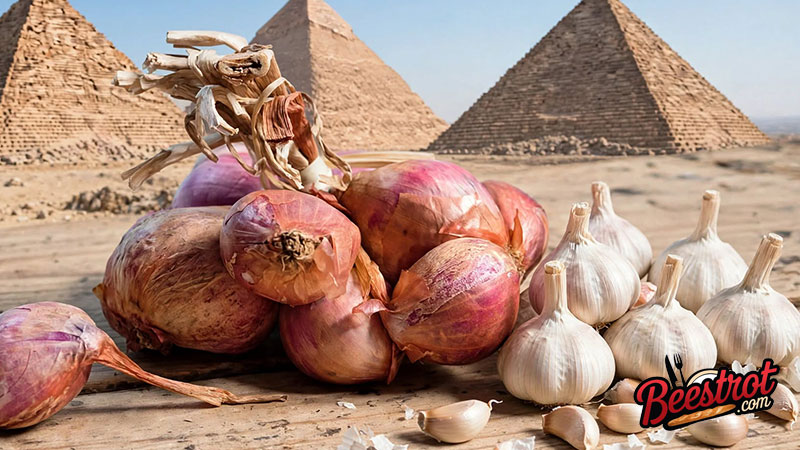
Herodotus claimed he read it on the pyramid itself: an inscription recording the quantities of garlic, radishes, and onions consumed by the workers during construction. The sum he attached to them, sixteen hundred talents of silver, is probably an exaggeration. The garlic almost certainly is not.
Modern archaeology at the Giza worker villages has confirmed what ancient texts suggested: the people who built the pyramids were paid employees, not slaves, and their wages were largely delivered in food. Bread and beer formed the core. Garlic, onions, and leeks were standard ration items. The logic was entirely practical. These were calories that could be grown, stored, transported, and distributed at scale across a construction site in the desert.
A Wage You Could Eat
The concept of food as currency was not unique to Egypt, but Egypt refined it into a bureaucratic system of considerable precision. Ration records from the Old Kingdom construction period detail not just quantities but categories: who received what, in what amounts, according to their role on the site. Supervisors received more. Skilled workers received more than laborers. The ration list was, in effect, a payroll.
Garlic and onions appear consistently in these records. They were not incidental additions to the diet. They were nutritionally dense, resistant to spoilage in dry conditions, and valued in Egyptian medicine for their protective properties. Distributing them to a workforce of thousands laboring in extreme heat was not a gesture of generosity. It was a calculated provision aimed at keeping people functional.
Excavations at the Giza worker village have uncovered evidence of organized food production on a large scale: bakeries, breweries, and storage facilities designed to feed a rotating workforce estimated at between 10,000 and 20,000 people. The logistics of feeding the pyramid builders were as complex, in their way, as the logistics of building the pyramids.

Instant Pot Duo 7-in-1, 6 Qt
Pressure cooker, slow cooker, rice cooker, steamer, sauté, yogurt maker and warmer, all in one. The kitchen workhorse that changed how millions of people cook.
View on Amazon
The System Behind the Ration
The food ration system worked because Egypt’s agricultural output was centrally managed. The state controlled grain stores, and workers were compensated by drawing on those stores rather than receiving metal currency. This was not barter. It was a wage system denominated in commodities the state controlled and workers depended on entirely.
Garlic and onions were part of this because they solved specific logistical problems. They could be harvested once and stored for months. They could be bundled and moved. They required nothing elaborate to prepare or consume. For a workforce that lived in organized villages near the construction site and had limited use for abstract currency, food rations were more functional than silver.
The workers were not reluctant participants in this arrangement. Archaeological evidence from the Giza village includes graffiti naming work gangs with competitive nicknames, evidence of organized sports, and burial grounds that indicate a community with social structures and something recognizable as professional pride. The ration was their income. When it failed to arrive, they understood exactly what to do about it.
The Giza worker cemeteries discovered in the 1990s contained remains showing evidence of healed fractures and medical care provided by the state. These were not people worked to exhaustion and discarded. They were a skilled workforce that the administration had material reasons to maintain.
When the Garlic Stopped Coming
The clearest record of what happened when the ration system failed comes not from the pyramid builders of the Old Kingdom but from their descendants working on royal tombs in the Valley of the Kings, approximately thirteen centuries later. The document that survives is known as the Turin Strike Papyrus. It is the oldest recorded labor strike in history.
In the twenty-ninth year of the reign of Ramesses III, around 1159 BC, the workers of Deir el-Medina stopped work. They had not been paid for eighteen days. The grain ration, the beer, the garlic, the fish, the vegetables: none of it had arrived. The workers walked off the site and positioned themselves outside the walls of the mortuary temple of Thutmose III. They refused to return until someone in authority explained where their wages were.
What is striking about the papyrus is its tone. The workers were not rioting. They were negotiating. They sent formal notification. They identified themselves by name and work gang. They stated their grievance with precision: they were hungry, they had nothing at home for their families, and they had waited long enough.
The Turin Strike Papyrus records the workers’ own words: “We have been driven here by hunger and by thirst; we have no clothing, no fish, no vegetables. Write to Pharaoh our good lord about it, and write to the vizier our superior, that subsistence may be made for us.” The document is held in the Egyptian Museum in Turin.
What the Strike Proved
The strike succeeded. Officials arrived. Emergency rations were delivered. The workers returned to the tombs. The papyrus records this resolution without elaboration, as if the outcome were expected by everyone involved. It probably was.
The incident reveals something important about the nature of the ration economy. The workers’ power was not theoretical. It existed because the state needed the work completed, and the state had made the workers entirely dependent on a supply chain that could fail. When the garlic and the grain stopped arriving, the workers had limited recourse. They also had no hesitation about using the one they did have.
The garlic was not incidental to the story. It was the wage. And when the wage disappeared, so did the work.
Every dish has a past. I am just following it back to the beginning.
Jean Louis
Sources
- Turin Strike Papyrus, Wikipedia
- Deir el-Medina, Wikipedia
- Ancient Egypt Research Associates, Giza Workers Village Project
- The Giza Project, Harvard University
- Egyptian Pyramid Construction Techniques, Wikipedia
More Delicious Reads
The Temperature Secret That Separates Professional Cooking From Everything Else.

Corn Does Not Exist in Nature. It Was Engineered by Human Hands Over 9,000 Years. The Original Plant...

Canned Food Was Invented 50 Years Before the Can Opener. People Used Hammers and Chisels. Nobody Saw...

Mayonnaise Was Almost Certainly Invented During a Military Siege. No Kitchen Was Involved.

Coffee Was Banned in Three Continents at Different Points in History. The Reasons Were Always Politi...

The Tomato Was Considered Poisonous in Europe for 200 Years. Here Is Why.

Saffron Is the Most Expensive Spice in the World. Here Is Why It Is Worth Every Cent.

Ice Cream Was a Luxury Only Kings Could Afford for 200 Years. Then One Invention Changed Everything.

The Human Recipe: Why Emotion Wins Over AI in Storytelling