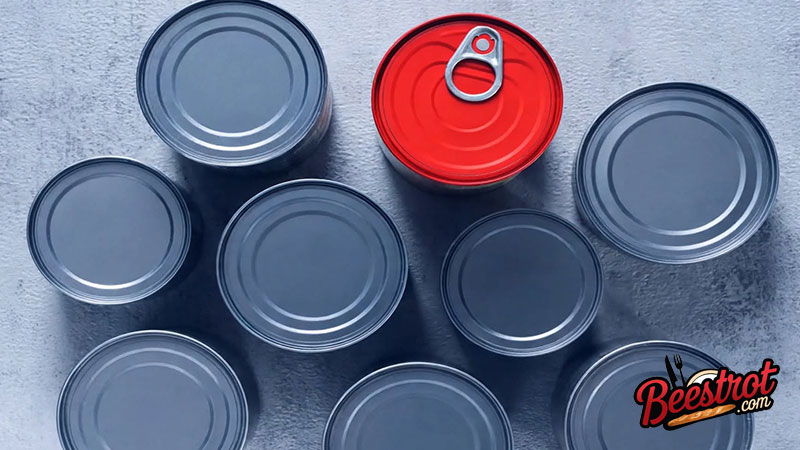
There is a tin can in a British museum, sealed in 1823, that was opened and tested in 1938. The contents, described as roasted veal, were found to be in reasonable condition. The can itself was remarkable for a different reason: it weighed more than its contents. The iron was thick enough to require real tools to breach it. The kind of tools you would use on a wall, not a pantry shelf.
This was not a defect. It was standard. For roughly fifty years after the invention of the tin can, there was no purpose-built tool for opening one. The cans existed. The openers did not. The gap between those two facts sits in the middle of one of the more quietly absurd chapters in the history of food.
The Prize That Started Everything
In 1795, Napoleon Bonaparte’s government offered a prize of 12,000 francs to anyone who could devise a reliable method of preserving food for the military. Armies of the era were losing more men to scurvy and dysentery than to combat. The logistics of feeding troops in the field were a consistent strategic problem. The prize sat unclaimed for fourteen years.
Nicolas Appert was a Parisian confectioner from Châlons-en-Champagne who had spent those years experimenting. His method was simple in principle and difficult in practice: food packed into glass bottles, sealed tightly, then heated in boiling water. He had no idea why it worked. The science of microbiology would not exist until Pasteur, fifty years later. Appert knew only that it did work, and in 1810 he claimed his prize and published his findings. The same year, a British merchant named Peter Durand replaced Appert’s glass with tin-coated iron and patented the result.
Tom Standage, in An Edible History of Humanity, traces how the pressure to feed armies has repeatedly driven the most significant innovations in food technology, from salt and fermentation to canning and refrigeration. Appert’s prize was not unusual in this history. It was the pattern. The military requirement created the invention. The civilian application followed, often decades later, often incompletely. The can arrived in the kitchen long before anyone thought seriously about how the kitchen would open it.

Silpat Premium Non-Stick Baking Mat, Half Sheet
No parchment, no sticking, no waste. Cookies, pastries, roasted vegetables: everything releases perfectly. Used by professional pastry chefs everywhere.
View on Amazon
The Can That Could Not Be Opened
The first tin cans were not the thin aluminium cylinders on today’s supermarket shelves. They were forged from wrought iron, coated in tin to resist rust, and built to survive the conditions of a military campaign. Some measured close to a quarter of an inch thick. They were heavy, robust, and extremely difficult to open without tools.
Where instructions existed at all, they were direct. One early manufacturer advised consumers to cut around the top near the outer edge with a chisel and hammer. This was printed on the can itself. It did not occur to anyone involved in production, distribution, or sale that this was an unusual instruction for a food product. The cans were designed for a world where chisels and hammers were ordinary household implements and where the person opening the can was most likely a soldier, a sailor, or a cook in an institution with a well-equipped kitchen.
Bee Wilson, in Consider the Fork, examines how the tools of the kitchen have always shaped what we cook and how we think about food, and how the absence of the right tool can make even the simplest task feel unreasonable. The chisel-and-hammer instruction reads as comedy from a modern perspective. At the time it was simply practical guidance. The mismatch between the technology of preservation and the technology of access went unnoticed because the people who designed cans were not the people who opened them, and the people who opened them had no mechanism to register a complaint.
What Soldiers Actually Did
British soldiers in the Napoleonic campaigns used bayonets. American soldiers in the Civil War used knives, rocks, and the edges of other cans. Polar explorers on provisioned expeditions wrote about the process in their logs without particular emphasis, the same way they described other physical tasks that simply required effort. It was not considered a design flaw. It was considered part of the work of eating in the field.
The first can opener appeared in 1858, patented by Ezra Warner of Waterbury, Connecticut. It was a fixed blade with a guard, designed to be driven into the lid and worked around the rim in a sawing motion. It functioned. It was also genuinely dangerous to use. The US Army issued it to troops during the Civil War at a ratio of roughly one per company. A soldier would collect his rations, have the can opened by the designated keeper of the tool, and return it. The opener itself was treated as a piece of equipment to be managed, not a convenience to be distributed.
Mark Kurlansky, in Salt: A World History, follows the long human effort to solve the problem of preservation: keeping food edible beyond the moment of harvest or slaughter, across distances and seasons. Canning was the most dramatic solution the nineteenth century produced. But Kurlansky’s account makes clear that every preservation method creates its own secondary problems: the curing process changes the flavour, the drying process changes the texture, the canning process creates a sealed object that nothing in the domestic kitchen was designed to open. Each solution carries its own inconvenience forward into the next era.
The Fifty-Year Oversight
The question of why it took fifty years is the interesting one. The obvious answer is that the people who controlled the technology did not feel the problem the way the people who used it did. Canning was developed for military logistics. Armies have tools. The soldiers and sailors who spent decades opening cans with bayonets and chisels had no route back to the manufacturers to register a preference for something easier.
By the 1850s, canned goods were being sold commercially in quantity to civilian households. The inconvenience became visible because the person now holding the can was not a soldier. Within a decade of Warner’s 1858 patent, dozens of variations on the can opener existed. The double-wheel rolling design that became standard appeared in the 1870s. A problem that had sat unaddressed for fifty years dissolved in less than a decade once it was experienced by people whose complaints reached the market.
The 1823 can of roasted veal opened in a museum in 1938 is still the cleanest illustration of what canning actually achieved: food that outlasted the civilization that produced it, sealed inside a container that required a small act of violence to access. The technology worked perfectly. The ergonomics were an afterthought that took half a century to arrive.
Every dish has a past. I am just following it back to the beginning.
Jean Louis


Sources
- Canning, Wikipedia
- Can opener, Wikipedia
- Nicolas Appert, Wikipedia
- Peter Durand, Wikipedia
- Ezra Warner, Wikipedia
More Delicious Reads

Fresh vs. Dried Herbs. The Rule Every Professional Cook Knows and Nobody Teaches.
Ketchup Was a Fermented Fish Sauce Invented in Asia. Heinz Turned It Into Something Entirely Differe...

Sushi Was Originally Street Food Sold in Less Than 30 Seconds. Here Is What Happened to It.

Olive Oil Has Been Produced for 8,000 Years. The Way It Is Sold Today Would Have Been Considered Fra...
How You Cut Garlic Changes What It Tastes Like. Four Cuts, Four Flavours.

The Best Ingredient I Ever Added to My Kitchen Had Nothing to Do with Food

Subway: The $1,000 Bet That Built and Nearly Buried an Empire
Pizza Was Peasant Food Eaten With the Hands in the Street. The Version the World Loves Was Invented ...
The One Ingredient Every Pastry Chef Adds to Desserts That Home Cooks Never Think Of.