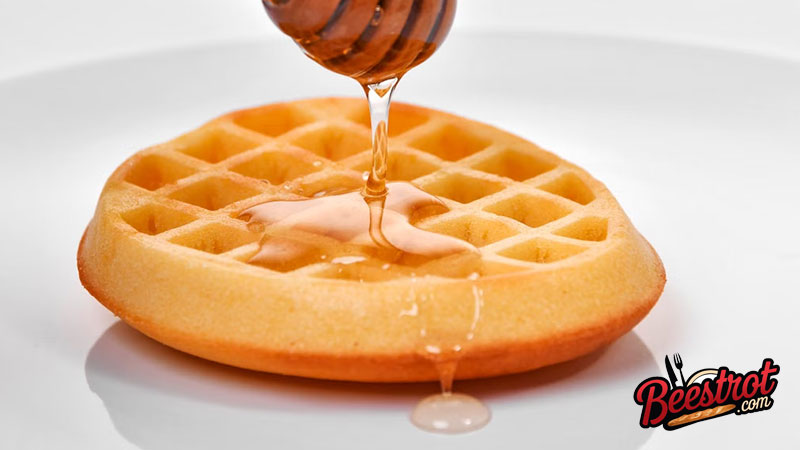
The iron came first. Long before anyone thought to pour sweetened batter into its plates, the hinged metal tool that produces a waffle was already in regular use across medieval Europe, pressed together over open flames to make something the baker had no intention of eating for breakfast.
The Iron and the Wafer
The gaufrier, the hinged iron used to make a waffle, appears in European records as early as the 13th century. What it produced then bore no resemblance to the thing people pour maple syrup over on a Sunday morning. The same plates, in slightly flatter form, pressed the communion wafer distributed at Mass: thin, dry, unleavened rounds of dough, marked with crosses or religious imagery by the engraved design of the iron itself.
The word traces back through Middle Dutch “wafel” and Old French “gaufre,” meaning honeycomb, a reference to the raised grid pattern the iron produced. But the earliest versions of these irons did not produce a honeycomb grid. They produced crosses and sacred images. The geometric grid that now defines the waffle’s appearance is a later development, a design that arrived when the iron moved from religious contexts into commercial production, and when depth became more useful than symbolism.
The connection between the communion wafer and the waffle is not metaphorical. They were made with the same type of tool, by the same type of craftsman, using essentially the same technique: a thin unleavened dough pressed between two heated plates and cooked quickly. Before each pressing, the iron was greased to prevent the dough from sticking, with lard in northern Europe and olive oil in Mediterranean regions. The only substantive differences were the pattern on the plates, the thickness of the final product, and the occasion on which it was consumed.
The communion wafer and the waffle share not just a tool but a technique, a lineage, and in their earliest forms, an almost identical recipe. What separated them was not cooking but context. One was pressed between sacred plates for the altar. The other was pressed between secular ones for the street.

Staub Cast Iron Round Cocotte, 4 Qt
Braises, stews, sourdough, tagines: the French-made cocotte that makes everything taste better. Beautiful enough to go straight from oven to table.
View on Amazon
From the Church Door to the Street Corner
By the 13th and 14th centuries, the wafer had escaped the liturgy. In medieval Paris, a recognized guild of street vendors called oublieurs sold thin wafers from trays hung around their necks, working the crowds that gathered near church doors after services. The oublie was still plain, still more cracker than cake, still largely unchanged from the communion wafer it had descended from. But it was now a commercial food, exchanged for money, consumed standing up in the street.
The sweet version arrived not through deliberate invention but through accumulation. Someone added honey to the dough. Someone else added spices, cinnamon and ginger, that were expensive enough to signal quality and common enough by that period to be accessible to a street food vendor. As sugar became available to broader segments of the population across the 15th and 16th centuries, it replaced honey in the mix. Each addition made the product more desirable, more distinct from its liturgical origin, and more profitable.
Street food obeys its own logic. It sells what people want to eat, not what the original designers intended. The oublie vendor who first added honey was not making a theological statement about the communion wafer. He was making a commercial one. The sweet version was an accident in the sense that nobody planned it, and a certainty in the sense that it was always going to happen once money entered the equation.
The transition from communion tool to street food took roughly a century and left no single inventor to credit. It was not a decision. It was a drift, one small addition at a time, pulled forward by the logic of commerce rather than the logic of religion. This is how most food history actually works: not an invention but an accumulation.
As the batter grew richer, the iron had to deepen. A thin iron that worked for a plain wafer could not contain a thicker batter without spilling. Deeper plates meant more surface area, and more surface area meant the grid pattern became structurally useful rather than merely decorative. The raised squares trapped batter, created even cooking across the whole surface, and produced a texture that held toppings rather than letting them slide off. The honeycomb grid was not an aesthetic choice. It was an engineering response to a more ambitious ingredient list.
The Belgian Distinction
By the 18th century, the waffle had fractured into regional variations across Europe. What would eventually travel under the name Belgian waffle was not one thing in Belgium but two entirely distinct products. The Brussels waffle was light and rectangular, leavened with yeast or beaten egg whites, with a crisp exterior and an airy interior. It was eaten plain, dusted with powdered sugar, or topped with cream. The Liege waffle was denser, made from a brioche-style dough enriched with butter and eggs, and studded with pearl sugar that caramelized directly against the iron during cooking, producing a sweet, sticky crust on the outside.
The two waffles had different textures, different ingredients, different occasions, and were understood in Belgium as entirely different foods. The Brussels waffle was a fair food and a street snack. The Liege waffle was closer to a pastry.
The name Belgian waffle was not used in Belgium. It was coined for an American audience. When a Belgian vendor introduced the Brussels-style waffle at the 1964 World’s Fair in New York, the product needed a geography that an American crowd could attach to. Belgian waffle was the answer. The name crossed the Atlantic and became the standard English term for a product that Belgians still call a Brussels or Liege waffle, depending on which one they mean.
The name Belgian waffle was invented for an American fair. In Belgium, it has two names, and Belgian is not one of them. The export version simplified what was always a more complicated local reality.
The Sunday Morning Transformation
The waffle as a home breakfast food, cooked in a dedicated iron and eaten with butter and maple syrup, is largely an American development. In Europe, the waffle remained a street food, a fair confection, a thing consumed at markets and celebrations rather than at the domestic breakfast table. The American domestication of the waffle iron, featured in 18th and 19th-century household recipe collections and associated with Sunday morning ritual, transformed a commercial street food into a family tradition.
That shift was partly driven by the availability of domestic waffle irons as manufactured goods, and partly by the American appetite for a breakfast that felt indulgent without being complicated. The waffle delivered both. It required equipment, which gave it the texture of an occasion, but the technique was fast enough for a weekend morning. The addition of maple syrup, a distinctly North American ingredient with no European parallel in this context, completed the transformation. The street food from medieval Paris had become something a family made together before church on Sunday, which is not entirely without irony.
The medieval communion wafer and the American breakfast waffle are connected by an unbroken line of iron, batter, and heat. What changed along the way was everything else: the occasion, the sweetness, the thickness, the geography, and the name. The original tool made something plain and sacred. The final version makes something sweet and domestic. The iron, pressed closed over the fire, does not care either way.
Every dish has a past. I am just following it back to the beginning.
Jean Louis
Sources
- Waffle, Wikipedia
- Wafer, Wikipedia
- Oublie, Wikipedia
- Belgian waffle, Wikipedia
- Liege waffle, Wikipedia
More Delicious Reads
The BLT Did Not Exist Before the 1920s. It Required Three Separate Agricultural Revolutions.
Ketchup Was a Fermented Fish Sauce Invented in Asia. Heinz Turned It Into Something Entirely Differe...
Mise en Place Is Not Organisation. It Is a Philosophy That Changes How You Experience Cooking.

The Guide Escoffier: The Culinary Bible That Shaped Modern Cooking
Peanut Butter Was Patented Before Americans Had Learned to Like Peanuts. The Man Behind It Was Not W...
You Have Been Storing Your Spices Wrong. Here Is What a Chef Actually Does.
The Roux Is Not Complicated. It Is Just Two Ingredients in the Right Ratio. Here Is Why It Matters.
Corn Does Not Exist in Nature. It Was Engineered by Human Hands Over 9,000 Years. The Original Plant...

The Humble Origins of Bistrot: How Small Kitchens Shaped Parisian Dining Culture