A Restaurant Named After a King, and a Sauce Named After His Birthplace
The Pavillon Henri IV opened in 1836 on the edge of the forest of Saint-Germain-en-Laye, west of Paris, on the same hilltop where the French royal family had hunted for centuries. It was named after Henri IV, the king who had been born in Pau, in the Béarn region of southwestern France. The name on the door was a nod to history. What came out of the kitchen would add to it.
The chef responsible was Jean-Louis Françoise-Collinet. The precise circumstances of what happened during service that day belong to culinary legend rather than documented record. But the traditional account, passed through French kitchens and culinary histories, is consistent on the essentials: something went wrong, the sauce came out in a form that had not been intended, and Collinet sent it out anyway. The guests at the table did not complain. They asked what it was.
He named it after the king the restaurant honored. The sauce from Béarn.
Béarnaise has never left professional menus in the century and a half since it appeared. That is not an accident of fashion. A sauce that survives that long is doing something that chefs are not willing to give up.
What Béarnaise Actually Is
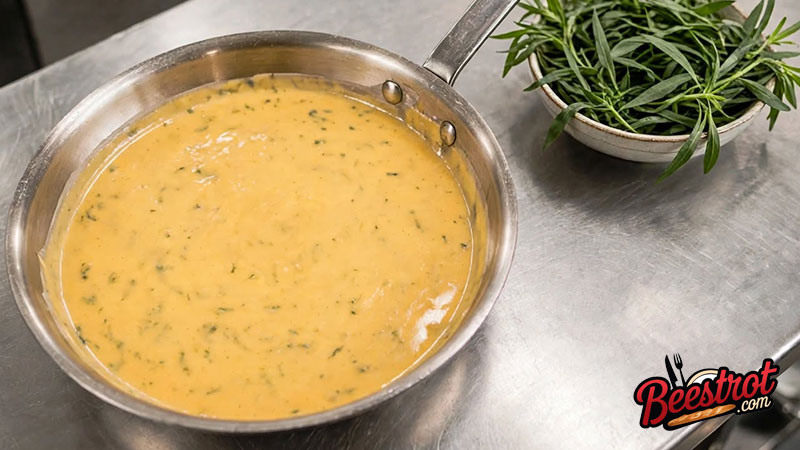
Béarnaise belongs to the same family as hollandaise: an emulsion sauce of egg yolks and clarified butter, cooked slowly over gentle heat, stabilized by the lecithin in the yolks. What separates béarnaise from its ancestor is the reduction that goes in first.

Vitamix E310 Explorian Blender
Silky smooth soups, nut butters, smoothies and sauces. Variable speed, self-cleaning, built for decades of use. The blender serious cooks actually buy.
View on AmazonBefore the eggs ever meet the butter, shallots and tarragon are simmered down in white wine and white wine vinegar until almost nothing remains. That concentrated liquid is the backbone of the sauce. It carries acidity, sweetness, and the distinctive anise note of fresh tarragon that makes béarnaise impossible to mistake for anything else. The great French sauce tradition built itself almost entirely on butter and cream rather than olive oil, which had dominated Mediterranean cooking for millennia. Béarnaise sits at the center of that tradition.
The final addition, stirred in at the end, is fresh tarragon and chervil. They wilt slightly from the residual heat of the finished sauce but retain their brightness. The herbs are not decoration. They are structural.
The difference between béarnaise and a failed béarnaise is heat. Too high and the emulsion breaks. Too low and the yolks never thicken. Professional cooks learn the temperature by feel, not by thermometer. This is why the sauce has always separated the careful from the impatient.
The Mistake That Made It
The traditional story of béarnaise involves a reduction gone wrong. Collinet had been working with a sauce of the hollandaise family, and during service, the tarragon-shallot base was reduced further than intended. Rather than discard it, he adjusted, incorporated the egg yolks and butter around it, and produced something with a sharper, more herbaceous character than the sauce he had been aiming for.
The story fits a pattern that runs through the history of cooking. Not through design but through the forced improvisation that happens when a kitchen is under pressure and a component has gone past its intended point. The sauce was not planned. It was salvaged. And the salvage turned out to be better than the plan.
Some of the most copied preparations in Western cooking trace directly to overreductions, failed fermentations, or ingredients pushed past their intended state. Béarnaise fits a pattern that runs across French culinary history: the mistake that became the standard.
How Béarnaise Became Official
Auguste Escoffier codified béarnaise in Le Guide Culinaire, published in 1903. By the time Escoffier wrote it down, the sauce had already been in professional kitchens for more than sixty years. What the codification did was fix it: the proportions, the method, the essential elements. It made béarnaise teachable in a systematic way. Every cook who trained through the classical French system after 1903 learned béarnaise as a foundational skill.
The sauce pairing with beef came naturally. The acidity of the tarragon-vinegar reduction cuts through the fat of a steak in the same way a wine sauce would, but without the sweetness. The herbs give it enough brightness to stand against the char of a grilled surface. It became the canonical accompaniment to tournedos Rossini and to entrecôte in serious French kitchens. The kind of restaurant that earned a Michelin star built its reputation, in part, on how well it executed the fundamentals. Béarnaise was always on that list.
The Sauce That Refused to Become Fashionable
Béarnaise has never been modern. It was not part of the nouvelle cuisine movement of the 1970s, which stripped French cooking back to cleaner preparations and lighter sauces. It is not found on menus that prioritize innovation as a primary value. It belongs to the classical tradition in a way that is not negotiable.
What it has done instead is survive. While dozens of other sauces from the same era disappeared from menus as tastes changed, béarnaise remained. The reason is the same reason it appeared in the first place: it works. The flavor is complete. The technique is demanding enough that a good béarnaise signals something about the kitchen making it. And the pairing with grilled beef has not been improved upon in nearly two centuries.
The Pavillon Henri IV still serves it. The restaurant where the sauce was born in error, during one service in 1837, still carries it on the menu in 2026. Some mistakes earn their permanence.
Every dish has a past. I am just following it back to the beginning.
Jean Louis
Sources
More Delicious Reads
The Sandwich Was Named After a Man Who Almost Certainly Did Not Invent It. He Was Just Too Busy Gamb...
Cinnamon Has Two Completely Different Varieties. One Is Toxic in Large Quantities. Most People Use t...
Rosemary Is Stronger Dried Than Fresh. Here Is When to Use Which and Why Most Recipes Get It Backwar...
Smoked Paprika and Sweet Paprika Are Not the Same Thing. The Difference Changes Everything.
Cheese Was Discovered by Accident Inside a Dead Animal's Stomach. It Became the Most Traded Food in ...
Corn Does Not Exist in Nature. It Was Engineered by Human Hands Over 9,000 Years. The Original Plant...
Workers Who Built the Pyramids Were Paid in Garlic and Onions. A Strike Stopped Construction When th...
Vanilla Is the Second Most Expensive Spice in the World. The Reason Is a Twelve-Year-Old Boy.
Toasting Spices Is Not Optional. Here Is the Science Behind Why It Matters.