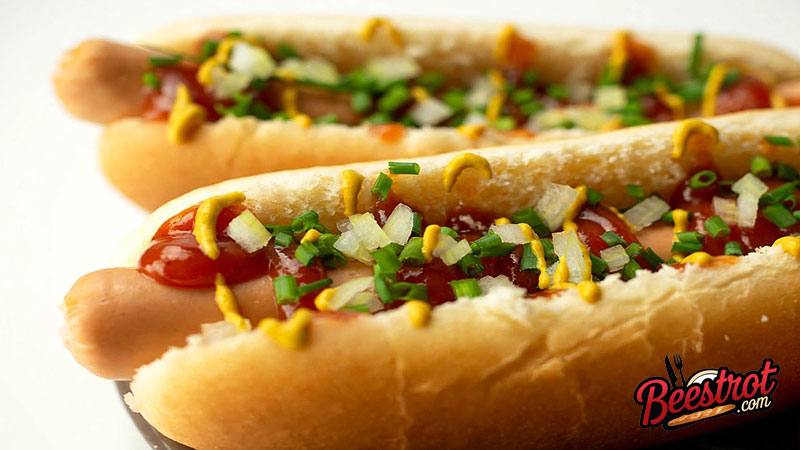
The 1904 Louisiana Purchase Exposition in St. Louis was the largest World’s Fair the United States had staged. It ran for seven months and drew nearly 20 million visitors. Among the food vendors working the fairgrounds was a German immigrant named Anton Feuchtwanger, who sold grilled sausages from a cart.
Feuchtwanger had a problem common to anyone selling hot food to a crowd: the sausages were scalding and customers had nowhere comfortable to hold them. His solution was white cotton gloves, which he lent to buyers to protect their hands while they ate. It worked until it stopped working. The gloves kept disappearing with the customers.
According to the most widely told version of events, Feuchtwanger consulted his brother-in-law, a baker. The baker suggested a long, soft roll split down the middle. The sausage fit inside. The customer needed no gloves. It was a practical fix for an immediate supply problem. It was not supposed to outlast the fair.
The Fair and the Vendor
The Louisiana Purchase Exposition was not primarily a food event. It was a celebration of the centenary of the Louisiana Purchase and a showcase of American industrial progress. But like all large fairs of the era, it functioned as a testing ground for food formats reaching a mass audience for the first time.
Several foods are associated with the 1904 World’s Fair: the ice cream cone, cotton candy, the widespread popularization of peanut butter. The fair created conditions in which a temporary vendor solution could reach millions of people in a single season, far more exposure than any restaurant or market stall could have generated.
What home cooks are actually buying on Amazon right now.
Updated hourly. Real purchases, real kitchens, the most trusted list on the internet.
See What's HotFeuchtwanger was operating in this environment. His sausages were already a known product: the frankfurter, brought to the United States by German immigrants and sold on the streets of New York and other cities since at least the 1860s. What he was solving was not the food itself but the logistics of delivering it.
The 1904 St. Louis World’s Fair attracted nearly 20 million visitors over seven months, making it one of the most attended events in American history to that point. It served as an unofficial launchpad for several mass-market food formats that became permanent fixtures of American eating.
The Problem With the Gloves
The glove solution tells you something about the food culture of the era. Eating while standing in a crowd, holding a hot sausage with bare hands, was apparently considered insufficiently dignified. The gloves were a concession to propriety.
They were also an operational disaster. Cotton gloves are not cheap, and customers at a crowded fair are not inclined to return borrowed items. A vendor lending gloves to every customer and recovering none of them had a business model that collapsed with each transaction.
The roll solved both problems simultaneously. It was edible, so there was nothing to return. It insulated the hand well enough to hold a hot sausage. It added a starch component that made the food more filling. And it could be produced in large quantities by a bakery at a fraction of the cost of cotton gloves.
The soft roll used for Feuchtwanger’s sausage was designed to be held rather than eaten separately alongside the meat. This distinction, the bread as delivery mechanism rather than accompaniment, was the structural decision that defined the modern hot dog format.
What the Competing Claims Say
The Feuchtwanger story is disputed by food historians, and that dispute is worth taking seriously. Charles Feltman, a German immigrant vendor at Coney Island, is credited by some sources with placing sausages in rolls as early as the 1860s. Harry M. Stevens, a stadium concessionaire, sold what he called dachshund sandwiches at New York baseball games in the 1890s.
The exact moment of origin, as with most food histories, is genuinely unclear. What origin stories like Feuchtwanger’s tend to offer is not precision but narrative shape: a problem, an improvisation, an accident that turned out to matter. Whether or not the gloves story happened exactly as described, it captures something true about how practical food formats emerge. Someone needed a solution by the end of the afternoon, and they found one.
Food historians have noted that the origin stories of popular American foods frequently center on a dramatic improvisation at a World’s Fair or public event. Whether fully accurate or not, these accounts persist because they give a satisfying shape to something that probably evolved gradually, without a single inventor or a single afternoon.
The Object That Outlived Its Purpose
What is not disputed is the result. The hot dog bun is now one of the most standardized food objects in mass production: a specific length, a specific softness, a specific split. It is engineered not for flavor but for function. To hold a specific diameter of sausage without breaking. To absorb condiments without disintegrating. To be eaten in a few bites while standing.
Nothing about it suggests permanence. It is a temporary solution to a problem that turned out to be permanent: the problem of feeding large numbers of people quickly, cheaply, and without utensils.
Feuchtwanger’s brother-in-law suggested a roll because the gloves kept walking away. The roll stayed.
Every dish has a past. I am just following it back to the beginning.
Jean Louis
Sources
- Hot Dog History, Wikipedia
- Louisiana Purchase Exposition, Wikipedia
- Smithsonian Magazine, A Brief History of the Hot Dog
- Charles Feltman, Wikipedia
- History.com, The History of the Hot Dog in America
More Delicious Reads
Workers Who Built the Pyramids Were Paid in Garlic and Onions. A Strike Stopped Construction When th...
You Have Been Storing Your Spices Wrong. Here Is What a Chef Actually Does.
Popcorn Was Being Eaten in the Americas 5,000 Years Before Cinema Existed. Hollywood Did Not Invent ...

Vanilla Is the Second Most Expensive Spice in the World. The Reason Is a Twelve-Year-Old Boy.

Fresh vs. Dried Herbs. The Rule Every Professional Cook Knows and Nobody Teaches.
Worcestershire Sauce Was Left in a Barrel for Two Years by Accident. The Chemists Almost Poured It A...
Your Vegetables Lose Their Colour and Flavour Because You Skip Ten Seconds.
Ice Cream Was a Luxury Only Kings Could Afford for 200 Years. Then One Invention Changed Everything.
Tarragon Is the Most Underrated Herb in Western Cooking. Jean Louis Makes His Case.

