Last Updated on September 25, 2026 by Jean Louis
Every restaurant in the world serves it. Most menus write it with a capital C, which is the first clue that it was named after a person. That person was not Roman. He was not even French. He was an Italian immigrant named Caesar Cardini, and he invented this salad in Mexico, on the Fourth of July, because he was running out of food.
The year was 1924. The place was Tijuana. And the reason there were enough customers to run out of food was Prohibition.
Caesar Cardini lived in San Diego and ran restaurants on both sides of the border. The Tijuana location existed specifically to serve Americans who crossed the border to drink legally. On the night of July 4, 1924, a holiday rush depleted his kitchen. He walked out with what he had left and invented a dish at the table. That is the Caesar salad: a masterpiece of improvisation born from a shortage, in a border town, by a man avoiding American law.
Let us stay with this for a moment, because the setting matters more than people realise. Tijuana in 1924 was not the city it is today. It was a destination. Americans poured across the border every weekend to eat, drink, gamble, and do everything their own government had told them they could not. The restaurants that lined Tijuana’s Avenida Revolución were among the most profitable establishments in North America at the time, precisely because they offered what the United States had banned. Caesar Cardini had positioned himself perfectly in this geography of vice and appetite.
What he had left in his kitchen that July night was romaine lettuce, garlic, olive oil, lemon juice, eggs, Worcestershire sauce, and Parmesan cheese. The croutons came from day-old bread. He had no anchovies, though his brother Alex, who ran a competing version of the salad, used them. The original Caesar salad, by Cardini’s own account and his daughter Rosa’s testimony, did not contain anchovies. The anchovy crept in later, possibly through Alex’s version, possibly through the natural evolution of a recipe that spread faster than its creator could control it.
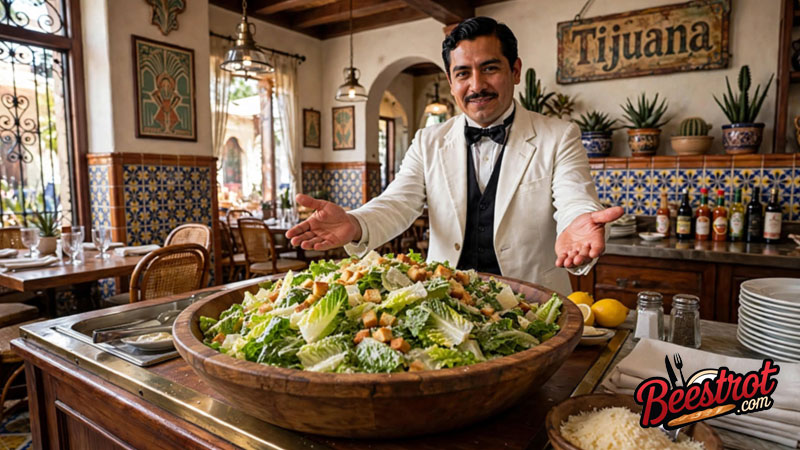
The dramatic flourish of the tableside toss was not an affectation. It was the point. Cardini built the salad in front of his customers because the theatre was part of what he was selling. In a restaurant running on improvisation that night, the performance of confidence was everything. He tossed the lettuce, folded in the egg, and served it. The customers came back the next week asking for it by name.
Word spread quickly across the border. Hollywood actors who ate at Caesar’s Palace in Tijuana brought the salad back to California. W. Somerset Maugham reportedly called it the greatest recipe to come out of America, which technically he was wrong about on two counts: it came out of Mexico, and Cardini was Italian.
By the 1930s the salad had become fashionable in Los Angeles restaurants. By the 1940s it appeared on menus across the United States. In 1953, the International Society of Epicures in Paris named the Caesar salad the greatest recipe to originate from the Americas in fifty years. Cardini had by then moved to Los Angeles and was bottling his dressing commercially. He died in 1956, having watched his tableside improvisation become one of the most recognised dishes in the world.
The dispute about who actually invented it has never fully resolved. Alex Cardini’s supporters claim he made the dish first and that his brother took the credit. Several of Cardini’s staff also claimed authorship over the years. Rosa Cardini, Caesar’s daughter, spent decades defending her father’s version of events and eventually trademarked the Caesar Cardini name to protect it.
What everyone agrees on is this: the salad was born in Tijuana. The name Caesar has nothing to do with ancient Rome. It belongs to a man from Lago di Como who moved to Mexico to feed Americans who had come to escape their own country’s laws. The salad they invented that night has been on every restaurant menu in the world ever since. Not bad for a kitchen that was running out of ingredients.
I have made Caesar salad hundreds of times in professional kitchens. I have argued about anchovies with chefs I respect. I have used coddled eggs, raw eggs, and no eggs. I have made croutons from brioche and from baguette and from bread so old it had no business being called bread.
What I have never done is pretended the salad is Italian. Or French. Or Roman.
It is Mexican by birth and American by adoption, invented by an Italian on a night when the kitchen was bare and the dining room was full. In my profession we call that cooking under pressure. Caesar Cardini called it Tuesday.
The kitchen never lies. History sometimes does.
Jean Louis
Sources
- Wikipedia. Caesar Salad. History and origin, Caesar Cardini, Tijuana 1924.
- Fox News. Caesar Salad Origins: Iconic Dish, Invented in Mexico, Turns 100. July 2024.
- Smithsonian Magazine. The Man Behind the Caesar Salad.