Last Updated on September 28, 2026 by Jean Louis
I cook with tomatoes every day. Every serious kitchen does. They are in the base of half the sauces on any menu, the backbone of a dozen dishes that people order without thinking twice. The idea that anyone was ever afraid of them is difficult to imagine from where I am standing.
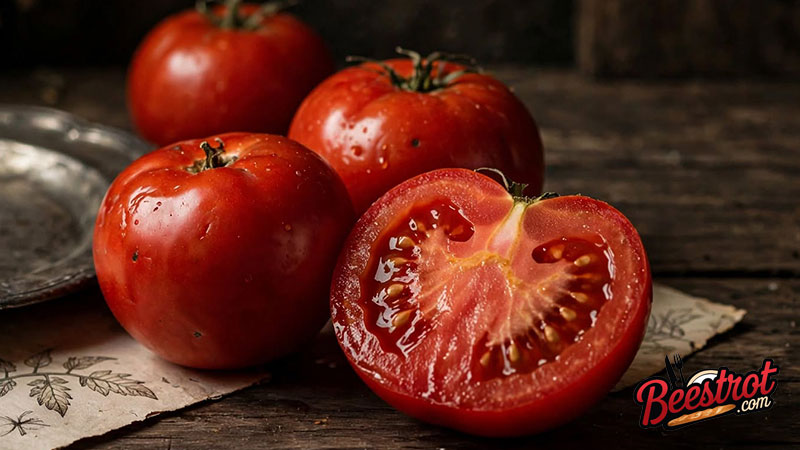
But for more than two hundred years, across most of Europe, the tomato was not food. It was a poison apple. It sat in aristocratic gardens as an ornamental curiosity. Botanists classified it as dangerous. Herbalists warned against it. People died, apparently, after eating it. And for two centuries, that was enough.
The story of how the tomato went from deadly ornament to the foundation of European cuisine is one of the more interesting stories in food history. It involves bad botany, lead poisoning, a misidentification that lasted a century, and a Neapolitan baker who changed everything.
The tomato arrived in Europe from the Americas in the early sixteenth century, brought back by Spanish conquistadors. The first known European reference to it appears in 1544, written by the Italian herbalist Pietro Andrea Mattioli. He classified it as a member of the nightshade family, Solanaceae, and as a mandrake: a plant historically associated with both poison and aphrodisiac properties. The mandrake appears twice in the Old Testament. Its reputation in European herbalism was unambiguously dark. Classifying the tomato as a relative of the mandrake was not a neutral botanical observation. It was a verdict.
The classification was not entirely wrong, which is what made it so persistent. The tomato is in the Solanaceae family, which includes several genuinely toxic plants: belladonna, henbane, and the deadly nightshade that European herbalists knew well. The tomato plant also has poisonous leaves and stems. The fruit itself is safe, but the leaves will make you very ill. An herbalist looking at a tomato plant for the first time, noting its resemblance to belladonna in growth pattern and leaf shape, was not being foolish to proceed with caution. The mistake was in failing to distinguish between the plant and the fruit, and in allowing that initial caution to harden into orthodoxy for two centuries.
There is a second explanation for the tomato’s deadly reputation that has been widely repeated and is considerably more dramatic: the pewter plate theory. The story goes like this. European aristocrats who did eat tomatoes served them on pewter plates, which had a high lead content. The acidity of the tomato leached lead from the pewter into the food. The diners were poisoned by lead, not tomato, and nobody made the connection.
It is a satisfying story. It has appeared in the Smithsonian Magazine, in food history books, and across the internet for years. There is just one problem: Joe Schwarcz, director of the Office for Science and Society at McGill University, has publicly dismissed it. In 2023, he stated that the amount of lead that would actually leach from a pewter plate via tomato acidity would be trivial, and insufficient to cause illness. The pewter plate story, he argues, is not supported by the chemistry.
What we have, then, is a food with genuinely poisonous leaves that was classified alongside known killers by the first botanist who described it, and a mythology of aristocratic deaths that may or may not have a basis in lead chemistry. Two hundred years of European reluctance built on a combination of legitimate caution and compounding misinformation. The tomato was not entirely wrongly suspected. It was just never correctly exonerated.
The exoneration came from Naples. Around 1880, the tomato was incorporated into what would become pizza, and the rest of the story is the story of Italian cooking spreading across the world. But before that, in America, there is a peculiar footnote. Colonel Robert Gibbon Johnson of Salem, New Jersey, allegedly stood on the steps of the Salem courthouse in 1820 and ate a basket of tomatoes in front of a crowd gathered to watch him die. He did not die. The crowd dispersed. The story may be apocryphal, but it captures something true about the moment: the tomato’s rehabilitation required a public performance of courage, because two centuries of fear had made caution feel like common sense.
I think about this sometimes when I am reducing a tomato sauce. The same fruit that Mattioli called a temptation and a poison is now the base of half the sauces in the world. It took two hundred years and a Neapolitan baker to correct a sixteenth-century botanist’s first impression. In cooking, as in life, first impressions are remarkably hard to revise.
The tomato’s leaves are still poisonous, by the way. The fruit is perfectly safe. The distinction that European herbalists could not make for two centuries is one that any competent cook knows instinctively: the plant and its fruit are not the same thing. What something grows on is not what it is.
The kitchen never lies. History sometimes does.
Jean Louis
Every dish has a past. These books will take you further into it.

Sources
- Smithsonian Magazine. Why the Tomato Was Feared in Europe for More Than 200 Years. K. Annabelle Smith.
- Chowhound. Why Europe Was Convinced Tomatoes Were Poisonous For the Longest Time.
- University of Vermont. The Tomato in America: Early History, Culture, and Cookery. Andrew F. Smith, 1994.