The Pan Is Not the Problem
Restaurant chefs do not use different pans. They do not have access to surfaces that resist sticking better than what you can buy. What they do before the fish goes in is what changes the result.
Fish sticks for one reason: moisture. When a wet surface hits a hot pan, the water turns to steam before anything else can happen. That steam sits between the fish and the metal, preventing the crust from forming, keeping the protein bonded to the surface instead of releasing from it. No crust, no release. The fish tears when you try to lift it.
The step that professional kitchens never skip is drying the fish completely before it goes in. Paper towels, pressed firmly against every surface, top and bottom, edge and fold. The fish should feel dry to the touch. If it still feels cold and damp from the refrigerator, dry it again.
Ten seconds of drying before the fish hits the pan is worth more than any non-stick coating. Moisture is the reason restaurant fish slides off the spatula and yours tears. Remove the moisture and you remove the problem.
Why the Pan Matters More Than You Think
Non-stick pans are not what restaurants use for fish. They use stainless steel or carbon steel, preheated until the metal is properly hot before any oil goes in. Non-stick surfaces require lower heat to protect the coating. Lower heat means no Maillard reaction. No Maillard reaction means no crust, and without a crust the fish has nothing to release from.

Microplane Premium Classic Zester & Grater
Lemon zest, Parmesan, ginger, garlic, nutmeg, the one tool that changes the flavour of everything. A cult favourite in professional kitchens.
View on AmazonThe correct sequence: preheat the pan over medium-high heat for two minutes. Add oil to the hot pan, not before. Wait for the oil to shimmer. Then place the fish in, dry side down.
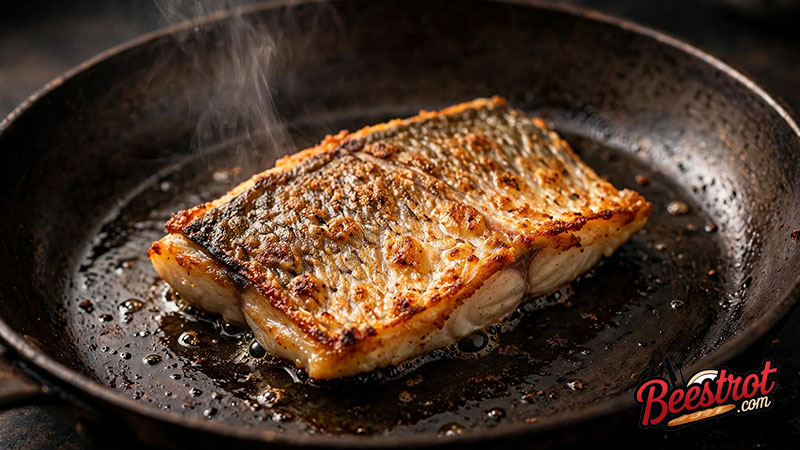
The Maillard reaction begins when proteins and sugars on the surface reach around 140 to 165 degrees Celsius. At that temperature, the surface changes chemically, forming the crust that naturally releases from the metal. This is why a fish fillet in a properly heated pan will visibly release when it is ready. You do not force it. You wait.
If the fish is sticking when you try to turn it, it is not ready to turn. A correctly seared fillet tells you when to move it by releasing from the surface on its own. Force is always the wrong answer.
Mise en Place, Applied to a Fish Fillet
Professional kitchens operate on the principle of mise en place: everything prepared and in position before the heat goes on. Applied to a piece of fish, this means the fillet is out of the refrigerator, dried, seasoned, and ready before the pan is even on the burner.
A fillet that goes straight from refrigerator to pan is cold at its center. The exterior sears faster than the interior cooks. Drying a cold fillet is harder than drying one that has rested for a few minutes at room temperature. The habit of preparing fish before heating the pan covers both issues at once.
Scoring the skin on skin-on fillets is part of the same preparation. Skin contracts when it hits heat. If it is not scored with two or three shallow cuts, it will pull the fillet into a curve, lifting the center away from the pan and producing uneven contact. One pass with a sharp knife along the skin, not deep enough to cut into the flesh, prevents it.
Why Carbon Steel Is What Professional Kitchens Actually Use
Carbon steel is the material most professional kitchens reach for when cooking fish. It heats faster than stainless, retains heat well, and builds a natural seasoning over time that makes the surface progressively more reliable. It is not non-stick in the commercial sense, but a well-seasoned carbon steel pan treated correctly behaves more consistently than any coated surface under high heat.
The rules apply regardless of pan material: dry the fish, preheat the pan, add oil to a hot surface, and do not move the fish until it releases. What carbon steel adds is speed and stability. It reaches cooking temperature faster and holds it more evenly when the cold fish goes in.
The mistake most home cooks make is not the pan and not the oil. It is adding fish to a pan that has not had time to reach the right temperature, or adding fish that is still wet from the refrigerator. Both failures happen before the fish goes in. The fix is in the preparation, not the cooking.
What Actually Happens When You Get It Right
A properly dried fillet on a properly heated pan makes a sound when it goes in. A short, sharp sizzle that settles into a steadier, quieter sound as the crust forms. If it sputters and spits for more than a second or two, the surface was not dry enough.
The crust will form in three to four minutes on a fillet of average thickness over medium-high heat. When you try to slide the spatula underneath and feel resistance, leave it. When it lifts without resistance, turn it. The second side takes roughly half the time of the first.
The step that changes everything is the one before the heat. Dry the fish. That is it.
A recipe is a promise. A technique is the truth behind it.
Jean Louis
Sources
More Delicious Reads
Cinnamon Has Two Completely Different Varieties. One Is Toxic in Large Quantities. Most People Use t...
The Hot Dog Bun Was Invented at a World's Fair by a Vendor Who Ran Out of Gloves. It Was Not Meant t...
Every Chef Knows This Trick for Perfect Pasta. Nobody Tells You Because It Seems Too Simple.

Fresh vs. Dried Herbs. The Rule Every Professional Cook Knows and Nobody Teaches.

Popcorn Was Being Eaten in the Americas 5,000 Years Before Cinema Existed. Hollywood Did Not Invent ...
Mise en Place Is Not Organisation. It Is a Philosophy That Changes How You Experience Cooking.

How to Boil an Egg Perfectly (Tutorial with Timers & No Cracks)
How to Grow Basil Indoors and Actually Keep It Alive Past Two Weeks.

Olive Oil Has Been Produced for 8,000 Years. The Way It Is Sold Today Would Have Been Considered Fra...