Last Updated on October 3, 2026 by Jean Louis
Every home cook has had this experience. You buy a good piece of beef. You cook it carefully. You eat it. And it is fine. It is perfectly fine. But it is not what you eat in a good restaurant, and you cannot explain exactly why.
I can explain exactly why. I have been on the other side of that kitchen door for thirty years.
The answer is not the quality of the meat, although that matters. It is not the seasoning, although that matters too. It is one technique that every professional kitchen applies without exception, that almost no home cook uses, and that changes everything about how a steak tastes and feels in your mouth.
It is called arroser in French. Butter basting in English. The technique involves tilting the pan so that the foaming butter pools on one side, and then continuously spooning that hot, herb-infused, brown butter over the steak throughout the cooking process. It is not difficult. It takes about ninety seconds. And it is the single most impactful thing you can do to a piece of beef in a home kitchen.
Here is what the butter is doing, because understanding the mechanism helps you do it correctly.
When butter hits a very hot pan it foams. Inside that foam the water is evaporating and the milk solids are beginning to brown. This browned butter, what the French call beurre noisette, has a nutty, complex flavour that plain butter does not. When you spoon this continuously over the steak, three things happen simultaneously: the top of the steak is being basted in fat that conducts heat evenly across its surface, the aromatics in the butter (thyme, garlic, whatever you have added) are being driven into the meat by the heat, and the crust you have already built on the underside is being protected from steaming while the top continues to cook.
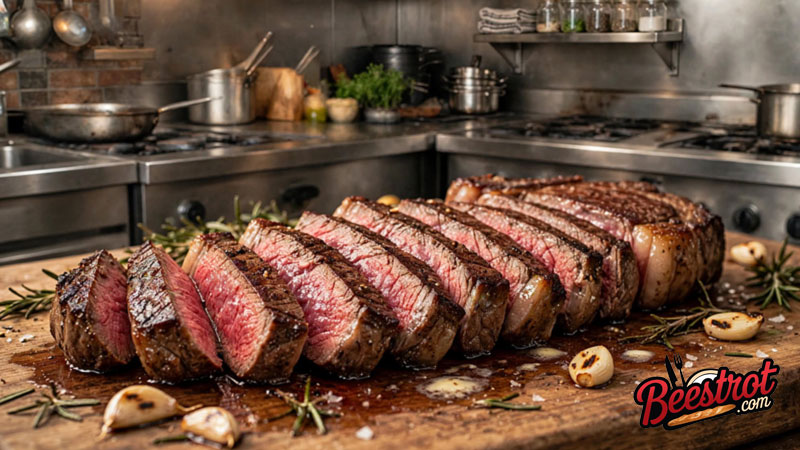
The result is a steak that is evenly cooked from edge to edge, with a crust on the bottom and a lacquered, aromatic surface on top. It is a different object from a steak that has simply been flipped and left alone in a pan.
The second thing most home cooks do wrong is the temperature. Restaurant broilers reach 700 to 900 degrees Celsius. Your home oven reaches perhaps 250. Your hob, on its highest setting with a cast iron pan fully preheated, can get close enough. But only if you have preheated the pan properly. A cold or warm pan does not sear. It boils the surface moisture off the steak and steams the meat instead of browning it. The Maillard reaction that creates the crust requires intense, dry heat and a completely dry surface on the meat. Pat the steak dry before it goes anywhere near the pan.
The third thing is resting, which everyone has heard of and almost everyone cuts short. When a steak comes off the heat, the muscle fibres are contracted and the juices are concentrated in the centre. Resting allows those fibres to relax and the juices to redistribute through the meat. Cut a steak immediately after cooking and the juices run onto the board. Rest it for five minutes and they stay where they belong. This is not optional. It is part of the cooking process.
The sequence in a professional kitchen looks like this. Dry the steak. Salt it generously, ideally at least thirty minutes before cooking. Preheat a cast iron pan until it is visibly smoking. Sear the steak on the first side without moving it for ninety seconds to two minutes, until a proper crust has formed. Flip it once. Immediately reduce the heat to medium-high, add a generous knob of butter, a crushed garlic clove, and a sprig of thyme. Tilt the pan. Baste continuously for sixty to ninety seconds. Remove the steak, rest it on a rack for five minutes. Slice against the grain.
I want to address the butter quantity, because this is where home cooks hesitate and restaurants do not. A proper butter baste requires enough butter that you can actually tilt the pan and collect it on one side. That means a knob that would make most people uncomfortable. It is not all going into your body. Most of it stays in the pan. What enters the steak is the flavour, the heat conductivity, and the aromatic compounds from the browning. The discomfort you feel about the quantity of butter is the gap between home cooking and restaurant cooking, made visible.
One final thing that costs nothing and changes more than people expect: salt the fat cap. If your steak has a rim of fat running along one edge, stand it up on that edge in the hot pan for thirty seconds before you lay it flat. The fat begins to render and baste the meat from the side as it cooks. You get flavour from parts of the steak that a flat sear never reaches.
The restaurant steak you have been chasing is not a mystery. It is butter, heat, time, and the willingness to tilt the pan.
The kitchen never lies. History sometimes does.
Jean Louis
Sources
- America’s Test Kitchen. Baste Your Steak in Sizzling Butter. Cook’s Illustrated.
- Chowhound. Why Restaurant Steaks Always Taste Better Than the Ones You Cook at Home.
- The New York Times via The Nightly. Learn to Make the Juiciest Steak with This Hot Restaurant Trick.